Hubble Captures Stunning Edge On View Of A Distant Galaxy With Hidden Secrets
NASA’s Hubble Space Telescope has captured a stunning new image of a distant galaxy, revealing fascinating details that offer a closer look at our universe.
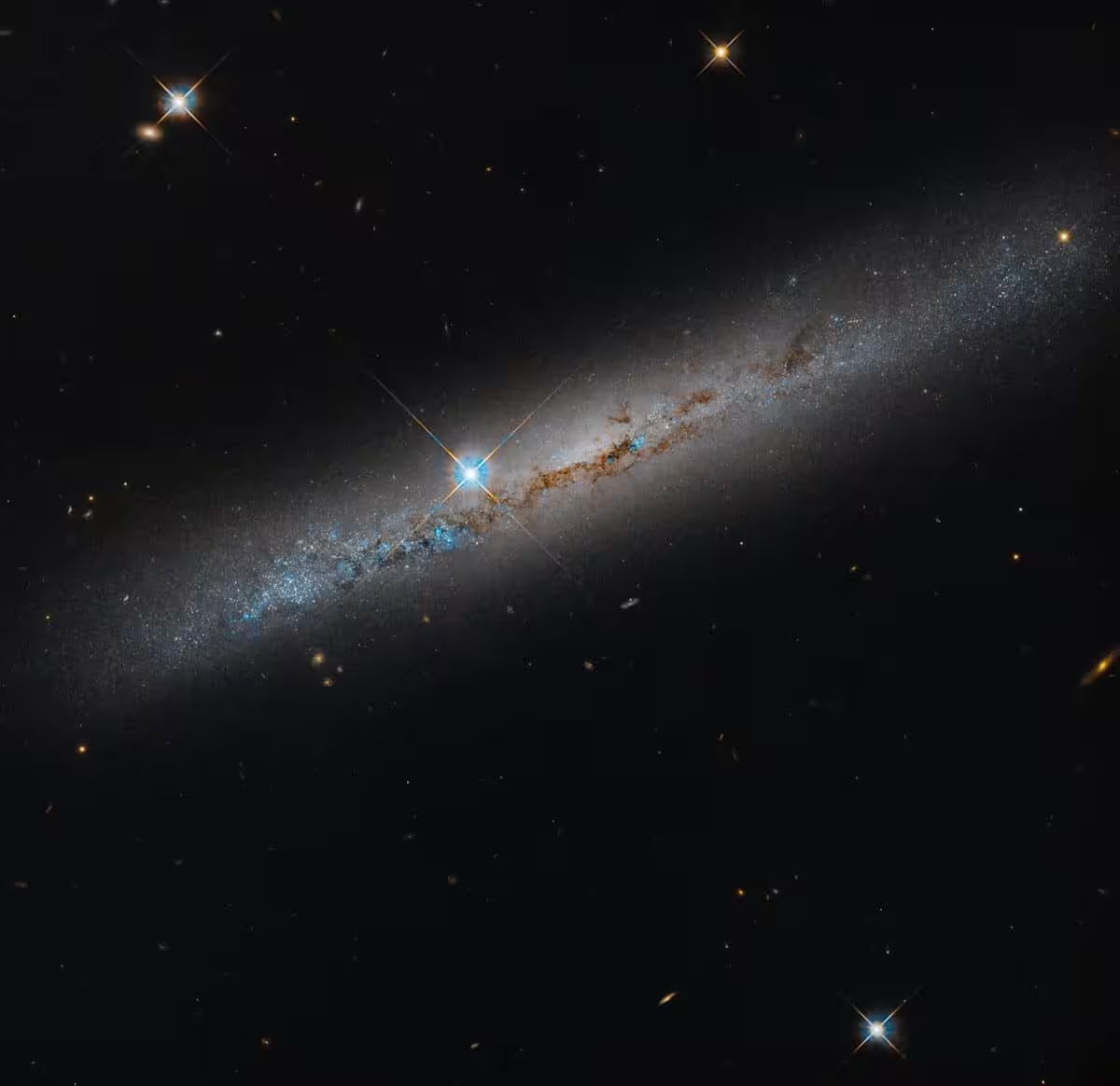
The Hubble Space Telescope has returned a striking new portrait of NGC 1827, an intermediate spiral galaxy situated approximately 37 million light-years away within the constellation Columba, the Dove. Viewed edge-on from our perspective, the galaxy appears as a slender, luminous streak, punctuated by intricate, rust-colored dust lanes and pockets of bright, star-forming regions.
A Closer Look at Cosmic Structure
Captured by the telescope’s Advanced Camera for Surveys, the image highlights the complex geometry of a spiral system seen from the side. While the galaxy’s disk is dominated by dark, dense clouds of dust, vibrant blue regions indicate areas of active stellar birth. A prominent star appears to hover near the galactic center in the photograph, though it is merely a foreground object located within our own galaxy; its distinct, four-pointed appearance is an optical artifact known as a diffraction spike, caused by the internal structure of the telescope.
This observation, detailed in a report released by NASA on October 16, 2026, is not merely for aesthetic appreciation. NGC 1827 is a single data point in a comprehensive, large-scale investigation into the nature of satellite galaxies orbiting systems comparable to our own Milky Way.
Mapping the Local Universe
The broader initiative aims to catalog and analyze 260 satellite galaxies distributed across 22 different host systems. By targeting galaxies within a 32-million-light-year radius, researchers are building a clearer picture of how low-mass galaxies behave in environments that mirror the conditions of our local neighborhood. To date, the Hubble survey has successfully documented 111 of these satellites, with 149 observations still pending.
The importance of this survey lies in the ongoing friction between theoretical cosmological models and empirical observation. Scientists have long noted that predictions regarding the distribution and nature of smaller, low-mass galaxies do not always align with the reality seen through high-resolution imaging. By gathering precise data on these smaller galactic members, astronomers hope to refine their models, potentially resolving discrepancies that currently challenge our understanding of how the universe evolved on both local and cosmic scales.
This article has been fact checked for accuracy, with information verified against reputable sources. Learn more about us and our editorial process.
Last reviewed on .
Article history
- Latest version
Reference(s)
- Gianopoulos, Andrea. “NASA's Hubble Spies Spiral’s Edge - NASA Science.”, October 16, 2026 NASA <https://science.nasa.gov/missions/hubble/nasas-hubble-spies-spirals-edge/>.
Cite this page:
- Posted by Karan Das