Astronomers Discover Giant Asteroids Spinning at Impossible Speeds
Astronomers have discovered a massive 2.5-kilometer asteroid that spins every 4 minutes, making it the largest ultra-fast rotator ever recorded.
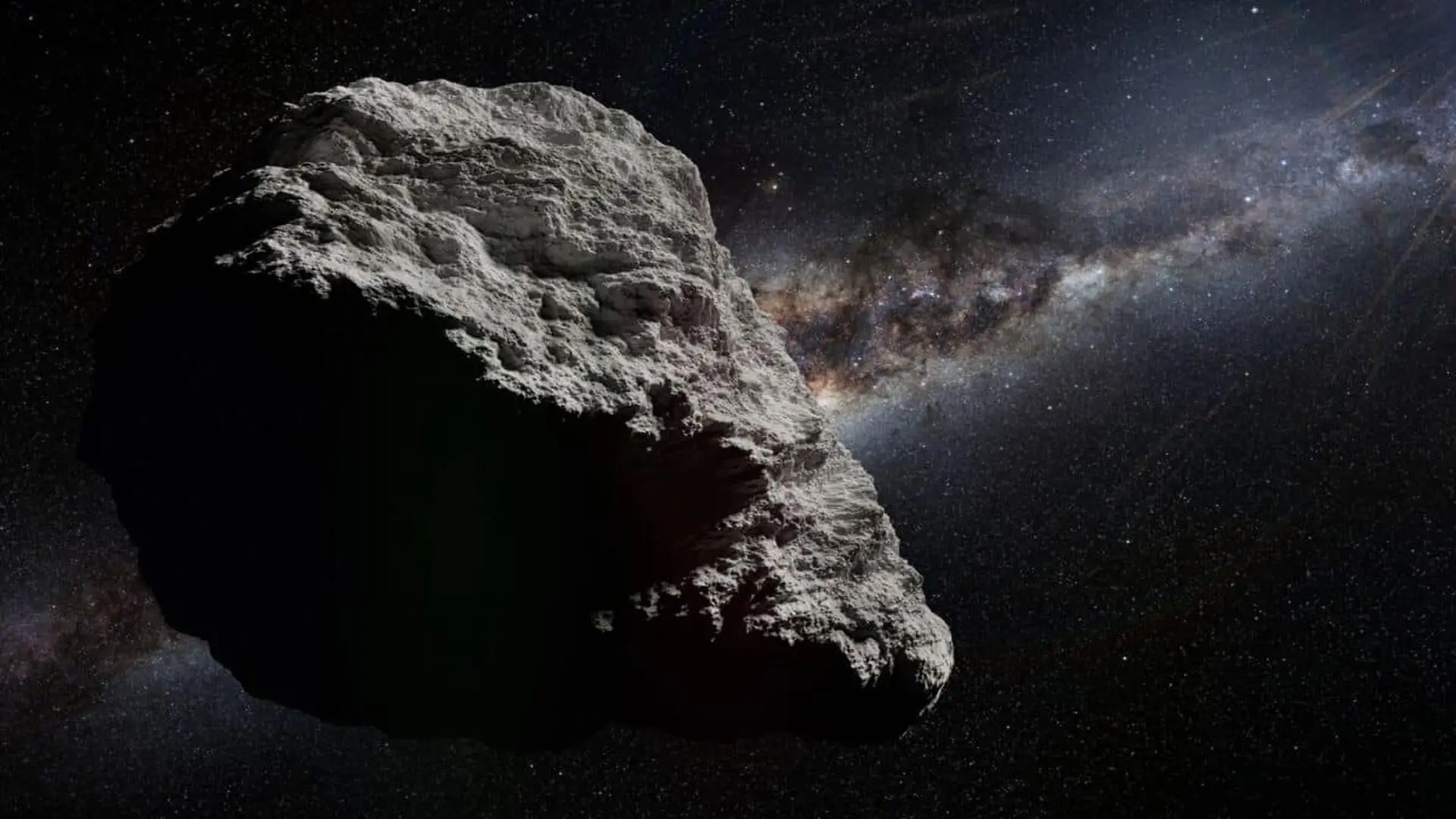
Astronomers have uncovered a pair of asteroids that defy the standard laws of orbital physics, spinning at speeds so high they should theoretically tear themselves apart. These findings challenge our current understanding of how rocky bodies in our solar system hold together, highlighting the potential for internal structures far more complex than previously assumed.
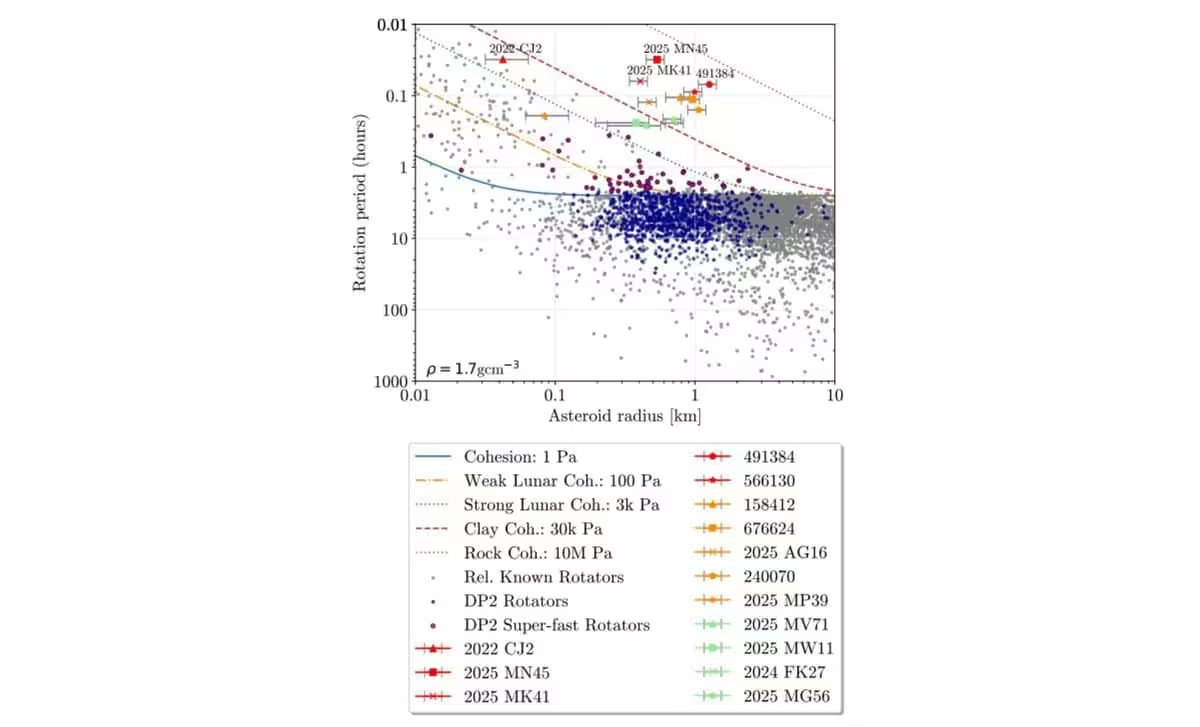
Most asteroids exceeding 150 meters in diameter adhere to a physical rule known as the spin barrier. Because these larger objects are typically considered “rubble piles”—loose aggregates of rock and debris held together solely by gravity—they cannot rotate faster than one revolution every 2.2 hours without the centrifugal force overcoming their gravitational grip. When an object surpasses this threshold, the kinetic energy of its rotation should naturally cause it to disintegrate.
However, a study led by Dmitrii Vavilov of the University of Washington, published in October 2026, details two massive anomalies. Asteroid 491384, estimated to be roughly 2.5 kilometers in diameter, is spinning at a staggering rate of one rotation every 4.18 minutes. A second object, asteroid 566130, is nearly as extreme, completing a full spin every 5.34 minutes. To remain intact at such velocities, these bodies would require significant internal cohesive strength—measured at 2.3 megapascals and 0.9 megapascals respectively—suggesting these asteroids possess a level of structural integrity not typically found in simple gravity-bound piles.
Revolutionizing Data Analysis in the Era of Big Sky Surveys
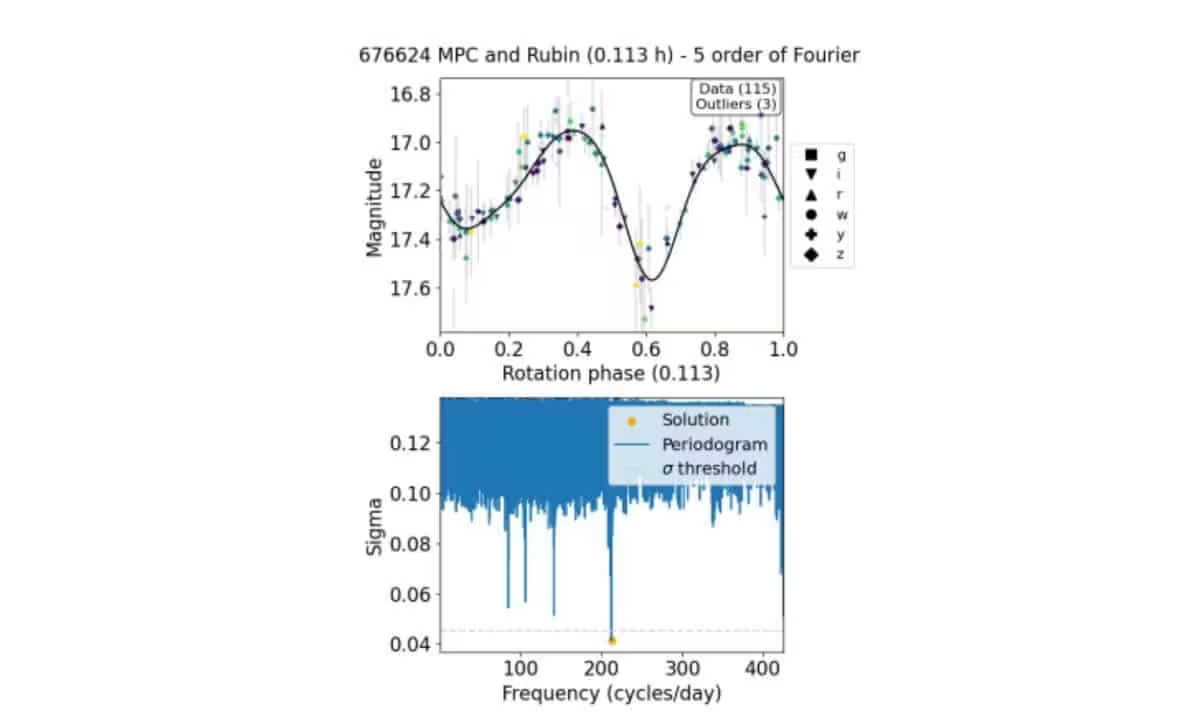
The discovery was made possible through a sophisticated new computational framework designed to process the massive influx of data from the Rubin Observatory’s Legacy Survey of Space and Time. Identifying true rotation periods in vast datasets is notoriously difficult, as irregular gaps between observations can create false signals that make a slow-spinning object appear to be moving at a breakneck pace.
To solve this, researchers applied a method using Fourier series, which breaks down complex brightness variations—known as light curves—into mathematically predictable periodic waves. By filtering through 9,417 asteroids, the team narrowed down 1,487 candidates that initially appeared to violate the spin barrier to a highly curated group of 66 confirmed high-speed rotators.
As the Rubin Observatory ramps up its operations, generating up to 10 terabytes of data per night, this automated approach provides a critical tool for mapping the dynamics of small bodies in the solar system. While these “super-fast” rotators represent a tiny fraction of the total population, they serve as essential stress tests for planetary science models. Ongoing observation will be required to confirm these extreme rotation periods and to investigate the geological properties that allow such objects to resist the forces of their own motion.
This article has been fact checked for accuracy, with information verified against reputable sources. Learn more about us and our editorial process.
Last reviewed on .
Article history
- Latest version
Reference(s)
- Vavilov, Dmitrii. “Discovery of 2 km ultra-fast rotating asteroid in Rubin DP2 catalog via varying Fourier order method.” arXiv.org <https://arxiv.org/abs/2610.07584>.
- “Lsst.” <https://rubinobservatory.org/explore/how-rigorous-works/lsst>.
Cite this page:
- Posted by Zara Tariq