Hubble Hits Incredible Milestone as It Watches a Rare Supernova Through a Cosmic Lens
Over 34 years since its launch, the Hubble Space Telescope has completed 200,000 orbits while capturing a distant explosion magnified by a galaxy cluster.
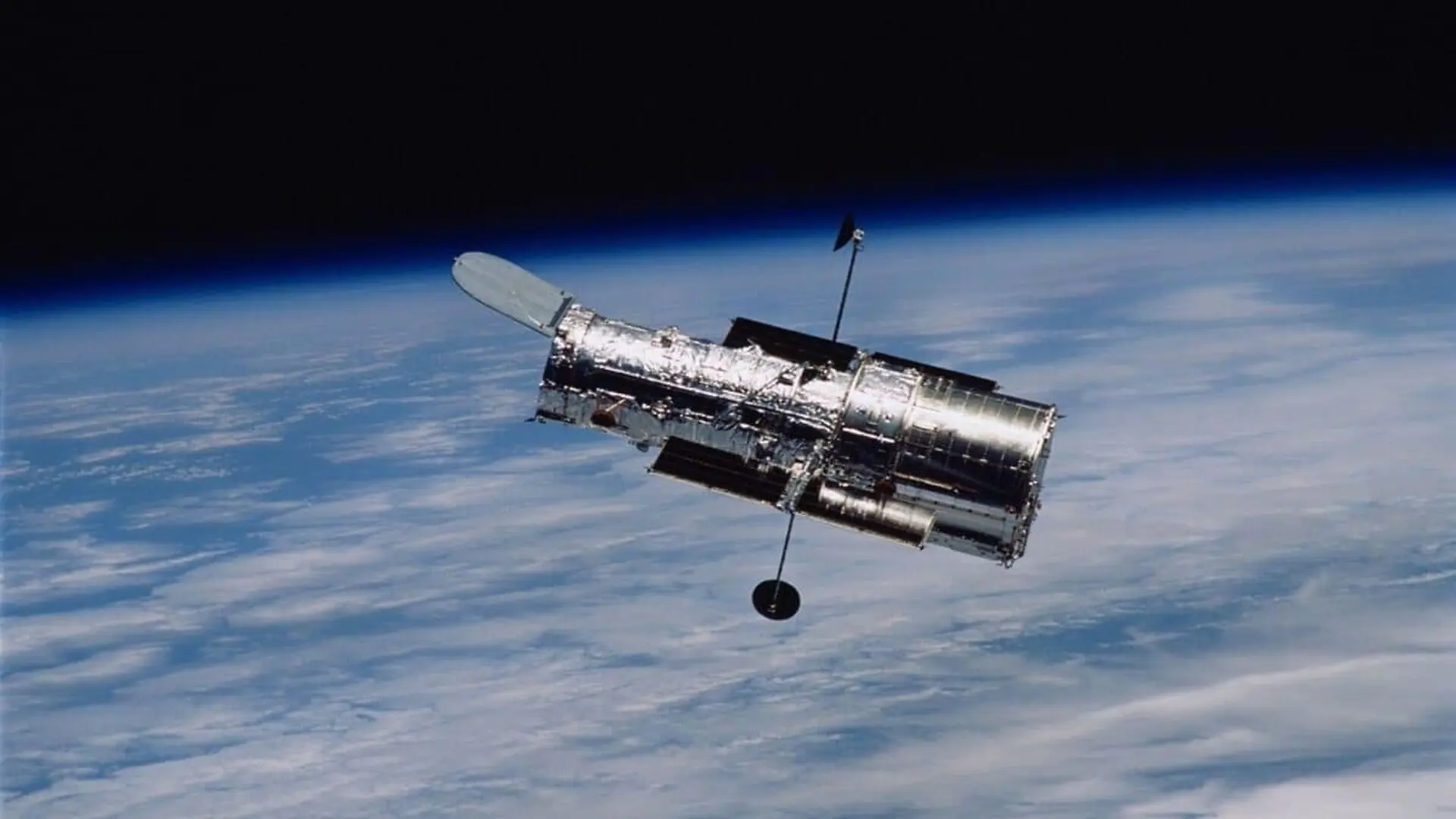
NASA’s Hubble Space Telescope has officially reached a historic milestone, completing its 200,000th orbit around Earth. This achievement comes as the venerable observatory continues its decades-long mission of unlocking the mysteries of the cosmos, currently focusing its sensors on a distant supernova magnified by a massive galaxy cluster.
Since its launch aboard the Space Shuttle Discovery in April 1990, the telescope has traversed more than 5 billion miles (8 billion kilometers). Over the course of more than 36 years of continuous operation, Hubble has logged over 1.7 million individual observations, providing humanity with an unparalleled view of the universe. The 200,000th orbit was finalized on September 19, serving as a reminder of the spacecraft’s remarkable resilience.
Currently stationed approximately 300 miles (483 kilometers) above our planet, Hubble operates in the vacuum of space, safely removed from the atmospheric interference that complicates ground-based astronomy. This vantage point allows it to capture light across ultraviolet, visible, and near-infrared spectrums, which are essential for its current scientific campaigns.
Peering Through a Natural Cosmic Lens
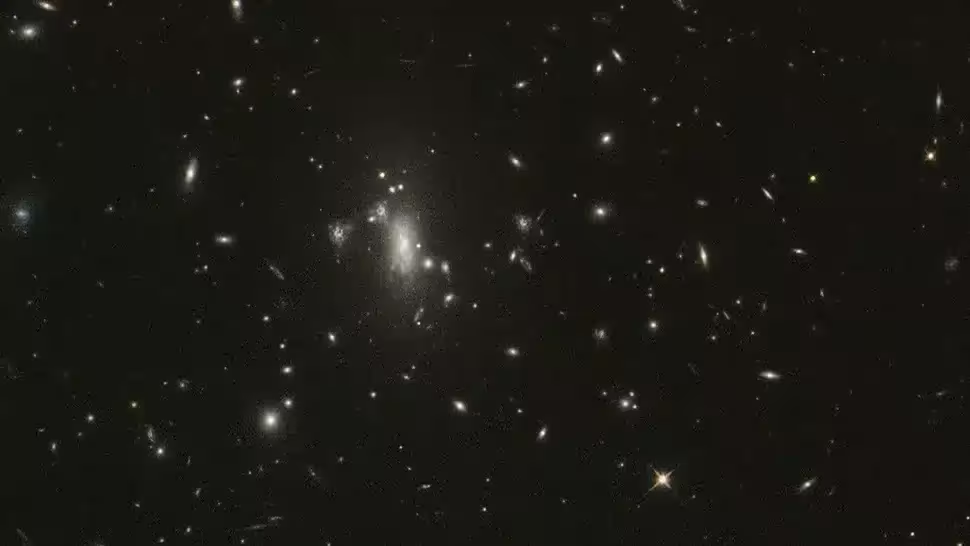
Hubble’s current research is directed toward MACS J0417, a massive galaxy cluster acting as a gravitational lens. By bending and intensifying the light of objects positioned behind it, the cluster functions as a natural telescope, allowing astronomers to view distant events like the supernova Athena in greater detail.
According to NASA, this gravitational phenomenon allows the light from the supernova to follow multiple paths, providing researchers with repeated glimpses of the explosion. These observations are crucial for mapping the mass distribution of the galaxy cluster and refining our understanding of the universe’s expansion rate, a primary goal of the telescope’s long-standing mission.
An Unprecedented Legacy of Longevity
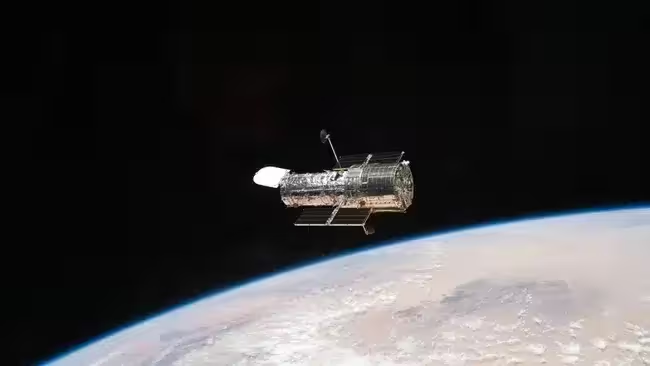
Every 95 minutes, Hubble completes another lap around the planet, moving at a blistering speed of roughly 17,000 mph (27,000 kph). Averaging 15 orbits per day, the telescope has far outlived its original design life of 15 years.
The observatory’s history is defined by its ability to overcome technical challenges. Despite shifting to single-gyroscope operations in 2024 to maintain stability, Hubble has remained productive, recently capturing a massive 2.5-billion-pixel mosaic of the Andromeda Galaxy. Having passed its 100,000th orbit in 2008 and its one-millionth scientific observation in 2011, the telescope remains an indispensable tool for modern astrophysics.
Looking Toward the Future
While Hubble continues to deliver ground-breaking data, its era of human-led maintenance has concluded, with the final servicing mission occurring in 2009. NASA anticipates that the telescope will remain scientifically viable well into the next decade.
Because of gradual atmospheric drag, the telescope’s altitude is slowly decaying. Agency officials expect that the spacecraft will not re-enter the atmosphere until the mid-2030s at the earliest. Until that time, Hubble will continue its vigil, scanning the depths of space to provide the scientific community with its final, invaluable insights.
This article has been fact checked for accuracy, with information verified against reputable sources. Learn more about us and our editorial process.
Last reviewed on .
Article history
- Latest version
Reference(s)
- Sabia, Stephen. “MACS J0417.5-1154 Wide Field (NIRCam Image) - NASA Science.”, September 4, 2024 NASA <https://science.nasa.gov/asset/webb/macs-j04175-1154-wide-field-nircam-image/>.
- Belleville, Michelle. “NASA's Hubble Seeks Lensed Supernova, Marks 200,000 Orbits - NASA Science.”, September 23, 2026 NASA <https://science.nasa.gov/missions/hubble/nasas-hubble-seeks-lensed-supernova-marks-200000-orbits/>.
- Belleville, Michelle. “Hubble Space Telescope - NASA Science.”, May 10, 2023 NASA <https://science.nasa.gov/mission/hubble/>.
Cite this page:
- Posted by Aisha Ahmed