Canadian Telescope Successfully Maps Cosmic Hydrogen Without External Help
Astronomers using the CHIME radio telescope have detected a 5-billion-year-old hydrogen signal, offering a powerful new map of the universe’s expansion.
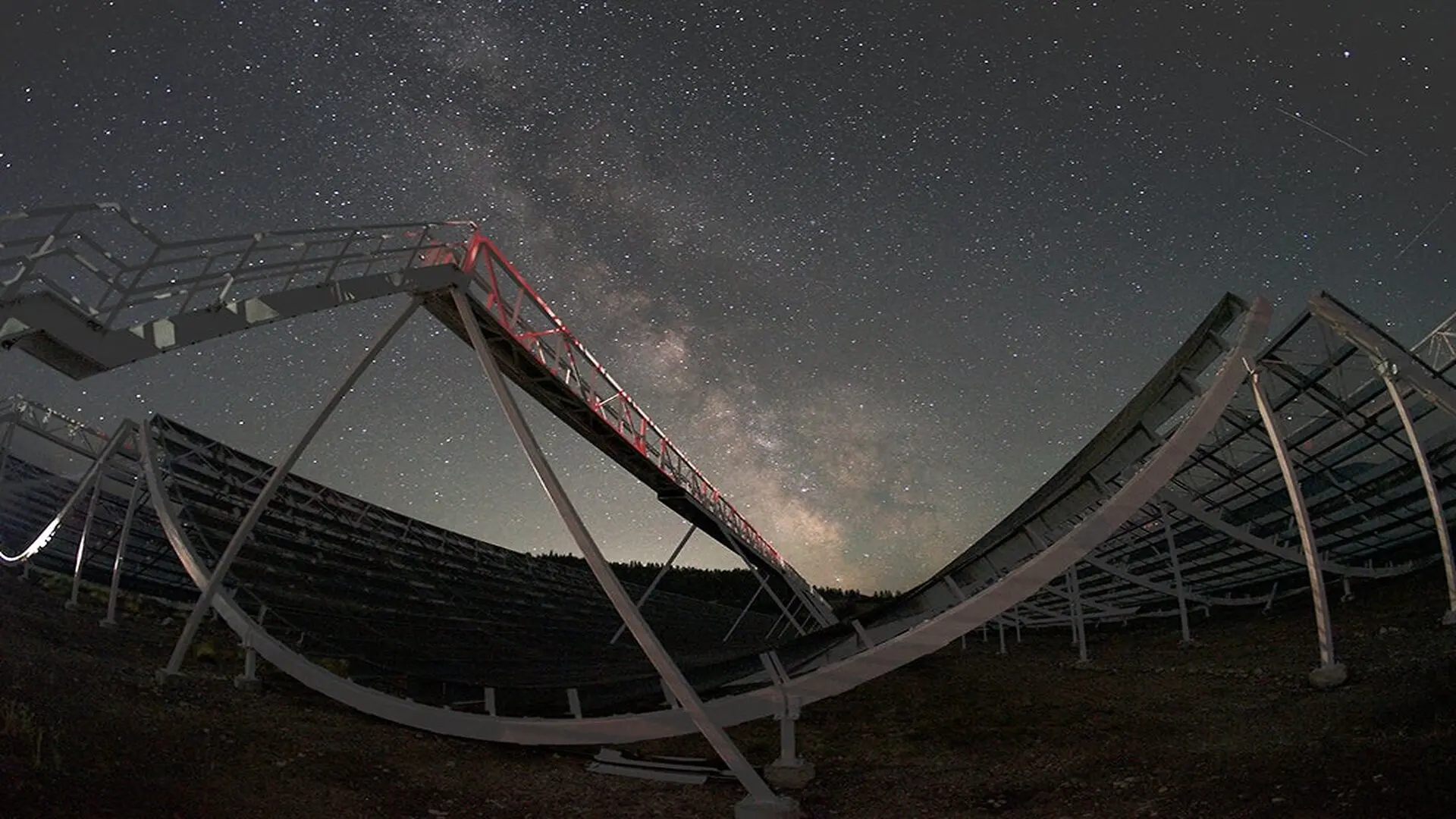
Astronomers have successfully extracted a whisper-quiet signal from the dawn of time using the Canadian Hydrogen Intensity Mapping Experiment (CHIME). By isolating the faint radio signatures of neutral hydrogen from billions of years ago without relying on external galaxy catalogs, the research team has cleared a major technical hurdle in the quest to map the expansion history of the universe.
The findings, detailed in The Astrophysical Journal, center on a 21-centimeter emission line, a fundamental frequency produced by neutral hydrogen gas. As the universe stretches, this light shifts toward longer wavelengths, acting as a cosmic timestamp that reveals the distribution of matter across vast epochs.
Mapping the cosmos through hydrogen intensity
Traditional deep-space surveys typically rely on pinpointing individual galaxies to trace the structure of the cosmos. However, CHIME utilizes a technique known as intensity mapping. Instead of resolving singular objects, the telescope captures the aggregate radio emissions from expansive volumes of space. This method allows scientists to identify the clustering of hydrogen, which serves as a proxy for the invisible dark matter scaffolds that underpin the structure of the universe.
“Hydrogen is the most common element in the universe and the raw material from which stars form,” noted co-author Arnab Chakraborty of the University of Toronto. “Its faint radio emission acts like a cosmic tracer, revealing how matter is distributed across space.”
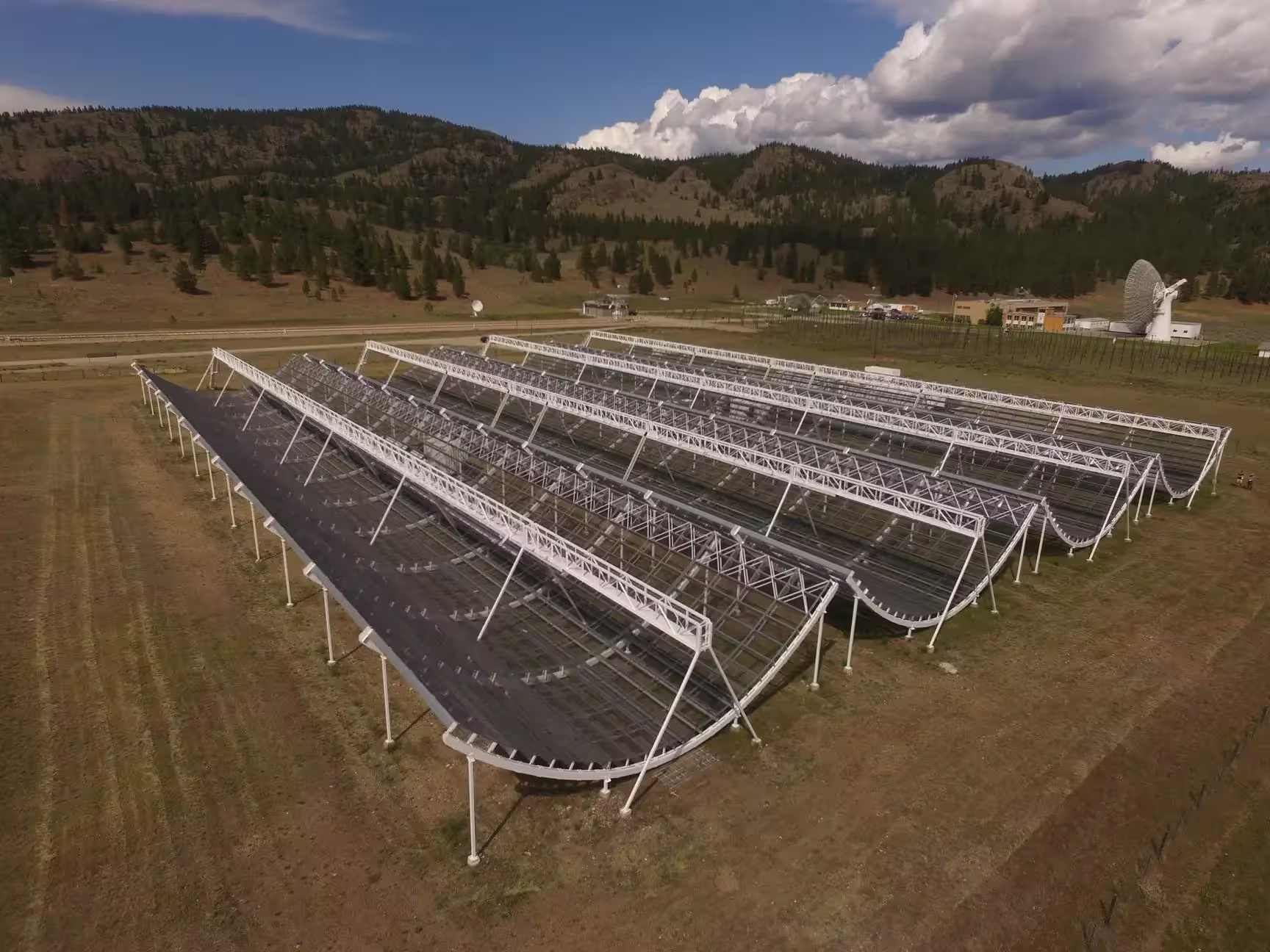
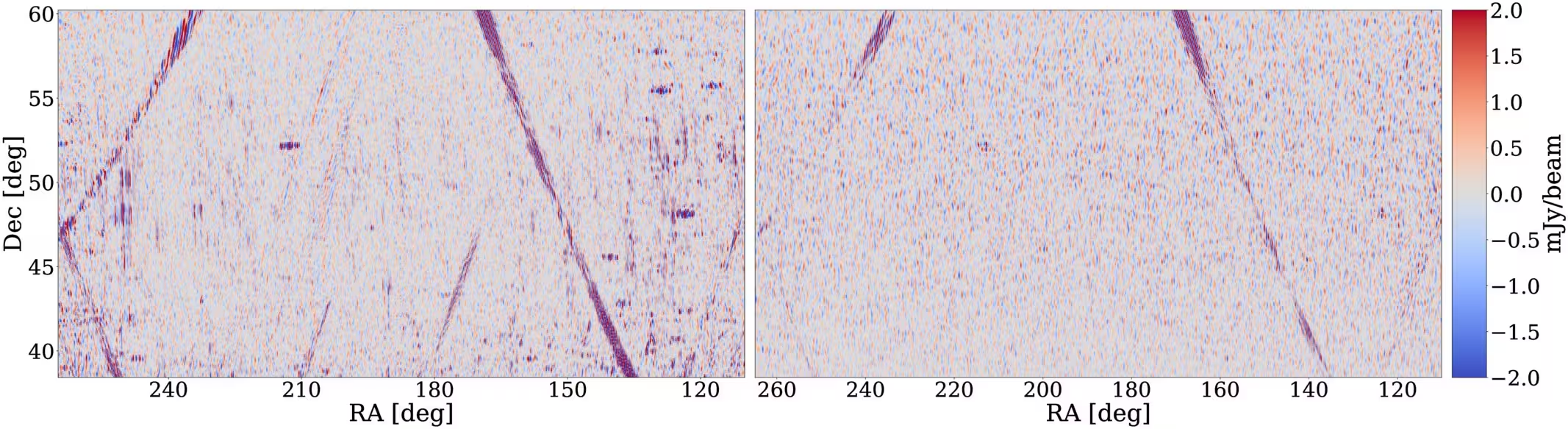
Located at the Dominion Radio Astrophysical Observatory in British Columbia, CHIME features four massive cylindrical reflectors that remain stationary, utilizing the rotation of the Earth to scan the northern sky. Because the target signal is buried under intense radio interference from our own Milky Way and human technology, the team had to develop a sophisticated suite of algorithms to filter out local noise and instrumental artifacts.
A standalone detection
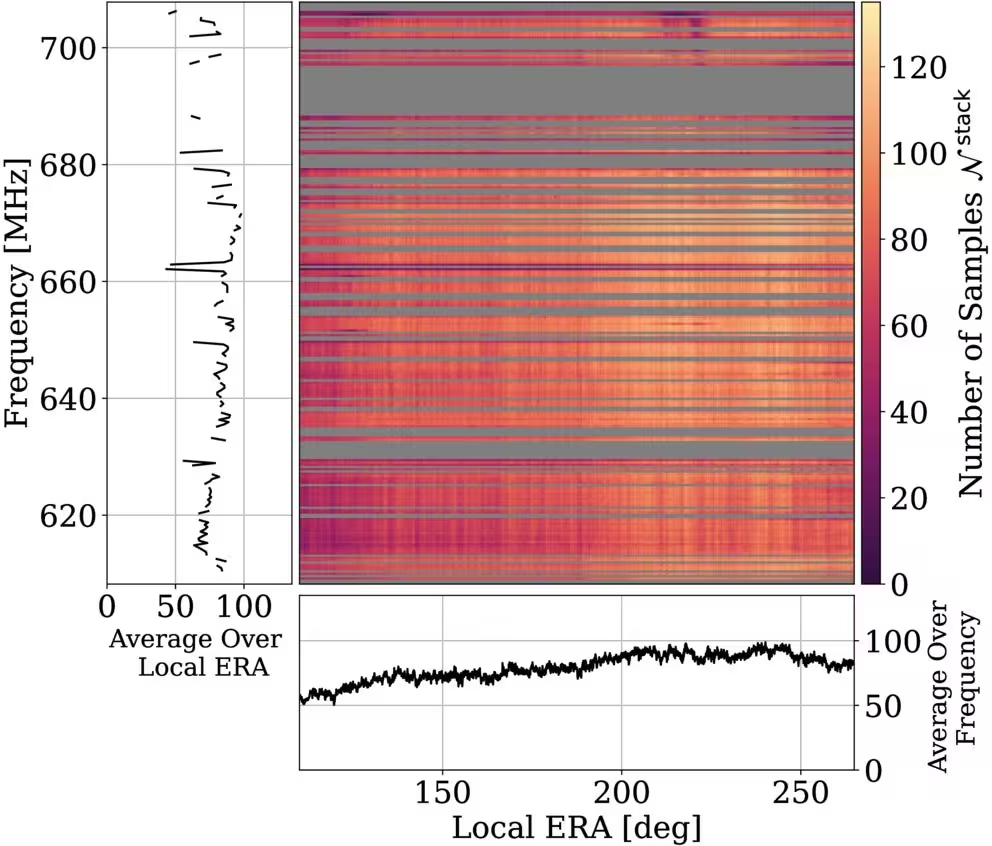
Previous iterations of this research required cross-referencing CHIME data with existing optical surveys. This new milestone marks the first time the telescope has identified the hydrogen auto power spectrum using solely its own data, achieving a signal-to-noise ratio of 12.4. By analyzing 94 nights of observations from 2019, the researchers confirmed the signal at an average redshift of 1.16, corresponding to an era when the universe was approximately 5 billion years old.
“This is a completely new technique for probing the cosmos, delivered by an instrument that was conceived, built and funded by Canadians,” said Dr. Mark Halpern, a principal investigator at the University of British Columbia. “It’s a bold new step in the global cosmology program and a Canadian success story.”
The road toward dark energy insights
While this current achievement does not yet provide a direct measurement of dark energy, it validates the methodology required for precision cosmology. The ultimate goal for CHIME is to track baryon acoustic oscillations—relic pressure waves from the early universe that function as a cosmic ruler. By observing how these patterns appear across different redshifts, researchers aim to reconstruct the expansion history of the universe and decipher the influence of dark energy.
The team is already looking toward the future, with nearly seven years of archived data currently awaiting analysis. By refining their ability to suppress foreground noise, scientists expect to push their observations deeper into the cosmic past, targeting eras when the universe was merely 3 billion years old.
Further reading and resources
- Interpretation of 21 cm Auto Power Spectrum Measurement at z∼1 by the Canadian Hydrogen Intensity Mapping Experiment: A detailed look at how these findings align with cosmological simulations like IllustrisTNG.
- Unveiling the large-scale structure of the Universe with 21cm Intensity Mapping: An overview of the role of intensity mapping in upcoming global radio observations.
- Revealing cosmological fluctuations in 21 cm intensity maps with MeerKLASS: A study on complementary approaches to foreground cleaning and clustering measurements.
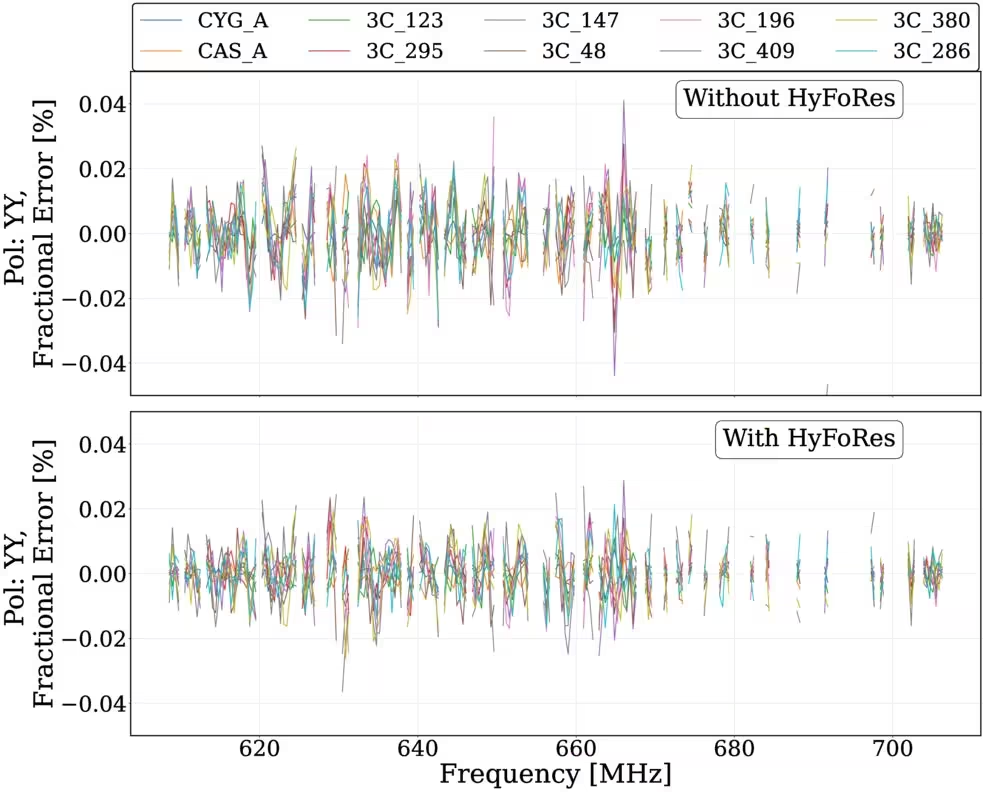
- Mitigating antenna gain errors with hybrid foreground residual subtraction in CHIME simulations: Technical research on reducing instrumental contamination.
- A Detection of Cosmological 21 cm Emission from CHIME in Cross-correlation with eBOSS Measurements: The preceding research that paved the way for this independent detection.
This article has been fact checked for accuracy, with information verified against reputable sources. Learn more about us and our editorial process.
Last reviewed on .
Article history
- Latest version
Reference(s)
- , et al. “Detection of the Cosmological 21 cm Signal in Autocorrelation at z ∼ 1 with the Canadian Hydrogen Intensity Mapping Experiment.” The Astrophysical Journal, vol. 1009, no. 2, September 28, 2026, pp. 159 American Astronomical Society, doi: 10.3847/1538-4357/ae9835. <https://iopscience.iop.org/article/10.3847/1538-4357/ae9835>.
- Collaboration, CHIME. “Interpretation of 21 cm Auto Power Spectrum Measurement at $z\sim 1$ by the Canadian Hydrogen Intensity Mapping Experiment.” arXiv.org <https://arxiv.org/abs/2603.25680>.
- , doi: 10.1017/S1743921325002158. <https://doi.org/10.1017/S1743921325002158>.
- Cunnington, Steven., et al. “Revealing cosmological fluctuations in 21 cm intensity maps with MeerKLASS: from maps to power spectra.” Astrophysics and Space Science, vol. 371, no. 2, February 10, 2026 Springer Science and Business Media LLC, doi: 10.1007/s10509-026-04547-7. <https://doi.org/10.1007/s10509-026-04547-7>.
- Wang, Haochen., et al. “Mitigating antenna gain errors with hybrid foreground residual subtraction in CHIME simulations.” Physical Review D, vol. 113, no. 4, February 26, 2026 American Physical Society (APS), doi: 10.1103/1pp6-x3mb. <https://doi.org/10.1103/1pp6-x3mb>.
- Amiri, Mandana., et al. “A Detection of Cosmological 21 cm Emission from CHIME in Cross-correlation with eBOSS Measurements of the Lyα Forest.” The Astrophysical Journal, vol. 963, no. 1, February 23, 2024, pp. 23 American Astronomical Society, doi: 10.3847/1538-4357/ad0f1d. <https://doi.org/10.3847/1538-4357/ad0f1d>.
Cite this page:
- Posted by Aisha Ahmed