170 Million Hidden Black Holes Reveal Milky Way’s Secret Supernova History
Simulations reveal the Milky Way holds about 170 million dark stellar-mass black holes, mapping their hidden distribution across the galaxy.
A fresh theoretical framework now ties the present‑day positions, masses and velocities of stellar‑mass black holes to the supernovae that birthed them. The study, posted on the arXiv preprint server while awaiting peer review, outlines how future observations could map this hidden population.
Because black holes that are not actively accreting material emit virtually no light, they evade most conventional telescopes, leaving astronomers uncertain about their total numbers within the Milky Way.
To overcome this gap, astrophysicist Tom Wagg of the Flatiron Institute orchestrated a suite of simulations that trace the Galaxy’s 13.6‑billion‑year evolution. By following star formation, stellar lifecycles, black‑hole births and galactic dynamics, the models forecast how many remnants should populate the Milky Way today.
Millions of Unseen Black Holes Predicted Across the Milky Way
The calculations suggest that roughly 170 million massive stars have already collapsed into black holes over cosmic time. Though the figure sounds staggering, the remnants are spread thinly throughout the Galaxy. Near the Sun’s orbital radius, the model predicts an average of one black hole per 6,250 cubic parsecs, roughly a cube with sides of 18.4 parsecs.
When averaged over the Galaxy’s entire history, the formation rate works out to about one new black hole every 80 years. The researchers note that this production was far from uniform: the bulk of the black holes emerged early, when star‑formation activity was considerably higher than it is today.
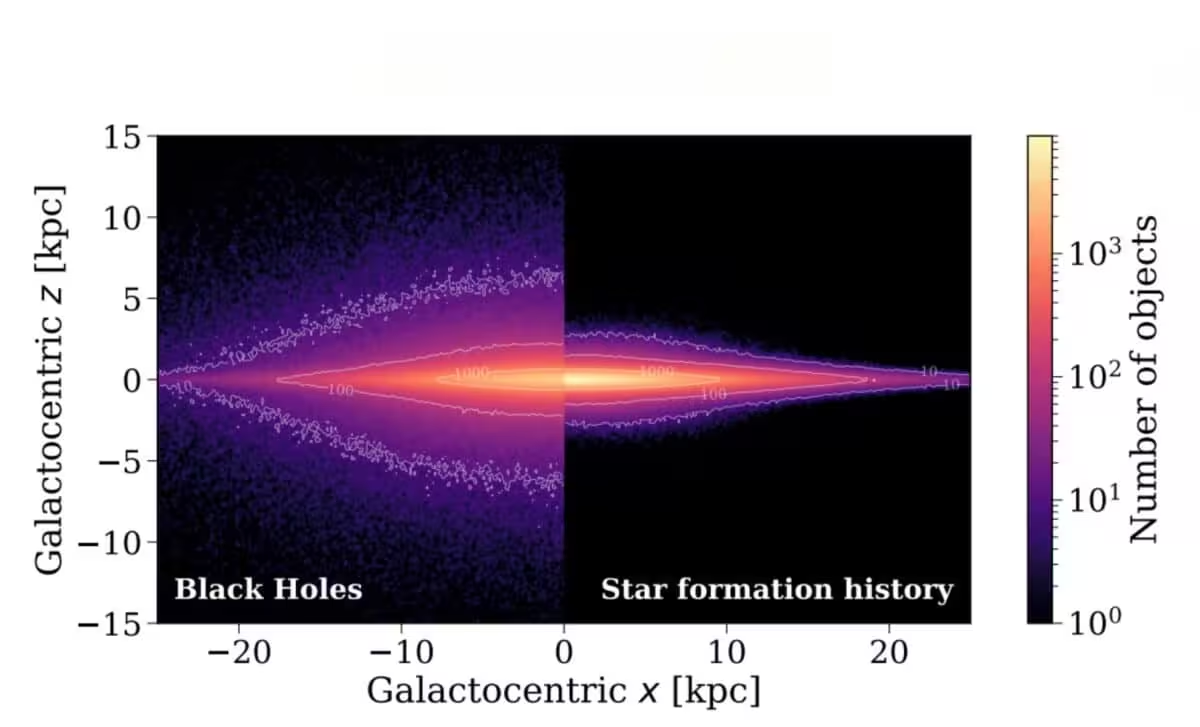
The paper also explores how the remnants have migrated from their birthplaces. Asymmetric supernova explosions can give newborn black holes a “natal kick,” propelling them across the Galactic disk. While most kicks are insufficient to eject a black hole from the Milky Way, they do redistribute the population over large distances.
Kicks and Masses Encode Supernova History
According to the simulations, the natal kicks have puffed up the black‑hole distribution, giving it a vertical thickness of about 790 parsecs—far larger than the Milky Way’s thin stellar disk, which sits at roughly 306 parsecs. This disparity is largely attributed to the momentum imparted during black‑hole formation.
A clear pattern emerges linking a black hole’s mass to its galactic trajectory. Lighter remnants, born from explosions that expelled more stellar material, receive stronger recoil and travel farther from the Galactic plane. In contrast, heavier black holes experience greater fallback of ejecta, which dampens the kick and keeps them nearer to their natal regions.
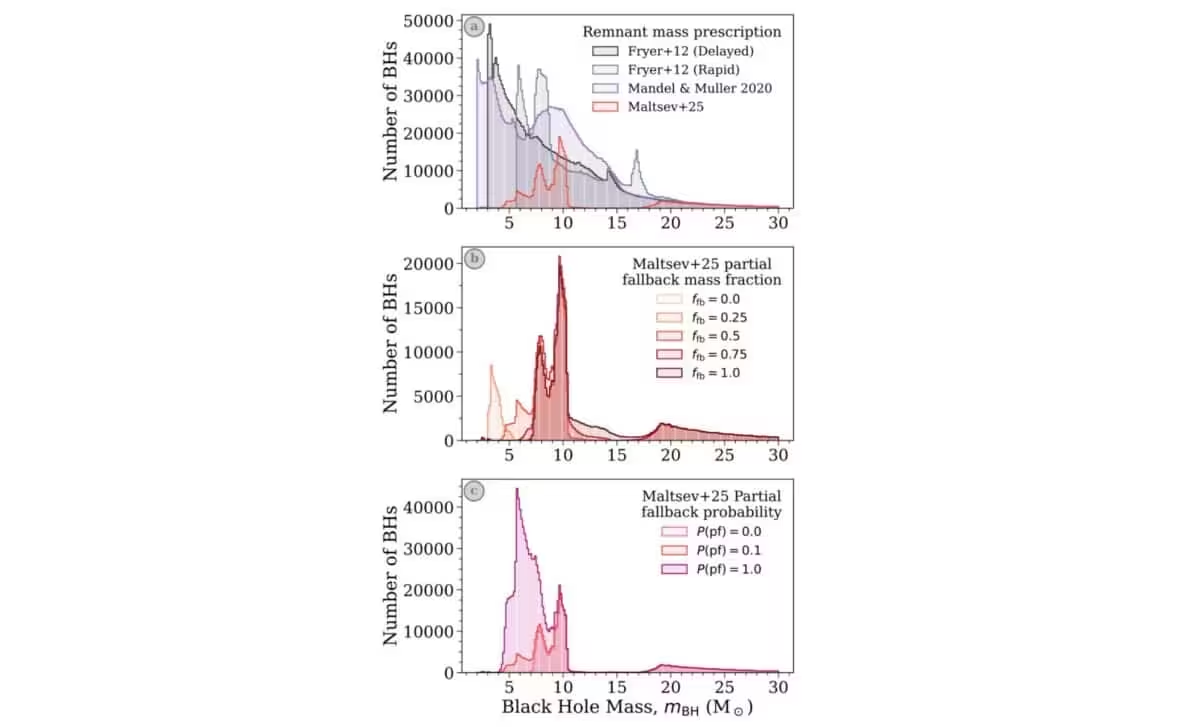
The authors argue that forthcoming surveys capable of measuring both the abundance and kinematics of these hidden black holes could discriminate among competing supernova models. If observational data align with the simulation’s forecasts, confidence in this modeling approach—and its broader implications for galaxy evolution—would be reinforced.
This article has been fact checked for accuracy, with information verified against reputable sources. Learn more about us and our editorial process.
Last reviewed on .
Article history
- Latest version
Reference(s)
- twagg, “Tom Wagg.”, September 30, 2025 Simons Foundation <https://www.simonsfoundation.org/people/tom-wagg-2/>.
- Wagg, Tom. “Charting the Galactic Underworld I: Comprehensive simulations of the kinematics, rates, and demographics of Milky Way black holes.” arXiv.org <https://arxiv.org/abs/2607.22814>.
Cite this page:
- Posted by Aisha Ahmed