Black Hole’s Fiery Feast Reveals It Ejects Half the Consumed Matter
Rare Swift J1727.8−1613 observation shows black holes can eject most of the material they consume long after an outburst fades.
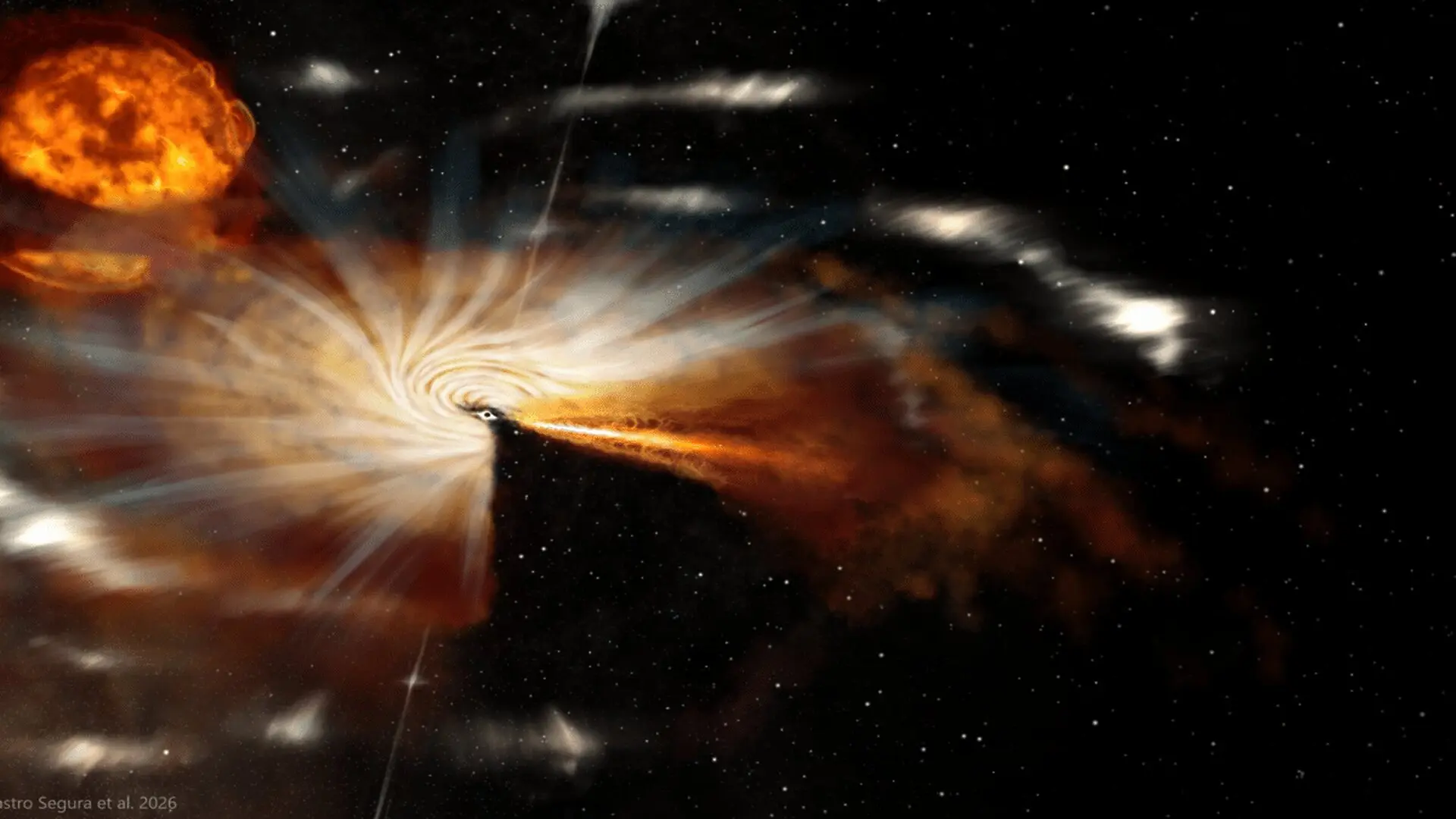
A recent investigation using the European Southern Observatory’s Very Large Telescope (VLT) has shown that a black hole can eject a substantial fraction of the gas it draws in, contradicting the classic view of an all‑consuming cosmic monster. The team focused on the dramatic 2023 flare of the binary system Swift J1727.8−1613, capturing the event from its peak brightness through its fading stages.
The results, released in Monthly Notices of the Royal Astronomical Society, provide one of the most detailed visual accounts of how matter behaves around a black hole during an outburst and after the initial explosion subsides. Even when the visible activity dropped to a few percent of its maximum, the system continued to launch energetic jets and winds.
A Binary Dance That Powers a Cosmic Firework
In Swift J1727.8−1613, a black hole siphons gas from a nearby companion star, forming a rapidly rotating accretion disk of superheated plasma. As the gas spirals inward, part of it is swallowed, while the rest is transformed and flung outward, creating a dynamic environment that can be observed across the electromagnetic spectrum.
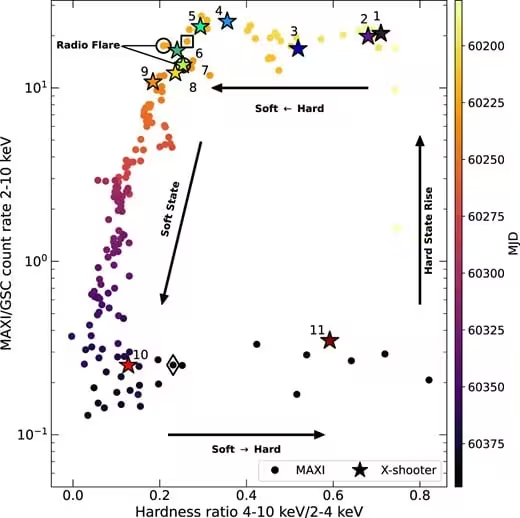
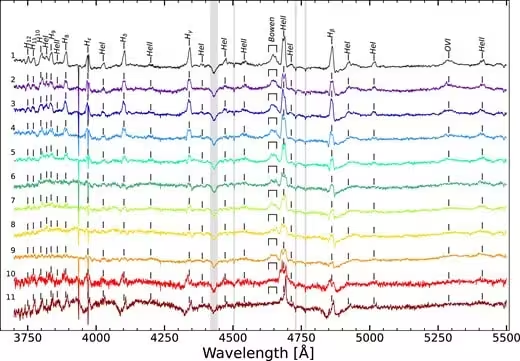
The 2023 eruption propelled the system to become one of the brightest X‑ray sources in the sky, allowing astronomers to monitor its evolution in real time rather than relying on isolated snapshots. Optical spectra collected by a VLT team led by Dr. Noel Castro Segura of the University of Warwick traced the changing conditions of the accretion flow throughout the outburst.
Jets and Winds Persist Long After the Peak
During the flare, the researchers identified a tight link between the inner accretion disk’s evolution and the launch of powerful outflows. A relativistic jet expelled material at high velocity, while dense winds carried additional gas away from the binary.
Remarkably, even after the X‑ray luminosity fell to roughly one‑hundredth of its maximum, signatures of outflowing gas remained detectable. This lingering activity suggests that the later phases of a black hole eruption hold valuable clues about the mechanisms that regulate matter exchange in binary systems.
Dr. Segura explained, “The conventional picture of black holes as one‑way sinks is overly simplistic. Our observations reveal a cycle where material is ingested, processed, and then a sizable portion is expelled back into space.”
“If black holes can continue shedding material even after their largest outbursts, it means they may be much less efficient eaters than we previously assumed. A significant fraction of the meal may never reach the black hole at all, changing our understanding of how binary stars in galaxies evolve.”
Revising the Role of Black Holes in Galactic Environments
The expelled gas may rival the amount ultimately captured by the black hole, implying that a large share of the mass transferred from the companion star escapes instead of contributing to the black hole’s growth. This insight reshapes models of how black holes influence their surroundings over both active and quiescent periods.
Kyle Solomons, a doctoral researcher at the University of Cape Town, noted, “We often focus on the spectacular fireworks at the onset of a black‑hole outburst, but the finale can be equally energetic. Even as the X‑ray output dwindled, the system retained enough power to launch a massive gas outflow.”
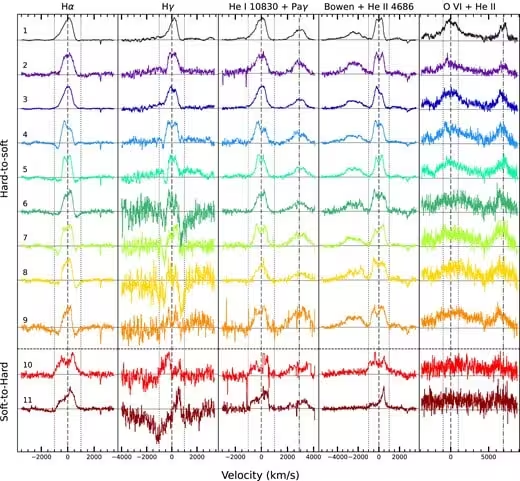
By following the outburst from its brightest moments through its quiet decline, the study underscores the importance of long‑term monitoring to capture the full life cycle of black‑hole activity. The findings suggest that the “quiet” phases may conceal significant feedback processes that shape the evolution of binary star systems and their host galaxies.
This article has been fact checked for accuracy, with information verified against reputable sources. Learn more about us and our editorial process.
Last reviewed on .
Article history
- Latest version
Cite this page:
- Posted by Aisha Ahmed