Hidden Viral DNA and Protein Switches Reveal How E. coli Senses Host Heat
Genetics

Hidden Viral DNA and Protein Switches Reveal How E. coli Senses Host Heat

A viral fragment and a repurposed silencer protein team up to drive rapid bacterial growth at 37°C.
By Faisal Qureshi
Published:
Email this Article
Hidden Viral DNA and Protein Switches Reveal How E. coli Senses Host Heat
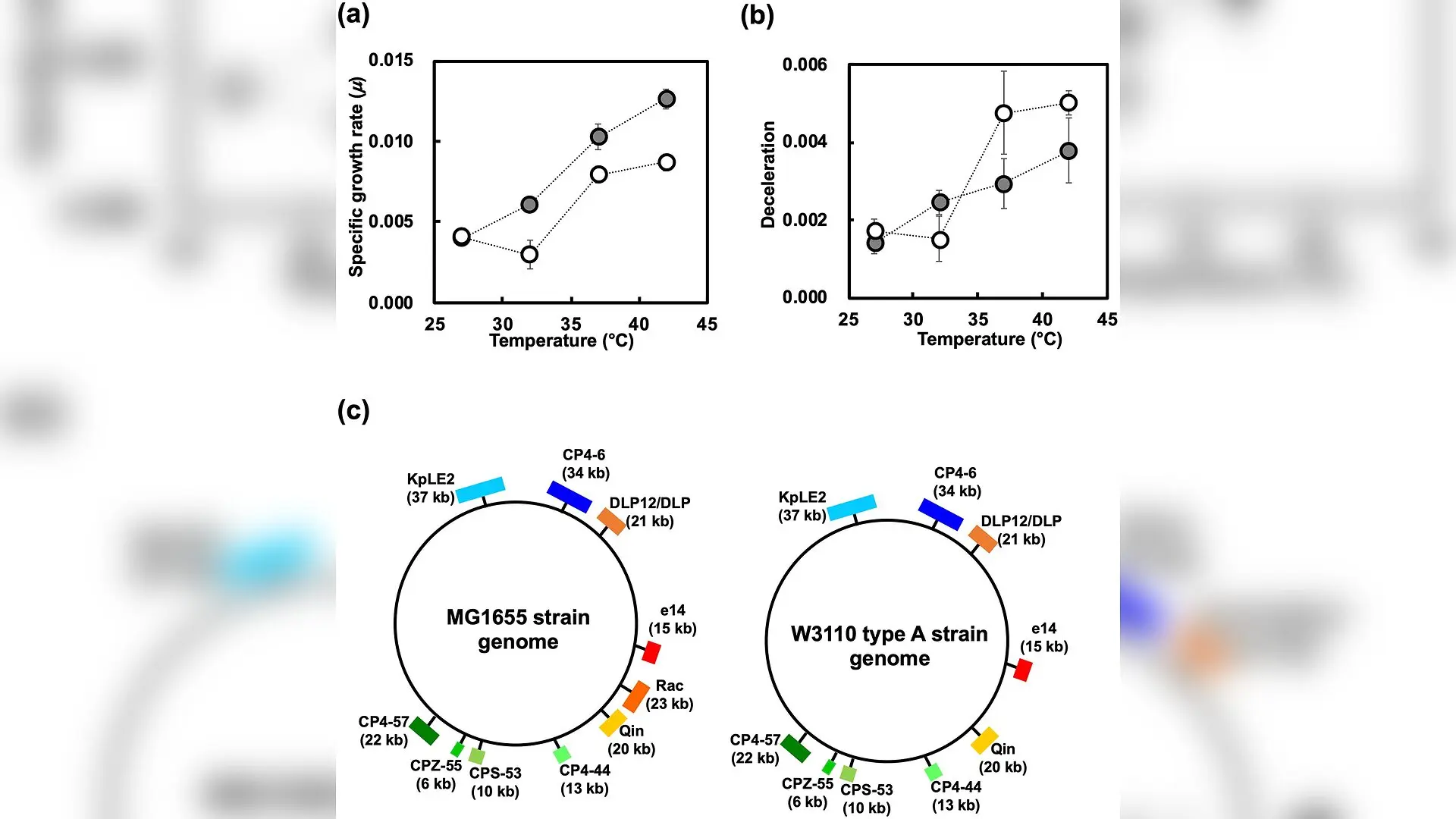
Impact of the Rac prophage on temperature-dependent growth stimulation and comparative genomic mapping. (a) Temperature-dependent profiles of the specific growth rate at the onset of the logarithmic phase (μ at ODratio = 0.2) for E. coli MG1655 (filled circles) and W3110 type A (open circles). (b) Comparison of growth deceleration rates across temperatures for MG1655 and W3110 type A. In both (a) and (b), each data point represents the mean value derived from 12 independent colonies, with error bars indicating the standard deviation. (c) Comparative circular genome maps of MG1655 (left) and W3110 type A (right). Colored boxes indicate the positions and sizes (kb) of various prophage elements. The 23-kb Rac prophage (orange box) is present in the MG1655 genome but notably absent in W3110 type A, correlating with the lack of significant growth stimulation at 37°C in the latter strain. Erika Yamauchi et al. / PLOS One

When Escherichia coli bacteria enter a warm-blooded host, they sense the shift to 37°C and quickly rev up their growth to colonize the gut. Researchers examining how this thermal trigger works have discovered that a protein traditionally known for silencing foreign genes actually acts as a vital structural organizer that makes rapid growth possible.

How a 37°C Host Temperature Triggers Rapid Growth

For bacteria like Escherichia coli, survival inside a host organism depends on detecting body heat and translating that physical cue into biological action. When entering an environment kept near 37°C, successful bacterial populations must expand their clonal presence rapidly. This explosive phase of reproduction requires the genetic material inside the cell to be tightly condensed and organized so that replication and transcription do not collide.

To understand the mechanics of this temperature-dependent shift, a team of Japanese researchers investigated the specific growth rate at the onset of the logarithmic phase across temperatures ranging from 27°C to 45°C. Using high-frequency automated monitoring, the team tracked how quickly cultures accelerated as turbidity changed. The results were published in PLOS One by Erika Yamauchi, Hayato Fujita, Yukari Miyake, and Kaneyoshi Yamamoto on October 28, 2026.

The Hidden Role of the Rac Prophage in Cellular Acceleration

The team compared two common laboratory strains of Escherichia coli, known as MG1655 and W3110 type A. While both strains grew well, MG1655 displayed a sharp stimulation of its specific growth rate when temperatures reached 37°C. Strain W3110 type A failed to show this same temperature-boosted velocity, even though it possessed a full complement of sigma factors and a functional regulatory allele.
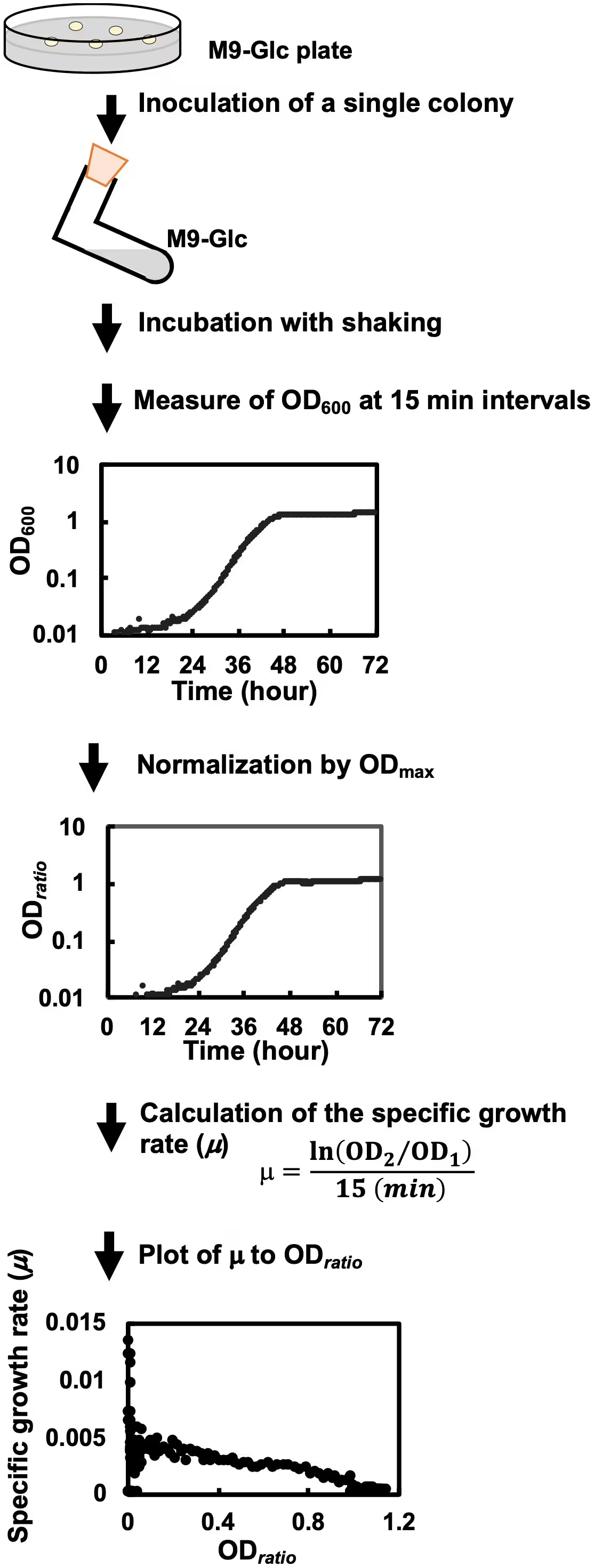
Fig 1: Experimental strategy for evaluating E. coli growth kinetics. E. coli growth was analyzed by quantifying the relationship between the specific growth rate and culture turbidity. A single colony was inoculated into M9-Glc medium in an L-shaped glass tube and incubated at 37°C with continuous shaking. Growth was monitored via high-frequency OD600 measurements at 15-minute intervals for up to 72 hours using a TVS062CA Compact Rocking Incubator (Advantec, Japan). To standardize growth profiles, OD600 values were normalized to the maximum observed turbidity (ODmax) to define the ODratio (ODmeasured/ODmax). The specific growth rate (μ) was calculated for each 15-minute interval using the formula μ = ln(OD2/OD1)/15, and subsequently plotted against the ODratio. Data represent findings from 12 independent colonies per strain.
Experimental strategy for evaluating E. coli growth kinetics. E. coli growth was analyzed by quantifying the relationship between the specific growth rate and culture turbidity. A single colony was inoculated into M9-Glc medium in an L-shaped glass tube and incubated at 37°C with continuous shaking. Growth was monitored via high-frequency OD600 measurements at 15-minute intervals for up to 72 hours using a TVS062CA Compact Rocking Incubator (Advantec, Japan). To standardize growth profiles, OD600 values were normalized to the maximum observed turbidity (ODmax) to define the ODratio (ODmeasured/ODmax). The specific growth rate (μ) was calculated for each 15-minute interval using the formula μ = ln(OD2/OD1)/15, and subsequently plotted against the ODratio. Data represent findings from 12 independent colonies per strain. Credit: Erika Yamauchi et al. / PLOS One

Whole-genome sequencing revealed a major genetic difference explaining the discrepancy. Strain MG1655 carries a 23-kilobase viral remnant known as the Rac prophage, which is entirely absent in W3110 type A. Viral DNA fragments like prophages make up about 20% of the E. coli K-12 genome and were once dismissed as evolutionary junk. The new data indicate that the Rac prophage serves as a key genetic determinant, unlocking rapid growth when the host temperature is reached.

Why H-NS Shifts From Gene Silencer to Structural Scaffolding

Unlocking the potential of the Rac prophage requires a protein called H-NS, short for histone-like nucleoid-associated protein. Traditionally studied as a silencer that represses horizontally transferred genes, H-NS undergoes a conformational change at around 37°C that alters its molecular geometry. When the researchers created mutants lacking the hns gene, the temperature-dependent growth stimulation vanished almost entirely.
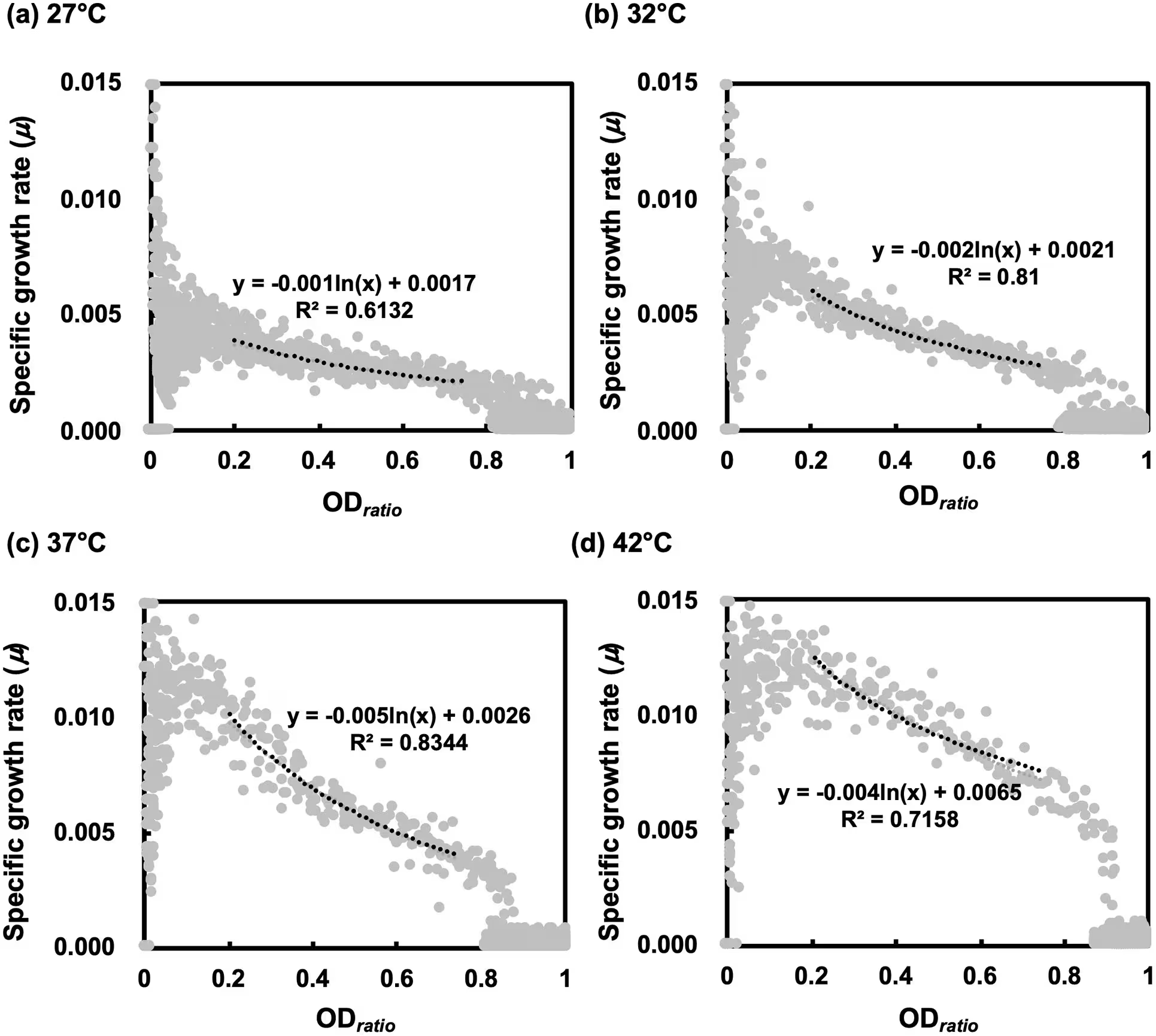
Fig 2: Quantitative analysis of temperature-dependent growth kinetics and the stimulation effect. The relationship between the instantaneous specific growth rate (μ) and normalized culture turbidity (ODratio) was evaluated across a range of temperatures. (a–d) Representative plots of μ versus ODratio for the parent strain MG1655 at 27°C (a), 32°C (b), 37°C (c), and 42°C (d). Individual data points (gray circles) represent measurements taken at 15-minute intervals from 12 independent cultures. The dotted lines indicate the logarithmic regression fit (y = aln(x)+b) calculated within the ODratio range of 0.2 to 1.0, which corresponds to the logarithmic growth phase. The regression formula and the coefficient of determination (R2) are displayed for each temperature condition. The specific growth rate at the onset of the logarithmic phase is statistically defined as the value of μ at ODratio = 0.2.
Quantitative analysis of temperature-dependent growth kinetics and the stimulation effect. The relationship between the instantaneous specific growth rate (μ) and normalized culture turbidity (ODratio) was evaluated across a range of temperatures. (a–d) Representative plots of μ versus ODratio for the parent strain MG1655 at 27°C (a), 32°C (b), 37°C (c), and 42°C (d). Individual data points (gray circles) represent measurements taken at 15-minute intervals from 12 independent cultures. The dotted lines indicate the logarithmic regression fit (y = aln(x)+b) calculated within the ODratio range of 0.2 to 1.0, which corresponds to the logarithmic growth phase. The regression formula and the coefficient of determination (R2) are displayed for each temperature condition. The specific growth rate at the onset of the logarithmic phase is statistically defined as the value of μ at ODratio = 0.2. Credit: Erika Yamauchi et al. / PLOS One

Single-cell imaging using DAPI staining to visualize the bacterial nucleoids showed that under minimal glucose media conditions, macroscopic chromosome condensation remained relatively stable in the mutants. This indicates that H-NS is not merely a bulk condenser. Instead, it provides a fine-scale physical scaffold that coordinates the spatial organization of transcription and replication, allowing the cell to overcome the severe biophysical stress of sudden growth.

Alternative Survival Strategies in Different Bacterial Strains

The study also tested other nucleoid-associated proteins, including StpA, HU, Fis, and Dps, to see if they played similar roles. While MG1655 relied almost exclusively on H-NS to exploit its prophage, W3110 type A showed a more distributed defense strategy. Lacking the Rac prophage, W3110 required a broader network of proteins, including both H-NS and its homolog StpA as well as the HU protein, to maintain its baseline growth velocity at 37°C.

These findings demonstrate that different bacterial lineages have evolved distinct internal frameworks for managing host colonization. Specialized strains leverage integrated viral elements through targeted protein switches, while others rely on cooperative networks of multiple structural proteins to achieve genomic stability under the same thermal conditions.

The research was published in PLOS One on October 28, 2026.

Fact Checked

This article has been fact checked for accuracy, with information verified against reputable sources. Learn more about us and our editorial process.

Last reviewed on .

Article history

  • Latest version

Reference(s)

  1. Yamauchi, Erika., et al. “Structural basis of H-NS-mediated temperature-dependent stimulation of initial growth in Escherichia coli.” PLOS One, vol. 21, no. 10, October 28, 2026, pp. e0346655 Public Library of Science (PLoS), doi: 10.1371/journal.pone.0346655. <https://doi.org/10.1371/journal.pone.0346655>.

Cite this page:

Qureshi, Faisal. “Hidden Viral DNA and Protein Switches Reveal How E. coli Senses Host Heat.” BioScience. BioScience ISSN 2521-5760, 29 October 2026. <https://www.bioscience.com.pk/en/subject/genetics/structural-basis-of-h-ns-mediated-temperature-dependent-stimulation-of-initial-growth-in-escherichia-coli>. Qureshi, F. (2026, October 29). “Hidden Viral DNA and Protein Switches Reveal How E. coli Senses Host Heat.” BioScience. ISSN 2521-5760. Retrieved October 29, 2026 from https://www.bioscience.com.pk/en/subject/genetics/structural-basis-of-h-ns-mediated-temperature-dependent-stimulation-of-initial-growth-in-escherichia-coli Qureshi, Faisal. “Hidden Viral DNA and Protein Switches Reveal How E. coli Senses Host Heat.” BioScience. ISSN 2521-5760. https://www.bioscience.com.pk/en/subject/genetics/structural-basis-of-h-ns-mediated-temperature-dependent-stimulation-of-initial-growth-in-escherichia-coli (accessed October 29, 2026).
End of the article