Compact RNA Structure Bypasses Cellular Barriers to Silence Pests
Genetics

Compact RNA Structure Bypasses Cellular Barriers to Silence Pests

Paperclip RNA successfully reaches the cytoplasm and silences target genes in mosquitoes, moths, and fungi even when conventional uptake pathways are blocked.
By Faisal Qureshi
Published:
Email this Article
Compact RNA Structure Bypasses Cellular Barriers to Silence Pests
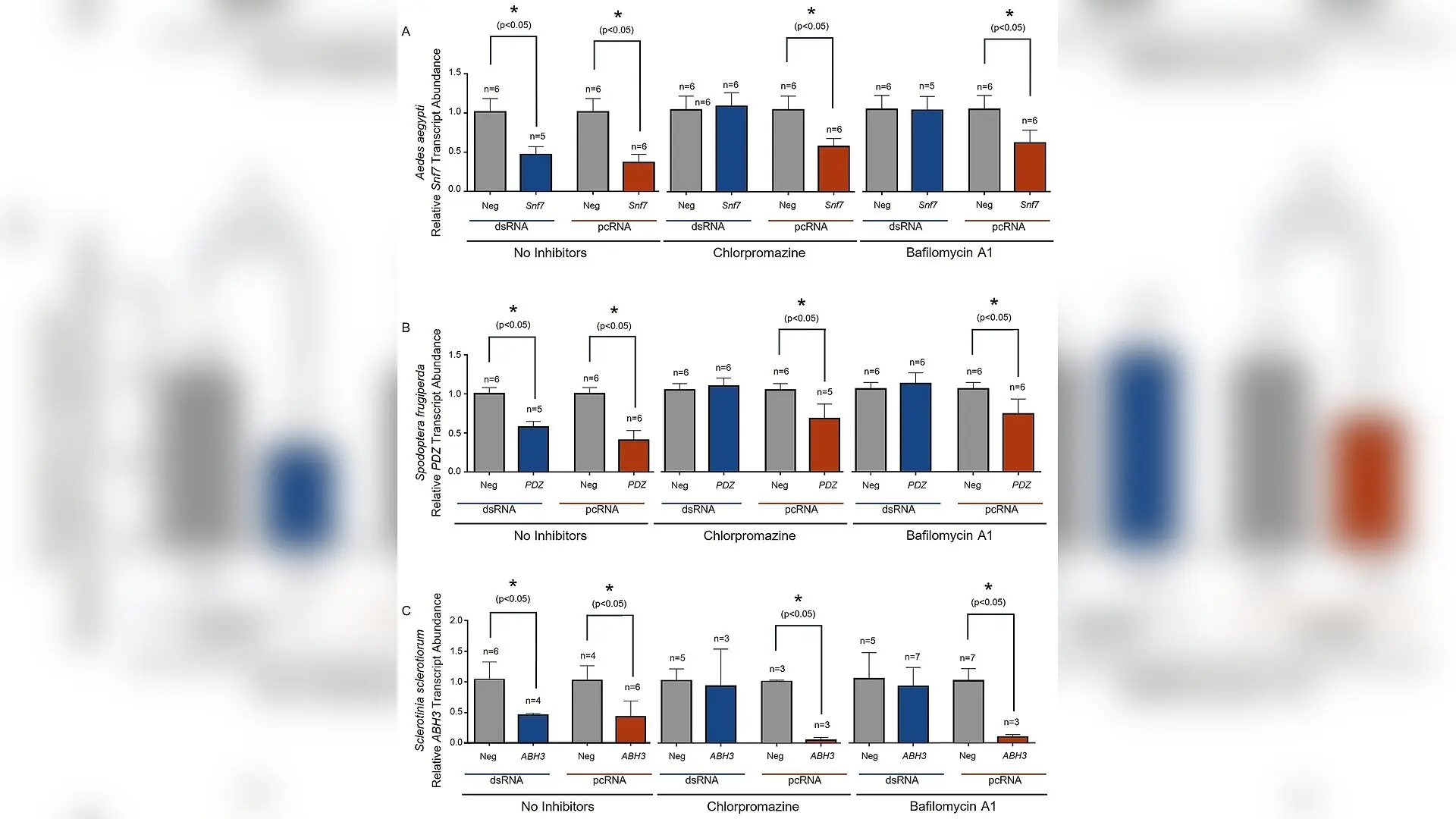
Transcript knockdown by long dsRNA and pcRNA in cultured Aedes aegypti (CCL125), Spodoptera frugiperda (Sf9) cells, and Sclerotinia sclerotiorum hyphae, both without inhibitors and following chemical inhibition of clathrin-mediated endocytosis. (A) Snf7 transcript levels in A. aegypti. (B) PDZ transcript levels in S. frugiperda. (C) AB-HYDROLASE 3 transcript levels in S. sclerotiorum. For the inhibitor assays, cells or hyphae were pre-treated with chlorpromazine or bafilomycin A1. Transcript abundance was quantified by qRT-PCR and normalized to 28S rRNA (insects) or Sac7 (fungus) and expressed relative to untreated controls. Negative control (Neg) treatments consisted of cells or hyphae exposed to non-specific (GUS) long or pcRNA, with vehicle-only treatments serving as the controls for inhibitor assays. Values represent the means ± s.e.m; n denotes biological replicates per treatment, each consisting of 3 technical replicates. Asterisks indicate both statistically significant differen Nazanin Amanat et al. / PLOS One

Compact RNA structures known as paperclip RNAs can slip past a cellular roadblock that normally blocks standard biopesticides in mosquitoes, crop pests, and fungi. Chemical insecticides and fungicides have long served as the primary defense against agricultural losses, but their widespread use poses environmental and health risks while accelerating chemical resistance in many pest species. To combat these issues, scientists have turned to RNA interference, a biological process that silences specific genes by destroying their messenger RNA instructions.

While researchers can spray double-stranded RNA directly onto plants to target pests, a method called spray-induced gene silencing, many insects and fungi prove stubbornly resistant because their cells fail to take up the long RNA molecules properly. In a study published in PLOS One, a research team led by Nazanin Amanat, Bliss M. Kernodle, Brigo Castillo, Alison Tayler, Mark Belmonte, and Steve Whyard investigated whether redesigning the RNA into a compact hairpin shape could overcome this hurdle.

How Paperclip RNA Bypasses Cellular Barriers

To test how different RNA structures enter cells, the researchers worked with cultured cells from the yellow fever mosquito, scientifically known as Aedes aegypti, the fall armyworm moth, known as Spodoptera frugiperda, and hyphae from the plant-pathogenic fungus Sclerotinia sclerotiorum. They exposed these organisms to conventional long double-stranded RNA and to paperclip RNA, which consists of a short 23 to 25 base pair double-stranded region flanked by looped ends. Using chemical inhibitors that block clathrin-mediated endocytosis, a cellular process where the cell membrane folds inward to swallow extracellular molecules, the team tracked how the different RNA types entered the cells.
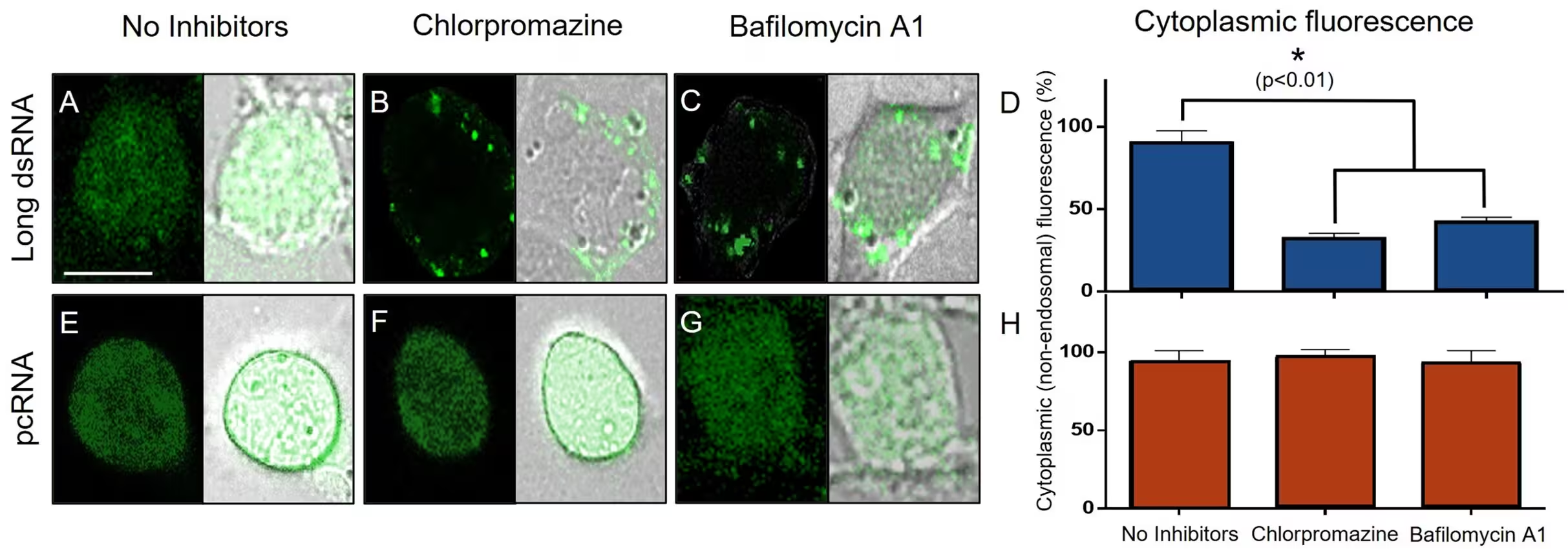
Fig 2: Cellular localization of fluorescein‑labelled long dsRNA and pcRNA in Aedes aegypti (CCL125) cells with and without using chemical inhibitors of clathrin-mediated endocytosis. Chemical inhibition of CME reduces uptake of exogenous long dsRNA, but not pcRNA, in Aedes aegypti (CCL125) cells. Confocal microscopy images show the intracellular localization of fluorescein-labelled long dsRNA (A-C) and pcRNA (E-G) under three conditions: (A, E) untreated controls; (B, F) chlorpromazine; and (C, G) bafilomycin A1. For each treatment, the left image in each panel shows the fluorescein channel alone, while the right image shows the merged fluorescein and brightfield channels. Images were acquired on a Zeiss LSM 700 confocal microscope with an Imager M2. Scale bar = 10 µm. (D and H) The percentage of total fluorescence is attributable to cytoplasmic signal, excluding the punctate endosomal aggregates. The values represent the means and SEM for 6 images, and the asterisk indicates significantly di
Cellular localization of fluorescein‑labelled long dsRNA and pcRNA in Aedes aegypti (CCL125) cells with and without using chemical inhibitors of clathrin-mediated endocytosis. Chemical inhibition of CME reduces uptake of exogenous long dsRNA, but not pcRNA, in Aedes aegypti (CCL125) cells. Confocal microscopy images show the intracellular localization of fluorescein-labelled long dsRNA (A-C) and pcRNA (E-G) under three conditions: (A, E) untreated controls; (B, F) chlorpromazine; and (C, G) bafilomycin A1. For each treatment, the left image in each panel shows the fluorescein channel alone, while the right image shows the merged fluorescein and brightfield channels. Images were acquired on a Zeiss LSM 700 confocal microscope with an Imager M2. Scale bar = 10 µm. (D and H) The percentage of total fluorescence is attributable to cytoplasmic signal, excluding the punctate endosomal aggregates. The values represent the means and SEM for 6 images, and the asterisk indicates significantly di Credit: Nazanin Amanat et al. / PLOS One

The experiments revealed that conventional long double-stranded RNA relies strictly on this clathrin-dependent pathway to gain entry. When the researchers blocked the pathway using chlorpromazine or bafilomycin A1, the long RNA molecules failed to enter the cytoplasm, becoming trapped in vesicular structures or blocked at the cell surface entirely. Consequently, the long RNA lost its ability to silence target genes such as Snf7 in mosquitoes, PDZ in moths, and AB-HYDROLASE 3 in the fungus. In contrast, paperclip RNA maintained robust gene silencing activity even when the clathrin pathway was blocked, reducing target transcript levels by roughly 50 percent in mosquito cells, 30 percent in moth cells, and over 90 percent in the fungus.

Confocal Imaging Confirms Cytoplasmic Delivery

Using confocal laser scanning microscopy with fluorescein-labeled RNA molecules, the team visualized the intracellular movement of the treatments in real time. In untreated cells of all three species, both long RNA and paperclip RNA spread rapidly into the cytoplasm within 20 minutes of exposure. However, when clathrin-mediated endocytosis was inhibited, the long RNA was largely restricted to the cell periphery or trapped in endosomes, with cytoplasmic fluorescence dropping sharply.
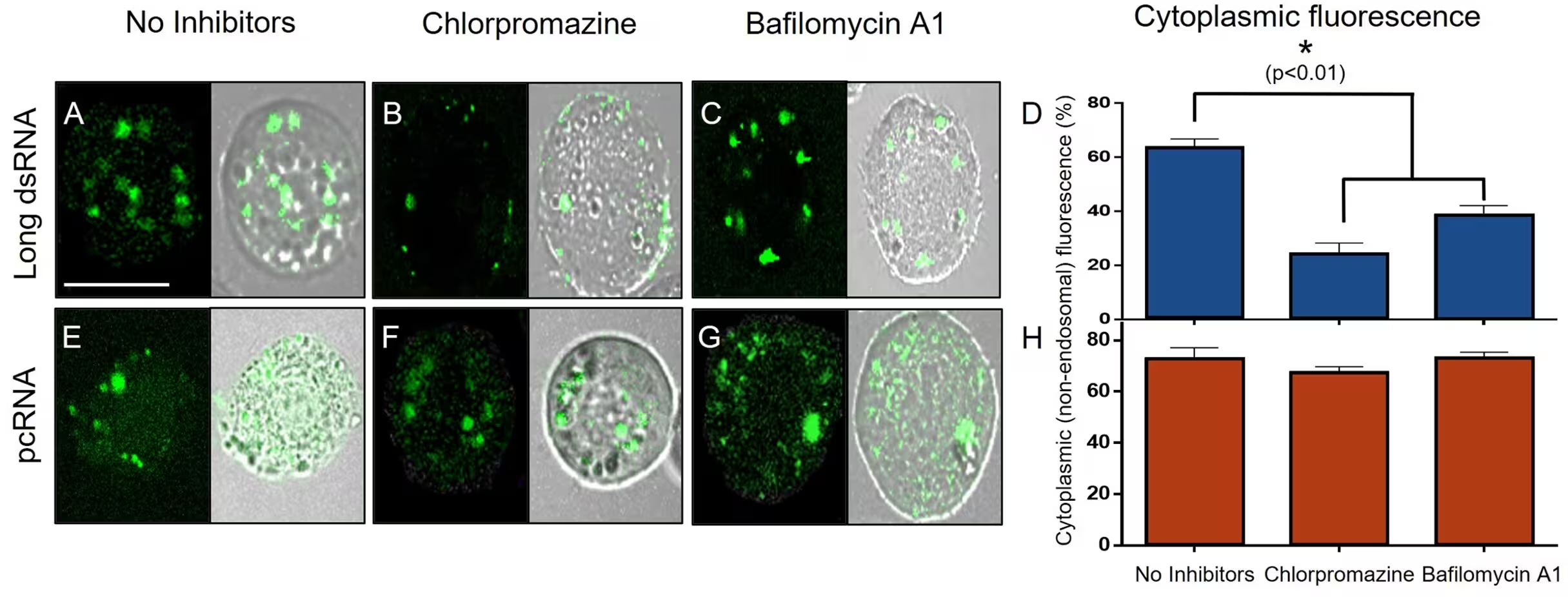
Fig 3: Cellular localization of fluorescein‑labelled dsRNA and pcRNAs in Spodoptera frugiperda (Sf9) cells with and without using chemical inhibitors of clathrin-mediated endocytosis. pcRNAs are internalized and reach the cytoplasm independent of CME, in contrast to the CME-dependent uptake of long dsRNA in Spodoptera frugiperda (Sf9) cells. Confocal microscopy images show the localization of fluorescein-labelled long dsRNA (A-C) and pcRNA (E-G) under three conditions: (A, E) untreated controls; (B, F) chlorpromazine; and (C, G) bafilomycin A1. For each treatment, the left image in each panel shows the fluorescein channel alone and the right image shows the merged fluorescein and brightfield channels. Images were acquired using a Zeiss LSM 700 confocal microscope with an Imager M2. Scale bar = 5 µm. (D and H) The percentage of total fluorescence is attributable to cytoplasmic signal, excluding the punctate endosomal aggregates. The values represent the means and SEM for 6 images, and the aste
Cellular localization of fluorescein‑labelled dsRNA and pcRNAs in Spodoptera frugiperda (Sf9) cells with and without using chemical inhibitors of clathrin-mediated endocytosis. pcRNAs are internalized and reach the cytoplasm independent of CME, in contrast to the CME-dependent uptake of long dsRNA in Spodoptera frugiperda (Sf9) cells. Confocal microscopy images show the localization of fluorescein-labelled long dsRNA (A-C) and pcRNA (E-G) under three conditions: (A, E) untreated controls; (B, F) chlorpromazine; and (C, G) bafilomycin A1. For each treatment, the left image in each panel shows the fluorescein channel alone and the right image shows the merged fluorescein and brightfield channels. Images were acquired using a Zeiss LSM 700 confocal microscope with an Imager M2. Scale bar = 5 µm. (D and H) The percentage of total fluorescence is attributable to cytoplasmic signal, excluding the punctate endosomal aggregates. The values represent the means and SEM for 6 images, and the aste Credit: Nazanin Amanat et al. / PLOS One

Meanwhile, paperclip RNA continued to flood the cytoplasm regardless of whether the clathrin pathway was active, showing fluorescence patterns virtually identical to untreated controls. The authors noted that while lipid-raft and caveolae-mediated endocytosis inhibitors did not alter the uptake of either RNA type, the exact alternative pathway used by paperclip RNA remains to be determined. The data suggest that the compact secondary structure of paperclip RNA allows it to circumvent the size and uptake limitations that typically render certain pests and pathogens refractory to conventional RNA-based treatments.

Implications for Future Pest Control Strategies

The ability of paperclip RNA to enter cells through an alternative route has significant implications for managing both natural RNA resistance and acquired resistance in agricultural settings. Because some insect populations can rapidly evolve resistance to conventional double-stranded RNA through defects in cellular uptake, alternative delivery mechanisms are urgently needed. The authors emphasize that future research must test paperclip RNA performance in naturally recalcitrant field strains, such as the wheat pathogen Zymoseptoria tritici and resistant lines of the Colorado potato beetle, to confirm whether this technology can restore susceptibility where traditional RNA sprays fail.

The research was published in PLOS One on October 28, 2026.

Fact Checked

This article has been fact checked for accuracy, with information verified against reputable sources. Learn more about us and our editorial process.

Last reviewed on .

Article history

  • Latest version

Reference(s)

  1. Amanat, Nazanin., et al. “Paperclip RNAs bypass clathrin mediated endocytosis in insect and fungal cells.” PLOS One, vol. 21, no. 10, October 28, 2026, pp. e0359888 Public Library of Science (PLoS), doi: 10.1371/journal.pone.0359888. <https://doi.org/10.1371/journal.pone.0359888>.

Cite this page:

Qureshi, Faisal. “Compact RNA Structure Bypasses Cellular Barriers to Silence Pests.” BioScience. BioScience ISSN 2521-5760, 29 October 2026. <https://www.bioscience.com.pk/en/subject/genetics/paperclip-rnas-bypass-clathrin-mediated-endocytosis-in-insect-and-fungal-cells>. Qureshi, F. (2026, October 29). “Compact RNA Structure Bypasses Cellular Barriers to Silence Pests.” BioScience. ISSN 2521-5760. Retrieved October 29, 2026 from https://www.bioscience.com.pk/en/subject/genetics/paperclip-rnas-bypass-clathrin-mediated-endocytosis-in-insect-and-fungal-cells Qureshi, Faisal. “Compact RNA Structure Bypasses Cellular Barriers to Silence Pests.” BioScience. ISSN 2521-5760. https://www.bioscience.com.pk/en/subject/genetics/paperclip-rnas-bypass-clathrin-mediated-endocytosis-in-insect-and-fungal-cells (accessed October 29, 2026).
End of the article