Adult Bone Marrow Harbors Embryonic-Like Progenitors That Generate Immune Cells Without Monocytes
Genetics

Adult Bone Marrow Harbors Embryonic-Like Progenitors That Generate Immune Cells Without Monocytes

Researchers discover a hidden population of bone marrow cells that revives an embryonic pathway to build specialized macrophages and red blood cells independently of standard monocyte recruitment.
By Faisal Qureshi
Published:
Email this Article
Adult Bone Marrow Harbors Embryonic-Like Progenitors That Generate Immune Cells Without Monocytes
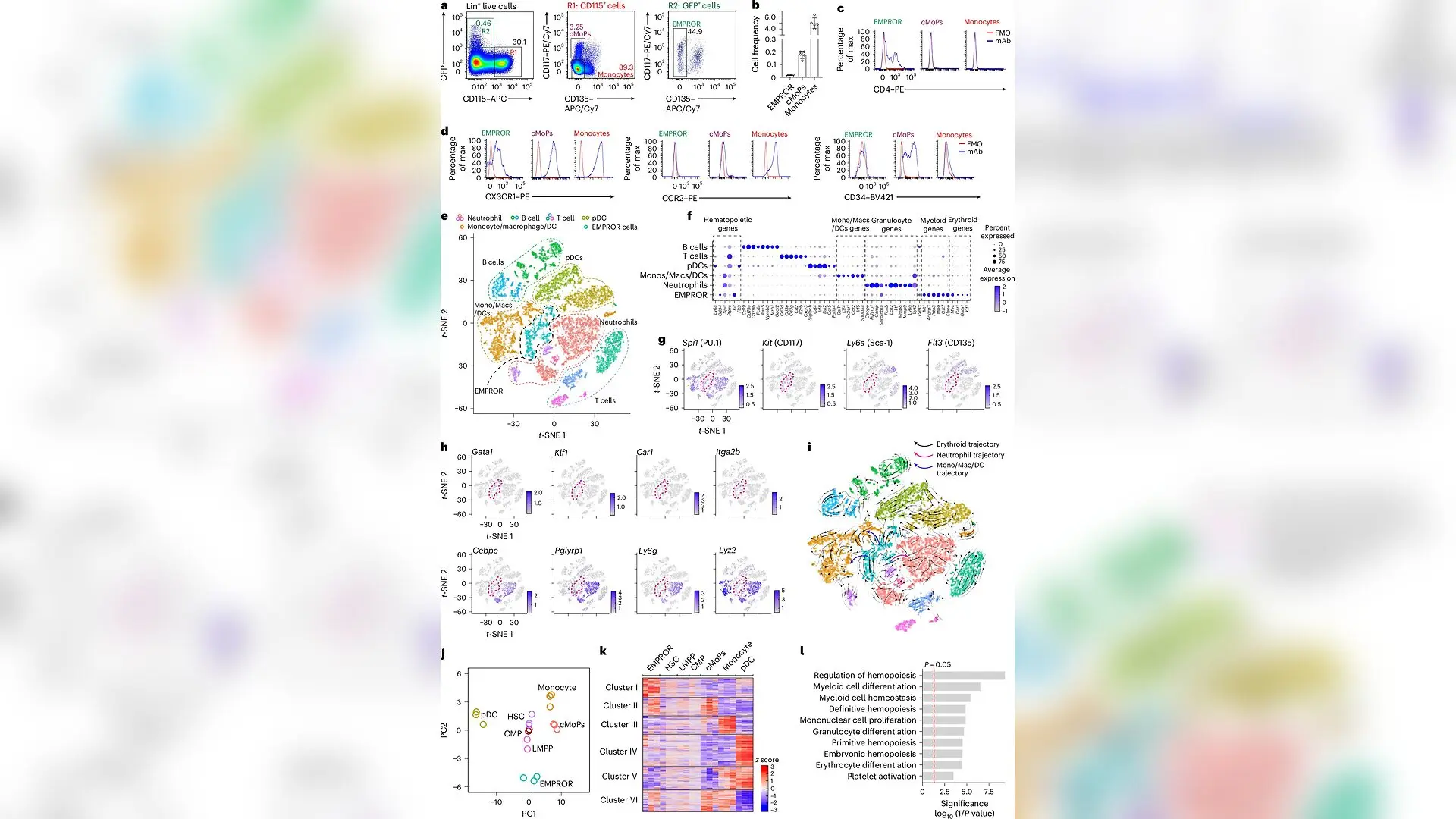
Identification and characterization of EMPROR cells. a, Flow cytometric analysis of DPE-GFP:Rag1−/− BM highlighting the presence of cMoPs, monocytes and EMPROR cells. Lineage markers comprise CD3e, Ly6G, NK1.1, CD19 and Siglec-H. Data are representative of five independent experiments. b, Cell frequency of cMoPs, monocytes and EMPROR cells as a percentage of total live cells in adult BM. Data are cumulative of five independent experiments. Bars represent mean ± s.d. c,d, Surface expression of CD4 (c) and CCR2, CX3CR1 and CD34 (d) on cMoPs, monocytes and EMPROR cells. Data are representative of three independent experiments. e, t-SNE plot of hematopoietic cells from DPE-GFP BM showing a distinct EMPROR cluster. The plot was generated by assimilating scRNA-seq data from sorted CD45+(with BM cells; see Methods for details), GFP+ and EMPROR cells sorted from DPE-GFP BM. f, Bubble plots showing expression of hematopoietic and developmental genes across cell clusters. g, t-SNE plots showing Tikoo et al. / Nature Immunology

Adult bone marrow harbors a newly discovered cell type that revives an embryonic pathway to build immune cells, challenging long-held assumptions about how the body repairs itself. The study was published in Nature Immunology (doi.org/10.1038/s41590-026-02686-1) and reveals an alternative route for generating specialized macrophages and other blood lineages independently of circulating monocytes.

Uncovering a Hidden Progenitor in Adult Tissue

For decades, textbook biology has taught that adult tissue-resident macrophages are replenished exclusively by circulating white blood cells known as monocytes during inflammation and cancer. Researchers set out to investigate the exact origins of perivascular macrophages, which are specialized immune cells that line blood vessels and help regulate local inflammation. By tracking genetic reporters in mice, the team noticed that a specific subset of these vessel-lining cells did not originate from standard monocyte pathways.

Instead, advanced single-cell RNA sequencing and flow cytometry pointed toward a rare, distinct population residing inside the bone marrow. The authors named these cells erythro-myeloid progenitors, or EMPROR for short. While traditional hematopoietic stem cells give rise to a broad spectrum of blood cells, EMPROR cells carry a distinct molecular signature that bridges adult physiology with early embryonic development.
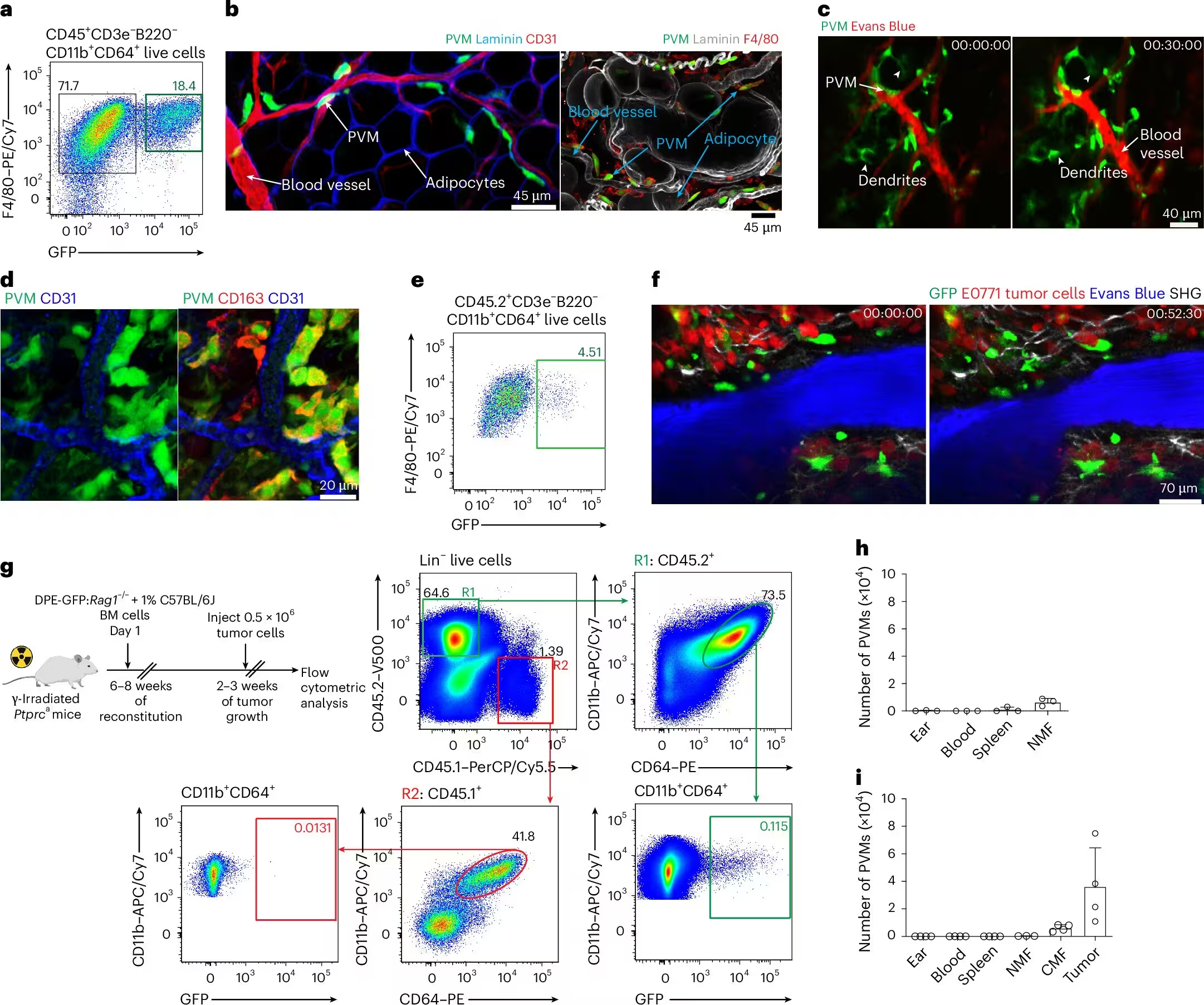
Fig. 1: Identification and origin of PVMs. a, Flow cytometric identification of CD45+CD3e−B220−CD11b+CD64+F4/80+GFP− and CD45+CD3e−B220−CD11b+CD64+F4/80+GFP+ macrophages in naive mammary fat pads of DPE-GFP mice. Data representative of three independent experiments are shown. b, Confocal imaging of immunostained mammary fat pad identifying GFP+ PVMs. Co-staining with F4/80 is depicted on the right. Data are representative of n = 3 mice from three independent experiments. c, Intravital imaging of sessile GFP+ PVMs within the naive mammary fat pad displaying actively scanning dendrites. Data represent images from three independent experiments. d, Confocal imaging of immunostained mammary tumors showing GFP+ PVMs along neoangiogenic tumor vasculature. Data represent images from three independent experiments. e, Flow cytometric identification of CD45.2+CD3e−B220−CD11b+CD64+F4/80+GFP− and CD45.2+CD3e−B220−CD11b+CD64+F4/80+GFP+ macrophages within mammary tumors. A representative flow plot from one o
Identification and origin of PVMs. a, Flow cytometric identification of CD45+CD3e−B220−CD11b+CD64+F4/80+GFP− and CD45+CD3e−B220−CD11b+CD64+F4/80+GFP+ macrophages in naive mammary fat pads of DPE-GFP mice. Data representative of three independent experiments are shown. b, Confocal imaging of immunostained mammary fat pad identifying GFP+ PVMs. Co-staining with F4/80 is depicted on the right. Data are representative of n = 3 mice from three independent experiments. c, Intravital imaging of sessile GFP+ PVMs within the naive mammary fat pad displaying actively scanning dendrites. Data represent images from three independent experiments. d, Confocal imaging of immunostained mammary tumors showing GFP+ PVMs along neoangiogenic tumor vasculature. Data represent images from three independent experiments. e, Flow cytometric identification of CD45.2+CD3e−B220−CD11b+CD64+F4/80+GFP− and CD45.2+CD3e−B220−CD11b+CD64+F4/80+GFP+ macrophages within mammary tumors. A representative flow plot from one o Credit: Tikoo et al. / Nature Immunology

Molecular Signatures and Multilineage Potential

Further laboratory assays demonstrated that EMPROR cells possess a restricted yet powerful developmental repertoire. When isolated and tested in culture or transplanted into animal models, these cells successfully generated red blood cells, platelets, neutrophils, and specialized macrophages. They notably lacked the ability to produce dendritic cells or lymphocytes, setting them apart from common monocyte and lymphoid precursors.

Transcriptional profiling showed that adult EMPROR cells share striking similarities with embryonic erythro-myeloid progenitors found during fetal development. They expressed genes typical of early precursors while lacking classic adult monocyte markers such as Csf1r and Ccr2. This absence of standard receptors explains why these cells operate independently of the chemical signaling pathways normally required to recruit conventional monocytes to sites of injury or tumor growth.
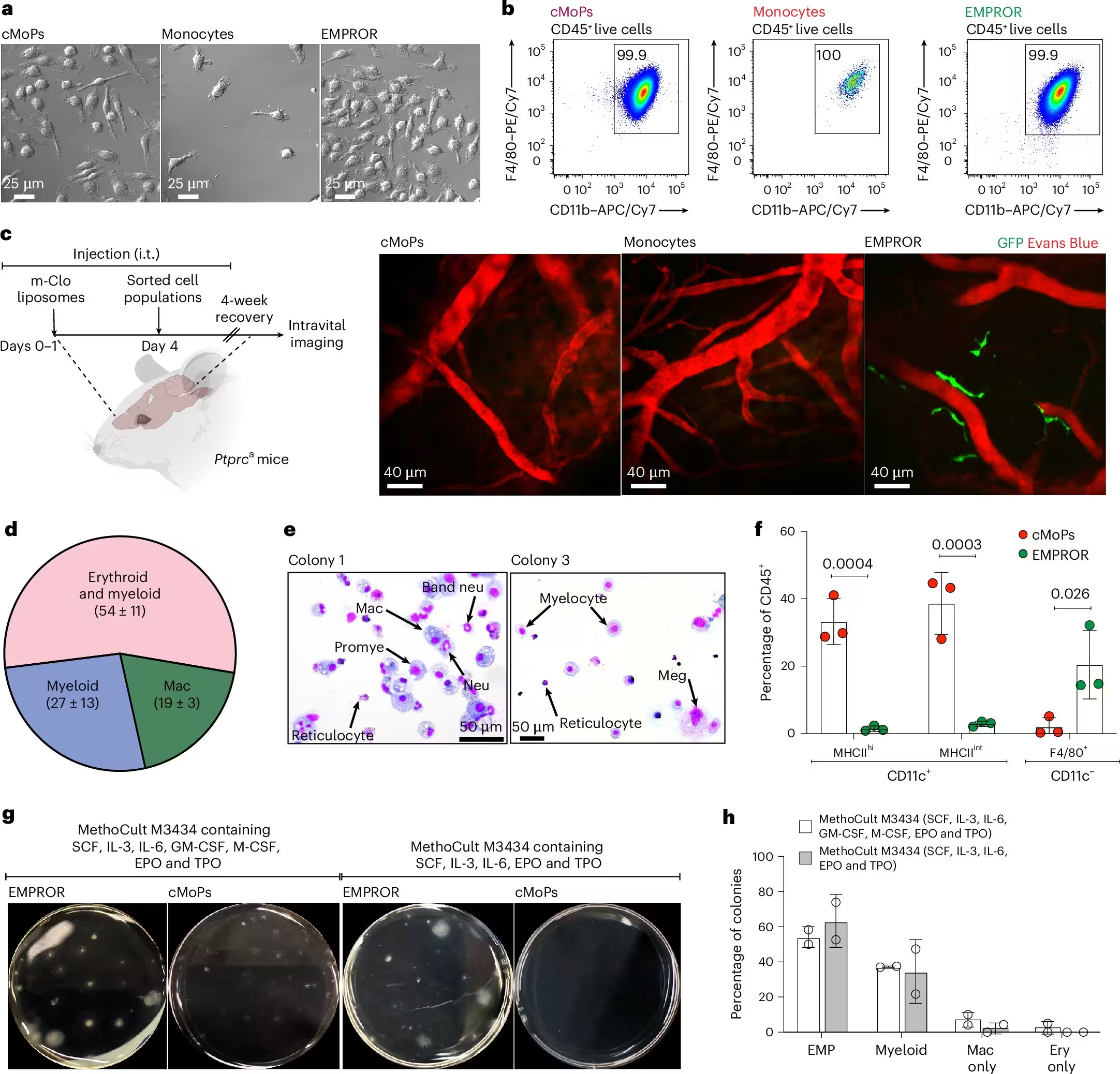
Fig. 3: Lineage potential of EMPROR cells. a, Confocal differential interference contrast imaging of sorted cMoPs, monocytes and EMPROR cells cultured in complete RPMI medium containing M-CSF. Representative images from one of two independent experiments are shown. b, Flow cytometric identification of CD45+CD11b+F4/80+ macrophages following culture. Representative flow plots from one of three independent experiments are shown. c, Intravital imaging of meningeal vasculature following i.t. transfer of sorted cMoPs, monocytes and EMPROR cells confirming the presence of GFP+ PVMs following EMPROR transfer. Data are representative of three independent experiments wherein the CNS was repleted with EMPROR cells (n = 3 mice), cMoPs and monocytes (n = 4) sorted from DPE-GFP:Rag1−/− BM; m-Clo, mannosylated clodronate. d, Pie chart displaying the proportion of macrophage (Mac), myeloid (macrophage and neutrophil) and erythro–myeloid (erythroid with macrophage and neutrophil lineages) colonies generated a
Lineage potential of EMPROR cells. a, Confocal differential interference contrast imaging of sorted cMoPs, monocytes and EMPROR cells cultured in complete RPMI medium containing M-CSF. Representative images from one of two independent experiments are shown. b, Flow cytometric identification of CD45+CD11b+F4/80+ macrophages following culture. Representative flow plots from one of three independent experiments are shown. c, Intravital imaging of meningeal vasculature following i.t. transfer of sorted cMoPs, monocytes and EMPROR cells confirming the presence of GFP+ PVMs following EMPROR transfer. Data are representative of three independent experiments wherein the CNS was repleted with EMPROR cells (n = 3 mice), cMoPs and monocytes (n = 4) sorted from DPE-GFP:Rag1−/− BM; m-Clo, mannosylated clodronate. d, Pie chart displaying the proportion of macrophage (Mac), myeloid (macrophage and neutrophil) and erythro–myeloid (erythroid with macrophage and neutrophil lineages) colonies generated a Credit: Tikoo et al. / Nature Immunology

Challenging Dogma in Inflammation and Cancer

The discovery reshapes our understanding of how tissues respond to pathological stress, such as solid tumors. When researchers implanted breast cancer cells into experimental mouse models, EMPROR cells actively migrated and generated tumor-associated macrophages and neutrophils. Furthermore, experiments using mice genetically engineered to lack the Ccr2 receptor showed that these specialized vessel-lining macrophages still developed successfully without standard monocyte recruitment.

The findings suggest that the adult body maintains a dormant reservoir of embryonic-like stem cells ready to step in when specific tissues need specialized repair. Because these experiments were conducted in murine models, future investigations will need to determine whether similar progenitor populations exist in humans and what exact roles they play in chronic inflammatory diseases.

The research was published in Nature Immunology on November 1, 2026.

Fact Checked

This article has been fact checked for accuracy, with information verified against reputable sources. Learn more about us and our editorial process.

Last reviewed on .

Article history

  • Latest version

Reference(s)

  1. Tikoo, Shweta., et al. “A CD4-lineage erythro–myeloid progenitor within the adult bone marrow defines an alternative pathway for macrophage generation.” Nature Immunology, vol. 27, no. 11, October 26, 2026, pp. 2293-2305. Springer Science and Business Media LLC, doi: 10.1038/s41590-026-02686-1. <https://doi.org/10.1038/s41590-026-02686-1>.

Cite this page:

Qureshi, Faisal. “Adult Bone Marrow Harbors Embryonic-Like Progenitors That Generate Immune Cells Without Monocytes.” BioScience. BioScience ISSN 2521-5760, 29 October 2026. <https://www.bioscience.com.pk/en/subject/genetics/a-cd4-lineage-erythro-myeloid-progenitor-within-the-adult-bone-marrow-defines-an-alternative-pathway-for-macrophage-generation>. Qureshi, F. (2026, October 29). “Adult Bone Marrow Harbors Embryonic-Like Progenitors That Generate Immune Cells Without Monocytes.” BioScience. ISSN 2521-5760. Retrieved October 29, 2026 from https://www.bioscience.com.pk/en/subject/genetics/a-cd4-lineage-erythro-myeloid-progenitor-within-the-adult-bone-marrow-defines-an-alternative-pathway-for-macrophage-generation Qureshi, Faisal. “Adult Bone Marrow Harbors Embryonic-Like Progenitors That Generate Immune Cells Without Monocytes.” BioScience. ISSN 2521-5760. https://www.bioscience.com.pk/en/subject/genetics/a-cd4-lineage-erythro-myeloid-progenitor-within-the-adult-bone-marrow-defines-an-alternative-pathway-for-macrophage-generation (accessed October 29, 2026).
End of the article