Tiny Inbred Fish Reveal Surprising Twist in Genomic Evolution
Isolated freshwater sticklebacks show elevated recombination rates that may help them survive severe inbreeding and genetic bottlenecks.
Tiny freshwater fish living in isolated northern ponds show unexpected signs of evolutionary adaptation, offering a fresh look at how genomes handle intense inbreeding. Researchers examining nine-spined sticklebacks (Pungitius pungitius) found that populations squeezed into small, restricted habitats for thousands of years carry significantly higher crossover counts than their sprawling marine counterparts.
Decoding the Genetic Landscape of Wild Fish
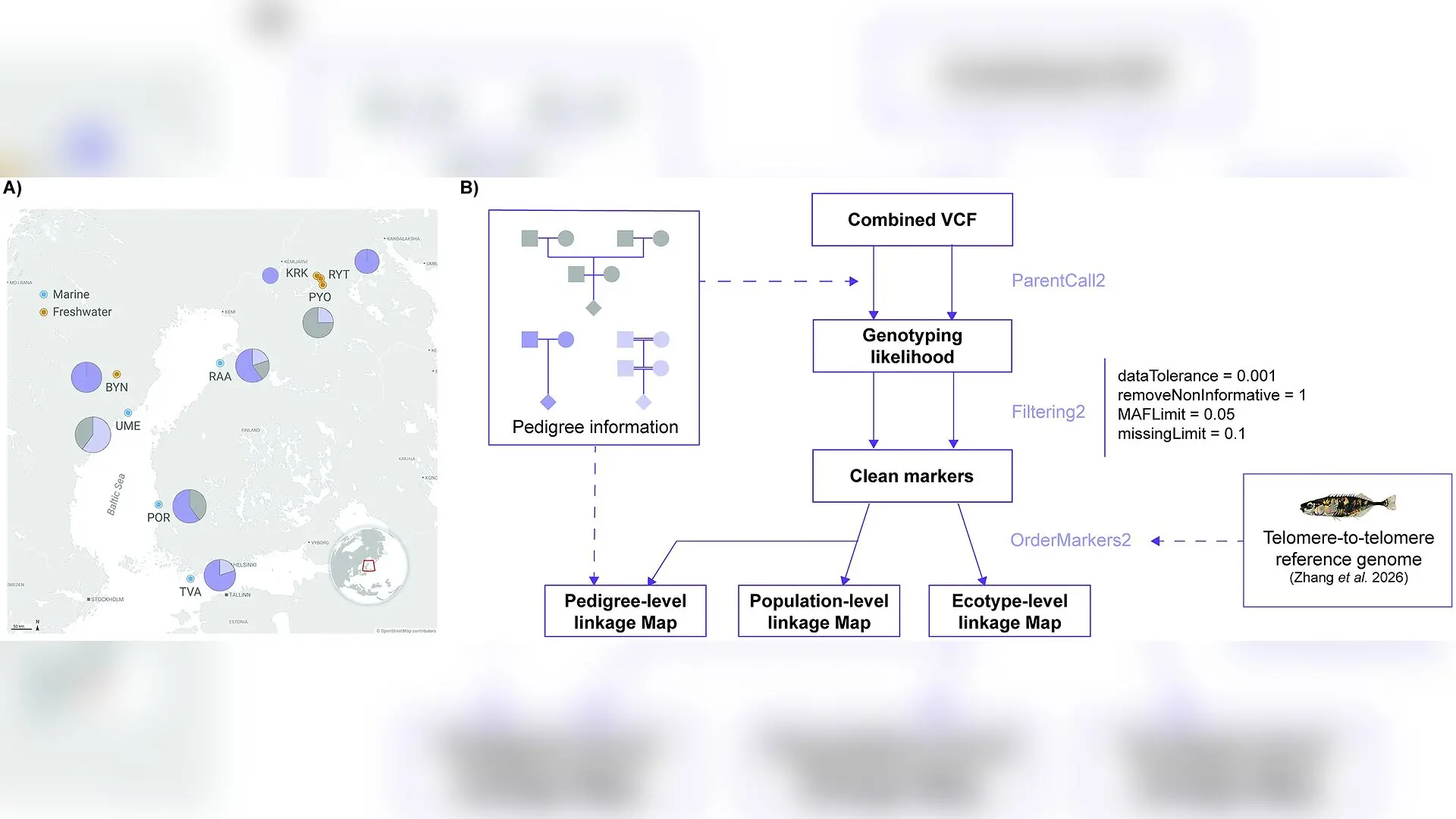
To uncover how population size shapes genetic health, a team of international scientists analyzed high-density linkage maps from eight distinct natural populations. The study compared four large marine populations from the Baltic Sea, boasting effective population sizes averaging roughly 376,000 individuals, against four small freshwater pond populations averaging just about 7,000 individuals. By tracking family pedigrees across these groups, the authors mapped millions of single nucleotide polymorphism markers, which are precise variations in DNA sequences, to measure how often genetic material shuffles during cell division.
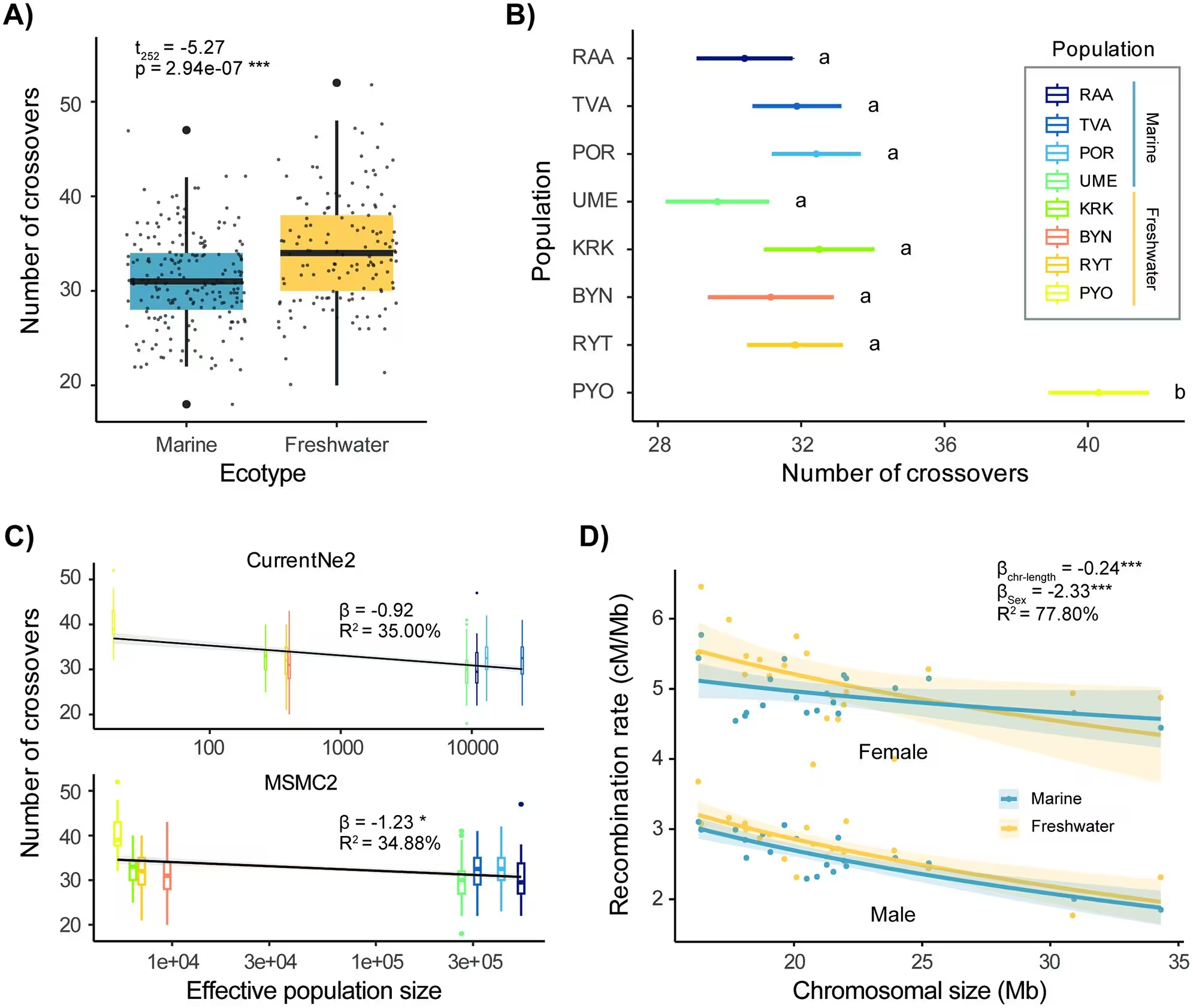
The study is available published in PLOS Genetics, providing a rare multi-population comparison that avoids the demographic biases common in simpler two-population models. The findings reveal that female fish consistently showed higher recombination rates than males across every single population, a phenomenon known as heterochiasmy, with female genetic maps measuring up to twice as long as male maps.
Why Small Populations Show Faster Genetic Shuffling
Population genetic theory traditionally dictates that natural selection operates less efficiently in small groups because random genetic drift washes out subtle advantages. Yet, the smallest freshwater pond population in the study, known as Pyörälampi (PYO), defied expectations by exhibiting a striking average of 40.3 maternal and paternal crossovers per meiosis. This count significantly outpaced the other populations, registering about 1.36 times more crossovers than the Umeå marine group.
The authors suggest that after colonizing freshwater ponds roughly 10,000 years ago, these isolated fish faced intense directional selection and accumulated heavy loads of harmful mutations. Evolving higher recombination rates may act as a vital survival mechanism, helping small, highly inbred populations generate novel trait combinations and purge deleterious genetic load more effectively.
The Surprising Breakdown Between Diversity and Recombination
In large outbred marine populations, the team observed a strong, steady positive correlation between nucleotide diversity and recombination rates across genomic windows. This pattern aligns with classic models where natural selection purges diversity in low-recombination zones through background selection or selective sweeps. However, that relationship weakened dramatically in small freshwater ponds and completely vanished in the severely inbred PYO population, where roughly 91 percent of the genome is estimated to be homozygous.
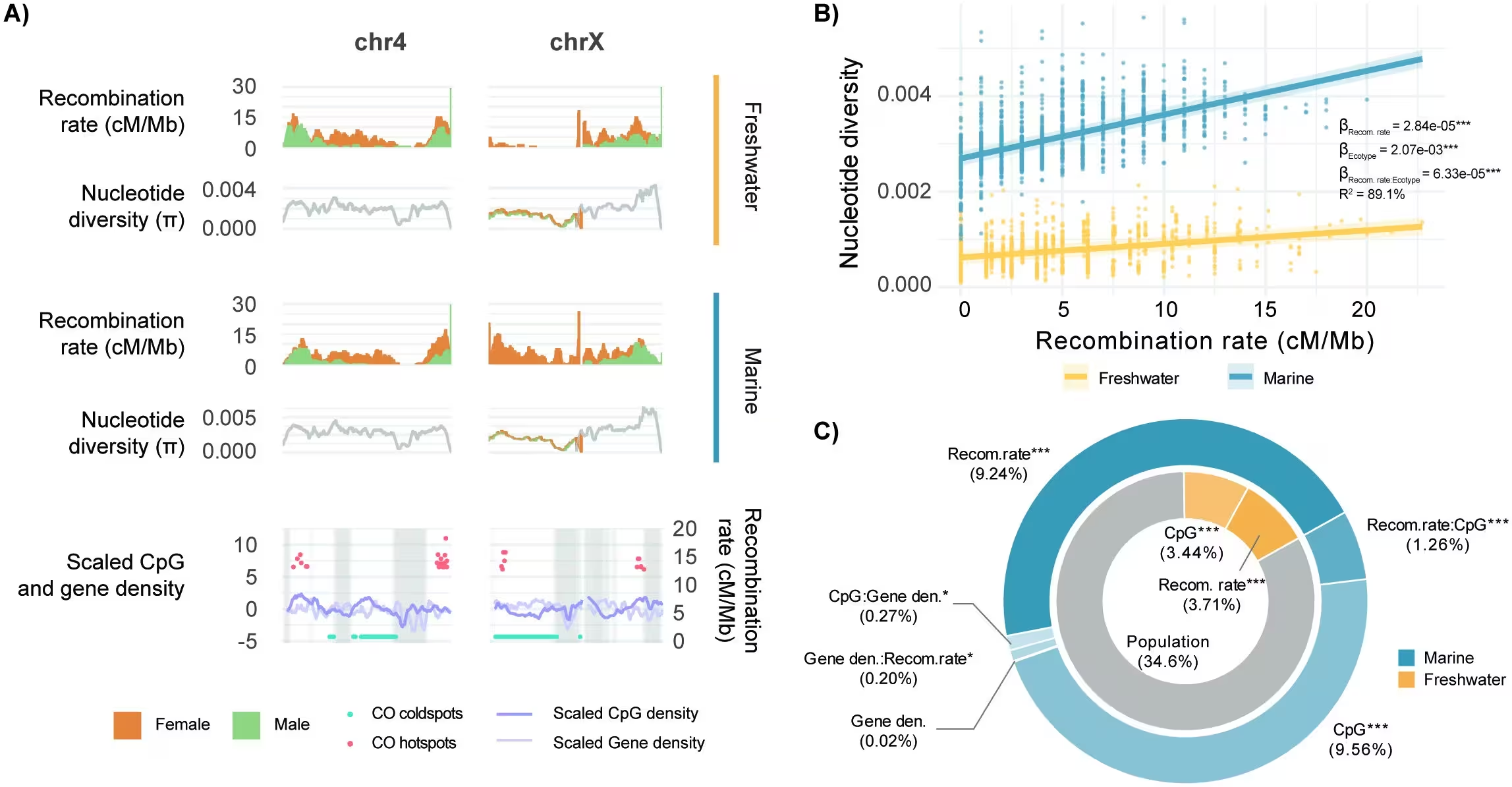
The data also highlighted that recombination events do not happen randomly across the genome. Crossovers strongly cluster near chromosome ends in regions rich in cytosine-guanine dinucleotide (CpG) content and sparse in gene density. Genome-wide association analyses further indicated that recombination in these fish is a polygenic trait governed by multiple loci rather than a single dominant master switch like the PRDM9 gene found in mammals.
Limitations and Open Questions for Future Research
While the study utilizes a pristine telomere-to-telomere reference genome, the researchers note certain technical constraints. Because the reference genome originates from a marine fish, physical distance measurements in freshwater populations might carry biases if freshwater genomes differ in total size. Furthermore, short-read sequencing struggles to resolve highly repetitive genomic regions, leaving room for future long-read sequencing to clarify the precise role of transposable elements in shaping recombination.
The research was published in PLOS Genetics on October 28, 2026.
This article has been fact checked for accuracy, with information verified against reputable sources. Learn more about us and our editorial process.
Last reviewed on .
Article history
- Latest version
Reference(s)
- Wang, Hongbo., et al. “Recombination rate and efficiency of linked selection in small and large stickleback populations.” PLOS Genetics, vol. 22, no. 10, October 28, 2026, pp. e1012335 Public Library of Science (PLoS), doi: 10.1371/journal.pgen.1012335. <https://doi.org/10.1371/journal.pgen.1012335>.
Cite this page:
- Posted by Faisal Qureshi