How Many Human Generations Have Lived Since Our Species Appeared 10 to 12 Thousand Revealed
Genetic discoveries reveal humanity’s ancestry extends far beyond recorded family trees, uncovering a vast lineage that far exceeds memory.

The most extensive recorded lineage on the planet belongs to the Chinese thinker Confucius, whose ancestry can be followed through more than 80 generations, spanning nearly three millennia from ancestors who lived in the eighth century B.C. to living descendants today. While this genealogical feat is remarkable, it represents only a sliver of human history. Homo sapiens has occupied the earth for about 300,000 years, according to the oldest fossil evidence, prompting a larger question: how many ancestral generations preceded those we can actually name?
Answering that query requires two key inputs, says Matthew Hahn, a population geneticist at Indiana University Bloomington. First, the duration of our species’ existence; second, the typical generation interval—the average period between a parent’s birth and that of their child. Dividing the species’ age by the interval yields a ballpark figure for the number of generations, though the exact count hinges on the interval assumed.
Defining a Human Generation Span
A generation interval is not a static calendar figure; it reflects the age at which people tend to become parents, a metric that varies with era, geography, and culture. Because men often have children later than women, the combined average rises when both sexes are considered together.
Historical documentation offers some of the clearest benchmarks. A 2003 analysis of Icelandic family records, compiled from centuries of church and civil data by deCODE Genetics, found an average interval of 30.3 years in Iceland over the previous three centuries.
A later 2005 investigation of European women who gave birth between 1960 and 2000 reported a slightly lower mean of 29.1 years. Both numbers suit recent history, but they cannot be projected far enough back to encompass the full timeline of Homo sapiens, as written records do not extend that far.
Genomic Signals Reveal Generation Times Over Two Hundred Fifty Thousand Years
To reach deeper into the past, scientists turned to the human genome, which preserves a record spanning hundreds of thousands of years. A 2023 study in Science Advances, led by Hahn, reconstructed generation intervals across the last 250,000 years by examining how the composition of genetic mutations transmitted from parent to child changes with parental age. Older parents imprint a distinct mutation pattern compared with younger parents, allowing researchers to infer approximate parental ages from mutation signatures.
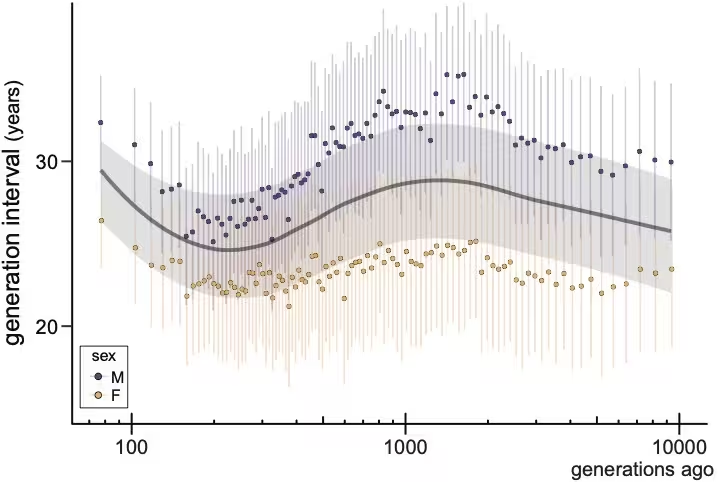
“If you know the mutation types that individuals pass to their offspring according to their age, and you have a collection of mutations, you can estimate how old the mixture of individuals was,” Hahn explained. His team calibrated the model using a 2017 Icelandic parent study and a 2020 analysis that dated millions of contemporary mutations, sorting them by age to derive generation intervals for successive time periods.
The analysis produced an average interval of 26.9 years over the entire 250,000‑year stretch, with fathers averaging 30.7 years and mothers 23.2 years. Though the interval fluctuated rather than remaining constant, applying it to the roughly 300,000‑year existence of Homo sapiens suggests about 11,152 successive generations since our species first emerged.
Why the Generation Count Varies
Not all experts converge on a single figure. Evolutionary biologist Moisès Coll Macià of the Institute of Evolutionary Biology in Barcelona notes that a 26.9‑year average is “not unimaginable,” but he prefers to frame the result as a range instead of a precise number.
For the lower bound, Coll Macià points to chimpanzees, our closest living relatives, which have an estimated generation interval of roughly 24.6 years according to a 2012 PNAS paper. Because humans and chimps share a common ancestor dating back to the Miocene (between 23 million and 5 million years ago), it is reasonable to assume that early human generations fell somewhere between the pace of modern chimps and that of present‑day humans.
At the upper end, he cites a 2016 PNAS study that used Neanderthal DNA embedded in ancient and modern genomes to estimate generation intervals over the past 45,000 years, arriving at values between 26 and 30 years.
Applying those bounds modestly adjusts the total count. Using a 30‑year interval yields at least 10,000 generations, while a 24.6‑year interval pushes the estimate up to roughly 12,195 generations.
This article has been fact checked for accuracy, with information verified against reputable sources. Learn more about us and our editorial process.
Last reviewed on .
Article history
- Latest version
Reference(s)
- Wang, Richard J.., et al. “Human generation times across the past 250,000 years.” Science Advances, vol. 9, no. 1, January 6, 2023 American Association for the Advancement of Science (AAAS), doi: 10.1126/sciadv.abm7047. <https://www.science.org/doi/10.1126/sciadv.abm7047>.
Cite this page:
- Posted by Elizabeth Taylor