AI Detects Solar Active Regions Up to 9 Hours Before They Appear Boosting Space Weather Alerts
AI model spots faint signals of emerging solar active regions up to 9.24 hours before they appear, boosting space weather forecasting.
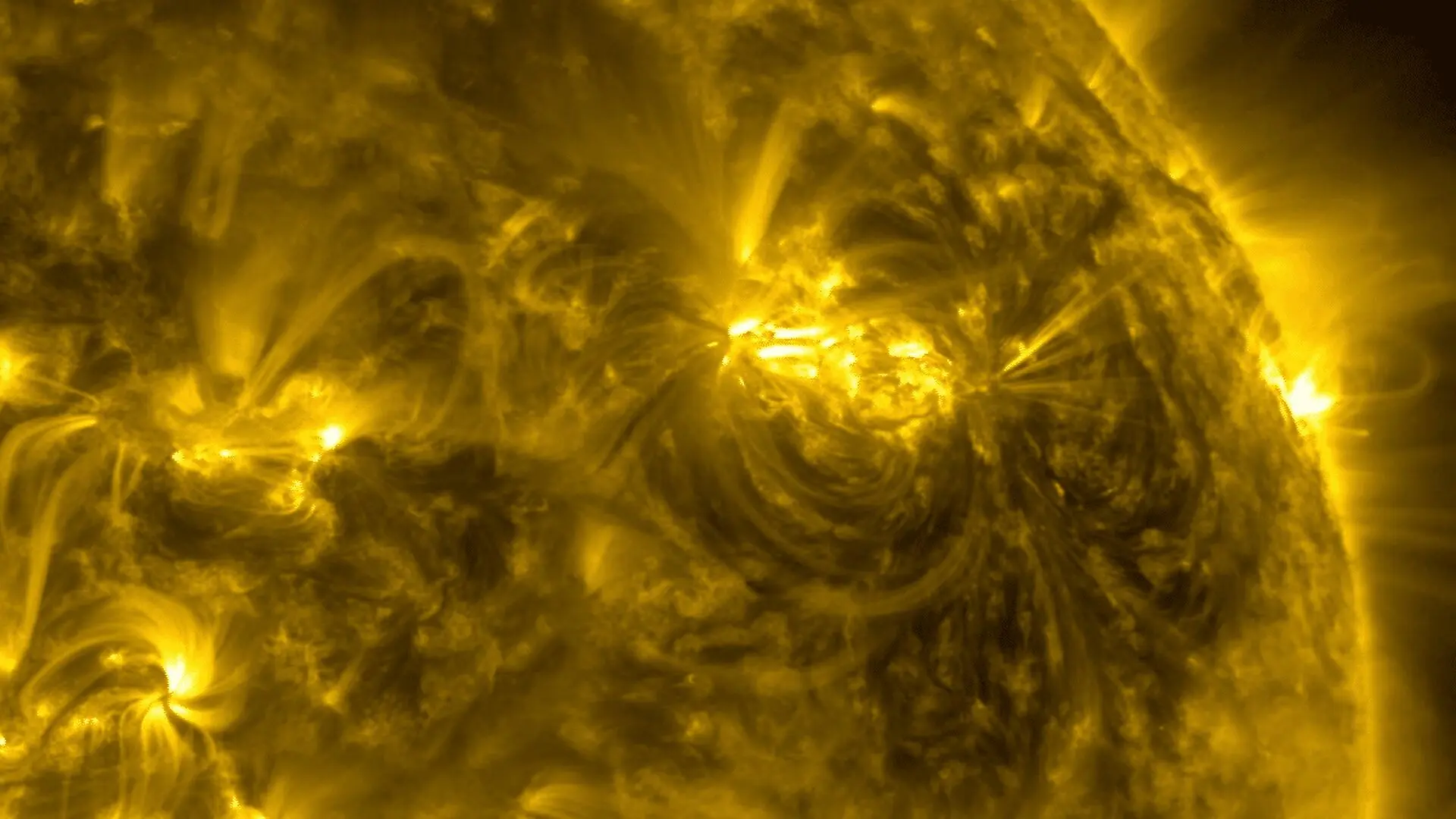
A machine‑learning model dubbed EarlyDetect has been shown to identify the faint precursors of new solar active regions roughly 9.2 hours before they become visible on the Sun’s photosphere, according to a study in the Journal of Geophysical Research: Machine Learning and Computation.
AI System Anticipates Solar Active Regions Hours Ahead
Solar magnetic structures originate deep within the Sun and gradually rise toward the surface, a process that can take several hours before manifesting as sunspots or other magnetic concentrations. By jointly analysing acoustic‑wave power maps and magnetic‑field measurements from NASA’s Solar Dynamics Observatory (SDO), the researchers trained EarlyDetect to spot the subtle signatures that precede visible emergence. The model ingests hourly acoustic power data alongside magnetic observations generated by the spacecraft’s Helioseismic and Magnetic Imager (HMI), which records full‑disk images every 45 seconds.
“The most valuable thing this work shows is that we can use machine learning to predict when solar active regions will emerge in advance,” said Jonas Tirona, an undergraduate researcher at NJIT and the study’s corresponding author. “That early warning could allow satellite communications companies or power grid companies to prepare and potentially mitigate damage from solar storms.”
Peering Beneath the Sun’s Surface with Helioseismology
Because the earliest stages of magnetic‑field emergence cannot be observed directly, the team turned to helioseismology—the study of solar oscillations—to infer internal changes. Acoustic waves travelling through the Sun are altered by rising magnetic structures, producing minute variations in wave patterns that can be captured by HMI. EarlyDetect combines these acoustic cues with concurrent magnetic‑field data, seeking correlations that traditional analysis might miss.
“The main difficulty is that an active region begins developing beneath the sun’s visible surface, where we cannot directly observe the magnetic structure,” explained Alexander Kosovichev, distinguished professor of physics at NJIT and co‑principal investigator. “Instead, we’re looking for very small changes in the magnetic field and in the pattern of acoustic waves continually traveling through the sun. It’s more like detecting a slight change in rhythm within a very noisy orchestra.”
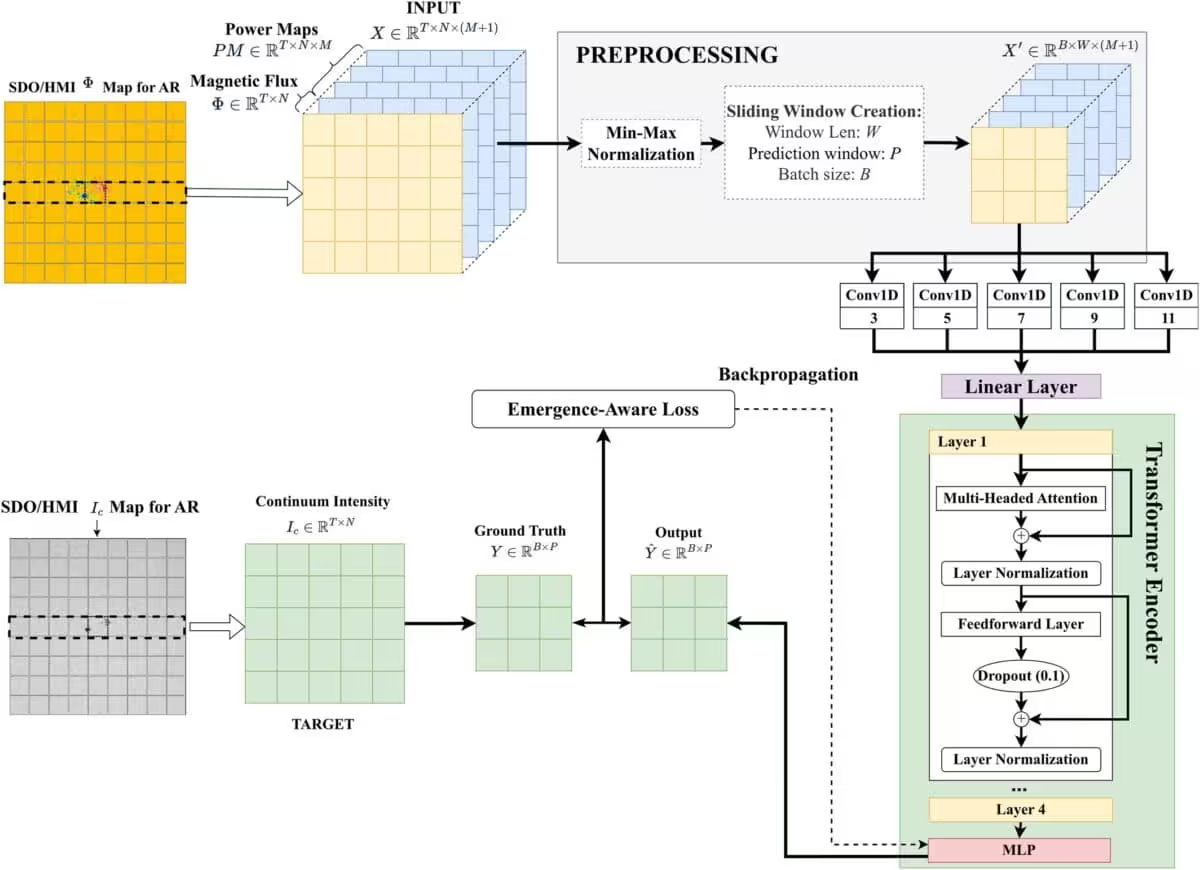
Unexpected Data‑Processing Challenge Reveals Hidden Signals
During model development, the researchers discovered that a filtering step meant to suppress noise inadvertently erased the very faint fluctuations EarlyDetect relied on. The finding, detailed in the Journal of Geophysical Research: Machine Learning and Computation, forced a reassessment of common preprocessing assumptions.
“That surprised us most,” said Kosovichev. “We initially expected it to help isolate useful short‑timescale patterns. Instead, it averaged away the very faint fluctuations that provided the earliest warning.” Tirona likened the effect to conventional noise‑cancellation techniques that can unintentionally remove subtle but informative signals.
The team ultimately concluded that preserving these low‑amplitude variations is essential for reliable early‑emergence detection, a lesson that may influence future solar‑data machine‑learning projects.
EarlyDetect Achieves Average 9‑Hour Advance Warning
When evaluated on a set of active regions excluded from training, EarlyDetect identified precursor signatures an average of 9.24 hours before the regions became observable. This lead time outperformed a baseline Transformer architecture and a prior benchmark method. The authors caution that the model is not yet ready for operational deployment; false positives still occur, and some emergences are only flagged after they have begun.
Importantly, the ability to forecast region emergence does not equate to predicting solar flares or coronal mass ejections, many of which never erupt despite the presence of an active region. Nonetheless, extending the warning horizon could prove valuable for satellite operators, communication networks, and power‑grid managers if future systems can link emergence forecasts to reliable eruption predictions.
“Machine learning hasn’t been widely applied to solar activity forecasting yet,” noted Mengjia Xu, assistant professor of data science at NJIT and principal investigator. “Our work shows that advanced machine learning models can open new possibilities for future space‑weather prediction.”
This article has been fact checked for accuracy, with information verified against reputable sources. Learn more about us and our editorial process.
Last reviewed on .
Article history
- Latest version
Reference(s)
- Tirona, Jonas., et al. “Forecasting Continuum Intensity for Solar Active Region Emergence Prediction Using Transformers.” Journal of Geophysical Research: Machine Learning and Computation, vol. 3, no. 4, August 14, 2026 American Geophysical Union (AGU), doi: 10.1029/2025JH001207. <https://agupubs.onlinelibrary.wiley.com/doi/10.1029/2025JH001207>.
Cite this page:
- Posted by Asif Iqbal