Proba-3 Creates Artificial Solar Eclipse Hours Before Europe’s Total Eclipse
ESA’s Proba‑3 pair generated an artificial solar eclipse in orbit, just hours before the Moon’s total eclipse blanketed parts of Europe.
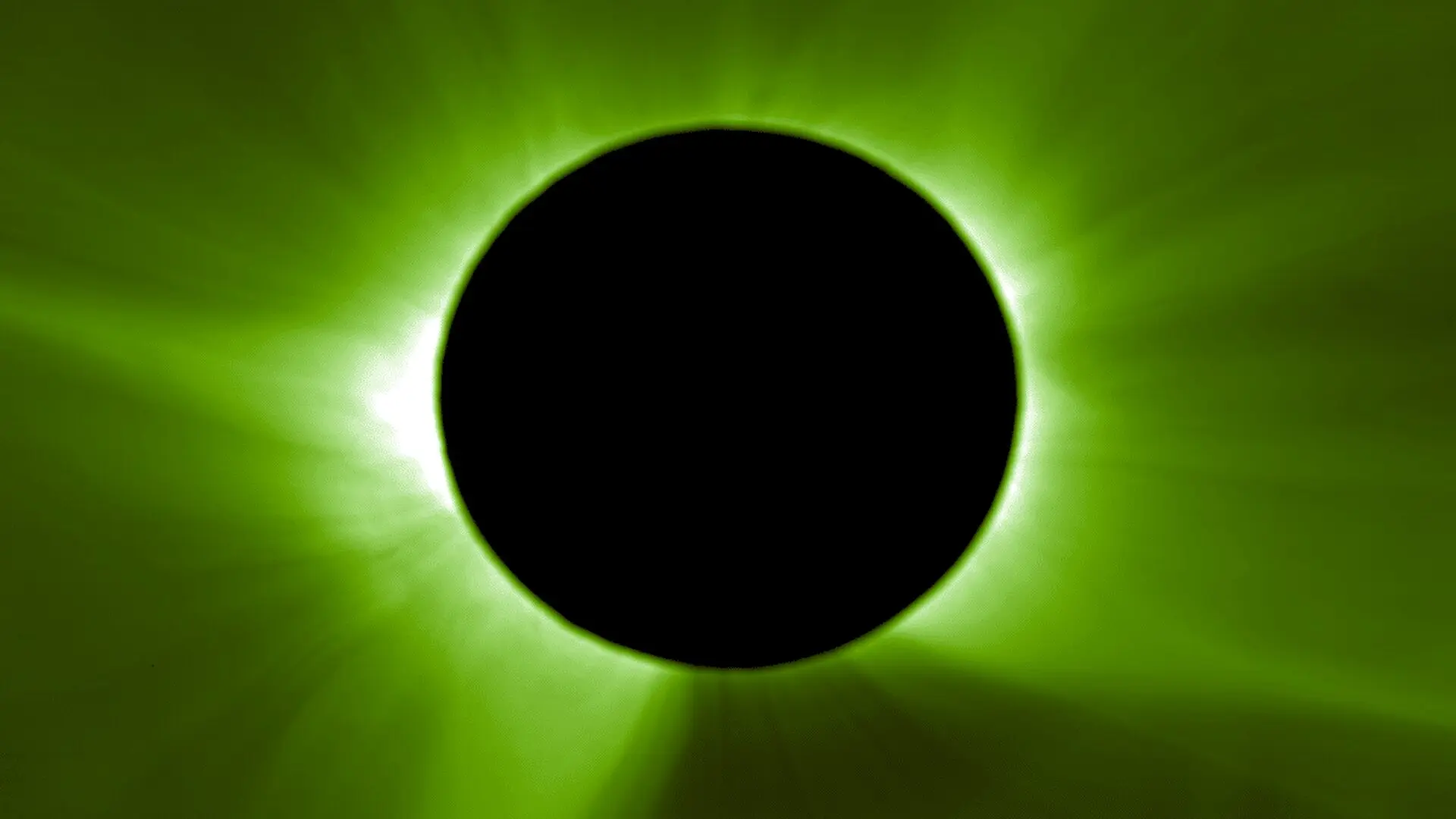
On the morning of 12 August 2026, ESA’s Proba‑3 mission generated an artificial solar eclipse at an altitude of roughly 60 000 km, capturing a view of the Sun’s faint inner corona just hours before a natural total eclipse swept across Europe.
Artificial Eclipse Highlights Hidden Solar Structures
The ESA‑released picture shows the solar disk obscured by a dark circular disc, while delicate green filaments extend into the surrounding darkness. Those filaments belong to the Sun’s inner corona, a region that normally disappears beneath the brilliance of the photosphere.
Processing the image with a green filter reproduces how ground‑based observers would see the corona through the same colour filter, allowing the faint structures to stand out against the blackness of space.
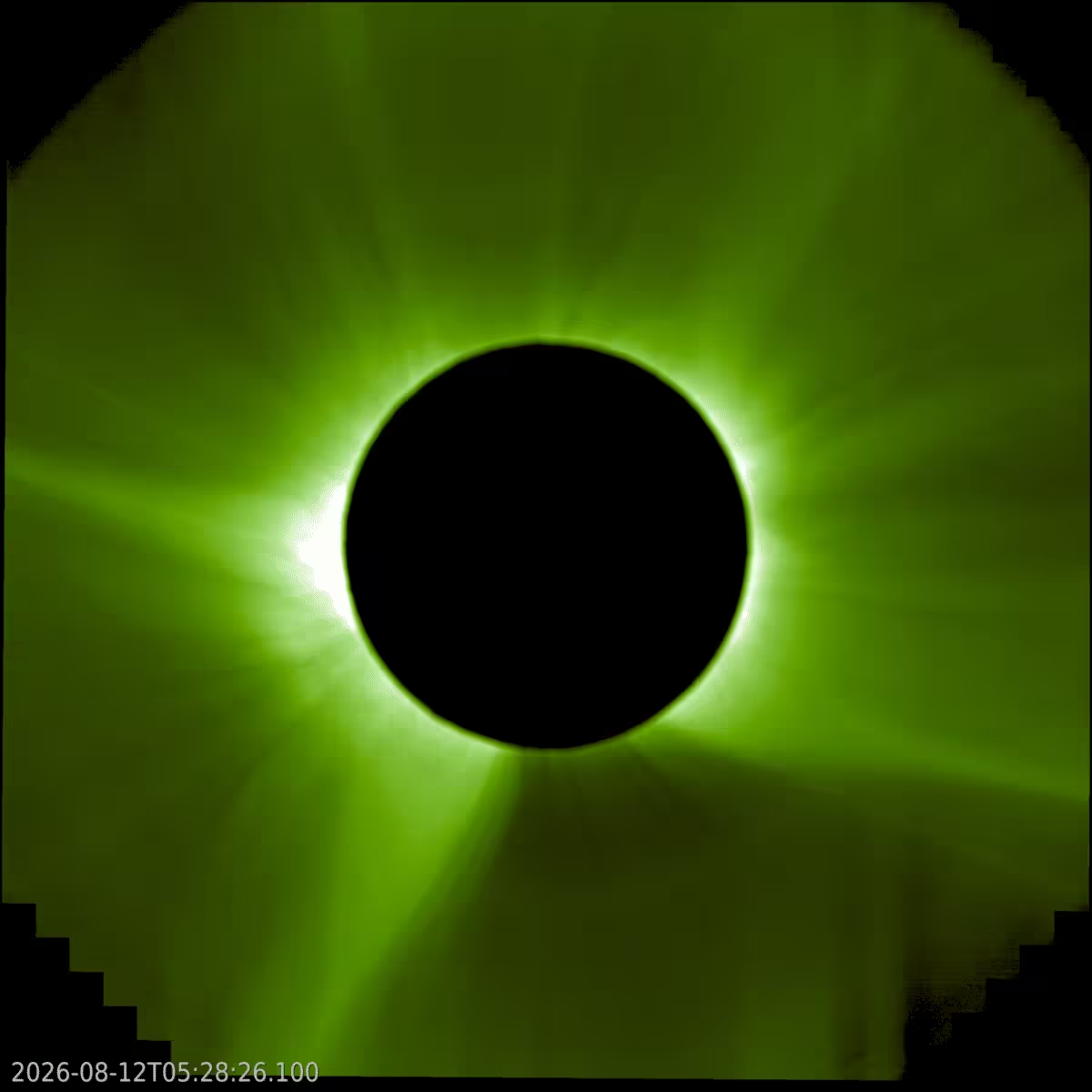
ESA notes that the picture was taken just a few hours before the Moon’s shadow reached Europe, creating a rare side‑by‑side comparison between a spacecraft‑generated eclipse and the natural event visible from the ground.
Proba‑3’s Twin‑Spacecraft Strategy Enables Repeatable Occultations
Unlike conventional coronagraphs that rely on an internal occulting disk, Proba‑3 separates its functions between two spacecraft flying in a tightly controlled formation about 150 m apart. The “Occulter” spacecraft positions itself directly between the Sun and the “Coronagraph” spacecraft, mimicking the Moon’s role in a total eclipse.
This geometry dramatically reduces diffraction effects, granting the coronagraph an uninterrupted view of the corona for extended periods. The approach also means the mission can recreate eclipse‑like conditions on demand, without waiting for a favorable Sun‑Moon‑Earth alignment.
Researchers use the data to probe the solar corona, the outer atmosphere that fuels eruptions and streams charged particles capable of disrupting satellites, communication networks, and other Earth‑based technologies.
In a fortuitous geometric coincidence, Proba‑3 had observed the Sun from the opposite side roughly two weeks earlier. Because the Sun rotates about half a turn in that time, the earlier view offered a useful, though not perfect, prediction of the coronal structures present on 12 August.
Natural Moon Completes a Rare Double Eclipse
Shortly after the artificial occultation, the Moon passed through Proba‑3’s field of view, briefly adding the natural satellite to the observation geometry. ESA described the sequence as a “double eclipse”: first the spacecraft‑borne occulter blocked the Sun, then the Moon entered the same line of sight.
This alignment underscores the flexibility of Proba‑3’s formation‑flying technique. While a conventional coronagraph depends on a single instrument’s internal mask, Proba‑3’s external occulter placed 150 m away achieves superior imaging performance and can be reproduced whenever needed.
This article has been fact checked for accuracy, with information verified against reputable sources. Learn more about us and our editorial process.
Last reviewed on .
Article history
- Latest version
Reference(s)
- “Proba-3’s eclipse hours before totality in Europe.” <https://www.esa.int/ESA_Multimedia/Images/2026/08/Proba-3_s_eclipse_hours_before_totality_in_Europe>.
Cite this page:
- Posted by Aisha Ahmed