Bow Shocks in Helix Nebula Reveal How Dying Star’s Debris Disappears Into Space
New Helix Nebula images show stellar debris slowly breaking down and rejoining interstellar space, offering fresh insight into nebular evolution.
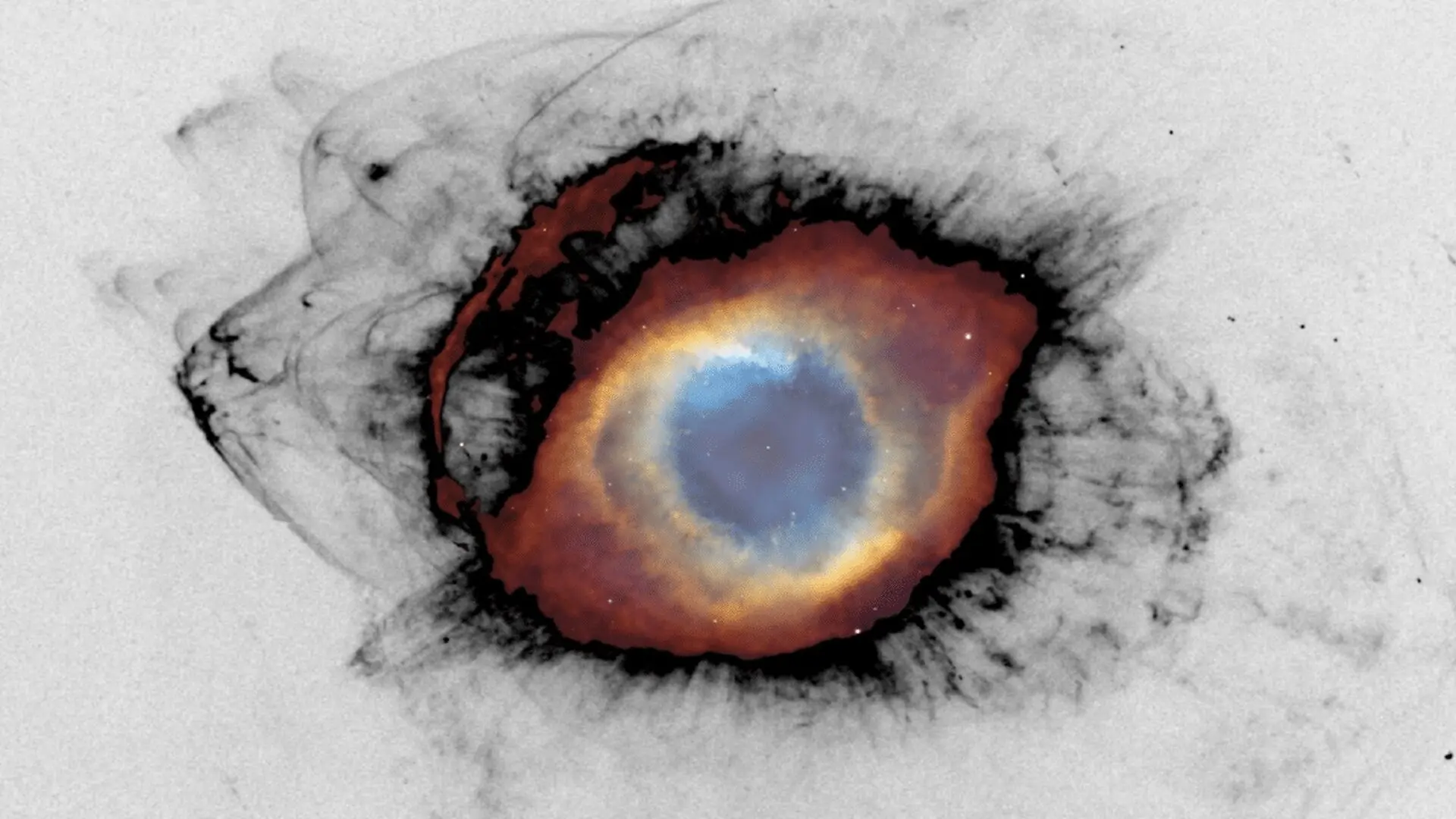
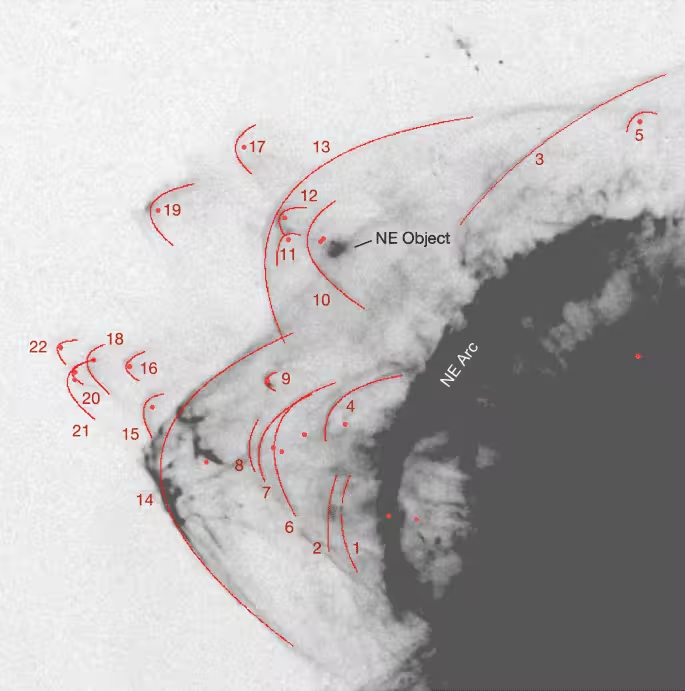
A team of astronomers has obtained an unprecedented glimpse of a dying star’s final moments, documenting how fragments of expelled material are torn apart and re‑absorbed into the surrounding galaxy. The observations focus on the faint outer halo of the Helix Nebula, roughly 650 light‑years from Earth, where 22 distinct bow‑shaped shock fronts trace the disintegration of stellar debris.
Faint Halo Unveils a Network of Bow Shocks
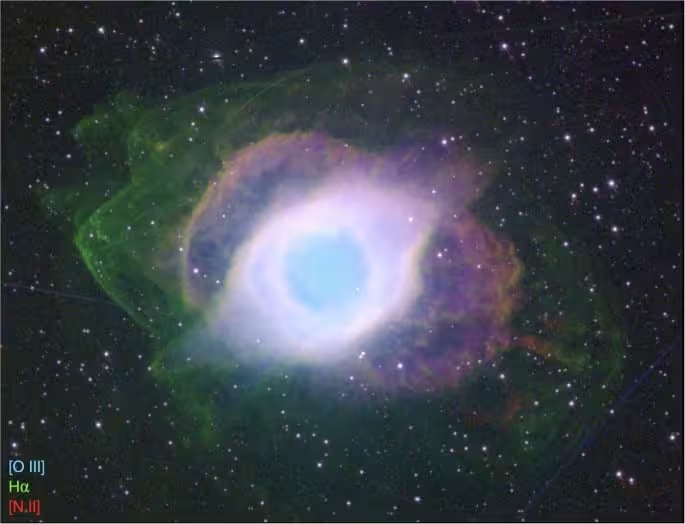
The Helix Nebula is a classic planetary nebula created as a Sun‑like star exhausts its nuclear fuel and ejects its outer layers, leaving a dense white dwarf at its core. While most studies have concentrated on the bright inner region, new deep imaging has reached far into the nebula’s extremely dim outer envelope, revealing structures that are invisible to conventional surveys.
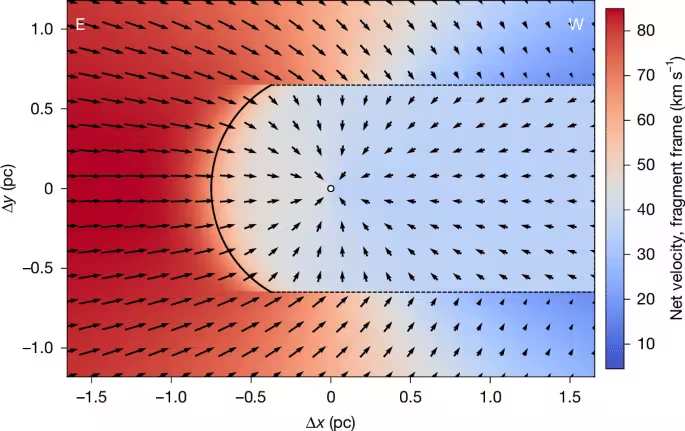
These bow‑shaped arcs behave like the wake of a boat moving through water, but the “boat” in this case is a compact clump of stellar debris racing through an almost empty interstellar medium. The shock fronts illuminate otherwise invisible material, allowing researchers to map the distribution and evolution of the fragments.
Closer to the central white dwarf, the shocks appear large, narrow, and sharply defined. Further out, they become progressively smaller, more diffuse, and increasingly fragmented, suggesting a gradual loss of cohesion as the clumps encounter the surrounding gas.
“We are seeing material shed near the end of a star’s life being broken apart and returned to the galaxy,” said van Dokkum, the Sol Goldman Family Professor of Astronomy and professor of physics in Yale’s Faculty of Arts and Sciences and lead author of the study.
Van Dokkum also participates in the Dragonfly Focused Research Organization, a nonprofit dedicated to building innovative astronomical instrumentation.
Fragment Lifetimes and the Cycle of Galactic Matter
The study, published in Nature, uses the distribution of these shocks to infer how long individual debris fragments survive. The team estimates that a fragment remains coherent for roughly 10,000 years before turbulent interactions shred it into the diffuse interstellar medium.
This relatively brief lifespan explains why such a transitional phase has been elusive in previous observations; most astronomical structures persist far longer, while the identifiable debris of the Helix fades quickly once exposed to the ambient gas.
“That handoff—from recognizable stellar debris to the diffuse gas between the stars—has been very difficult to observe,” van Dokkum said. “Far in the future, the sun will go through a similar process, and its material will enter the same cycle.”
The Helix therefore offers a rare window onto a stage that our own Sun is predicted to experience billions of years from now, when it will shed its outer layers and contribute fresh material to the galactic reservoir that fuels future star and planet formation.
MOTHRA Telescope and an Unexpected Find
The discovery originated from a calibration exposure rather than a targeted search. Researchers selected the Helix Nebula as a well‑studied benchmark for testing the capabilities of MOTHRA, the Modular Optical Telephoto Hyperspectral Robotic Array currently under construction at El Sauce Observatory in Chile’s Rio Hurtado Valley.
MOTHRA’s design diverges from traditional single‑mirror telescopes by employing a massive array of telephoto lenses—eventually totaling 1,140 units—combined with specialized filters and advanced computing to capture extremely faint, diffuse ionized gas across wide fields.
MOTHRA builds on technology pioneered by the Dragonfly Telescope, an instrument co‑developed by van Dokkum and co‑author Roberto Abraham. The Dragonfly system, based in New Mexico, combines multiple lenses to detect ultra‑low surface‑brightness features. By scaling this concept up, MOTHRA aims to survey faint emission over even larger sky areas.
“We thought we were taking a calibration image of one of the best‑known nebulae in the sky,” said study co‑author Roberto Abraham of the Dragonfly Focused Research Organization and the University of Toronto. “Instead, we found this extraordinary network of bow‑shaped structures. It was immediately clear that the faint outer Helix was telling us a story that had largely been missed.”
The serendipitous nature of the find underscores the power of wide‑field, low‑surface‑brightness observations to reveal hidden complexity in familiar astronomical objects, offering fresh insights into the lifecycle of stellar material.
This article has been fact checked for accuracy, with information verified against reputable sources. Learn more about us and our editorial process.
Last reviewed on .
Article history
- Latest version
Reference(s)
- van Dokkum, Pieter. “Numerous bow shocks in the outer Helix Nebula - Nature.”, vol. 656, no. 8127, pp. 334-337. Nature, doi: 10.1038/s41586-026-10724-z. <https://www.nature.com/articles/s41586-026-10724-z>.
Cite this page:
- Posted by Aisha Ahmed