Ancient Lamprey Brain Map Shows 450‑Million‑Year‑Old Blueprint for Modern Vertebrate Brains
A new 3D lamprey brain atlas shows vertebrate brain foundations appeared hundreds of millions of years earlier than thought.

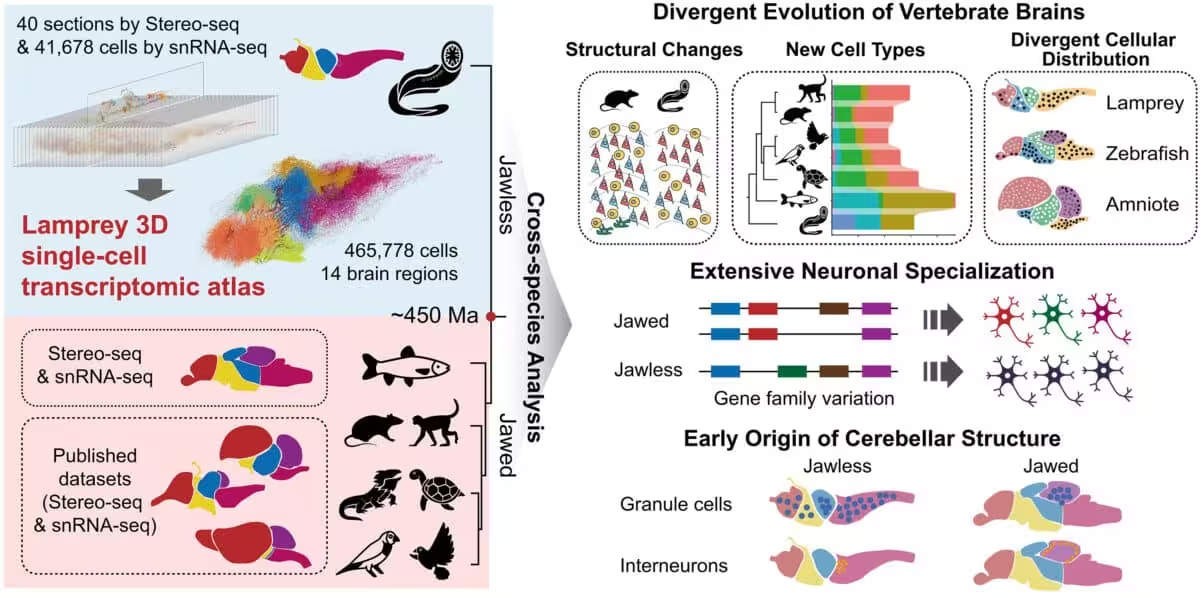
A collaborative effort has produced the first three‑dimensional, single‑cell map of the brain of the Far Eastern brook lamprey (Lethenteron reissneri), shedding light on the molecular architecture of vertebrate brains that existed roughly 450 million years ago. The atlas, published in Science, reveals that many of the genetic components governing modern brain function were already in place during the early stages of vertebrate evolution.
Comprehensive Cellular Blueprint of a 450‑Million‑Year‑Old Brain
Researchers from the Kunming Institute of Zoology, the Chinese Academy of Sciences, BGI‑Research and Liaoning Normal University combined high‑resolution spatial transcriptomics with single‑nucleus RNA sequencing to chart every major neuronal group within the lamprey brain. By assigning gene‑expression profiles to individual cells, the team reconstructed a detailed three‑dimensional framework that serves as a molecular fingerprint of one of the most ancient living vertebrate brains.
Lampreys branched from the lineage that gave rise to jawed vertebrates around 450 million years ago, and their body plan has remained relatively unchanged since then. This evolutionary stability makes them an ideal proxy for studying the ancestral vertebrate nervous system, and the new atlas provides a reference point for tracing the emergence of increasingly complex brains across the vertebrate tree.
Molecular Parallels Between Lamprey and Mammalian Brains
A comparative analysis with the mouse brain, reported in Science, uncovered strikingly similar gene‑activity patterns across several brain regions despite the vast evolutionary distance. These shared molecular signatures imply that the common ancestor of jawless and jawed vertebrates already possessed a surprisingly organized and genetically complex neural architecture. Rather than emerging from a rudimentary collection of neurons, the earliest vertebrate brain appears to have contained many of the specialized cellular programs that later diversified among fish, reptiles, birds and mammals.
The results challenge the prevailing notion that intricate brain organization arose gradually after vertebrates achieved higher evolutionary status. Instead, the foundational genetic instructions for brain development were likely established early and have persisted, albeit modified, throughout vertebrate history.
Evidence of Multifunctional Neurons in Ancient Lineages
The atlas identified a distinct group of cells termed anamniote‑enriched neurons (AEN), which display the capacity to transmit both excitatory and inhibitory signals—a form of cellular “moonlighting.” Similar multifunctional neurons were also detected in zebrafish, but they are rare among amniotes such as mammals, birds and reptiles. This pattern suggests that later vertebrate lineages shifted toward a division of labor among specialized neuronal types, a transition possibly driven by an ancient whole‑genome duplication that supplied extra genetic material for functional specialization.
Proto‑Cerebellar Cells Precede the Classic Cerebellum
Although lampreys lack a well‑defined cerebellum, the researchers found clusters of cells that closely resemble cerebellar neurons, dispersed within a primitive cerebellum‑like zone. This observation indicates that the cellular groundwork for the cerebellum emerged long before the fully organized structure appeared in later vertebrates. The finding supports the broader evolutionary concept that new organs often arise by repurposing existing cellular programs rather than inventing entirely novel components.
A Living Relic Illuminates Vertebrate Brain Evolution
By merging single‑cell genomics with three‑dimensional reconstruction, the study offers a powerful resource for exploring the origins of vertebrate neural complexity. It underscores that core features such as regional brain organization, diverse neuronal populations and intricate genetic regulation were established early in vertebrate history. Subsequent evolutionary branches, however, continued to innovate: lampreys retained unique neuronal types and large Müller cells, while mammals later developed a layered cerebral cortex associated with higher cognitive functions.
Together, these insights provide a more nuanced picture of how an ancient brain plan diversified into the remarkable array of vertebrate brains that inhabit the planet today, furnishing a valuable framework for future investigations into both evolutionary biology and the developmental origins of the human brain.
This article has been fact checked for accuracy, with information verified against reputable sources. Learn more about us and our editorial process.
Last reviewed on .
Article history
- Latest version
Reference(s)
- Wu, Haixu., et al. “Lamprey 3D single-cell transcriptomics reveals ancestral and specialized features of the vertebrate brain.” Science, vol. 392, no. 6804, June 18, 2026 American Association for the Advancement of Science (AAAS), doi: 10.1126/science.aea2535. <https://www.science.org/doi/10.1126/science.aea2535>.
Cite this page:
- Posted by Elizabeth Taylor