AI Detects First Dormant Supermassive Black Hole Roaming 30,000 Light‑Years From Its Galaxy
A dormant supermassive black hole 30,000 light‑years from its galaxy’s center was exposed by a sudden violent outburst.
An international team of astronomers has identified a supermassive black hole roaming roughly 30,000 light‑years from the heart of its host galaxy—the first dormant black hole discovered at such a distance. The object was revealed only after it ripped apart an unsuspecting star, generating a fleeting flare that an artificial‑intelligence‑driven sky survey captured in late 2025. The results appear in The Astrophysical Journal Letters (July 27, 2026).
AI Scans the Sky and Spots a Stellar Destruction
Researchers employed the Zwicky Transient Facility (ZTF)—a pair of telescopes at Palomar Observatory that image the entire northern sky every two days—to feed an algorithm trained specifically on the light signatures of tidal disruption events (TDEs). Unlike conventional searches that focus on galactic nuclei, the program surveyed the full sky, allowing it to flag a bright, short‑lived flare three months after its launch in August 2025.
When the AI highlighted the event, designated TDE 2025abcr, the team mobilized additional instruments within hours. “It was a Saturday, and everyone dropped what they were doing to chase the signal,” recalled lead investigator Robert David Stein, a Neil Gehrels Prize Postdoctoral Fellow at the Joint Space‑Science Institute. “Finding a dormant black hole so quickly was astonishing.”
A Massive Black Hole Without a Host Galaxy
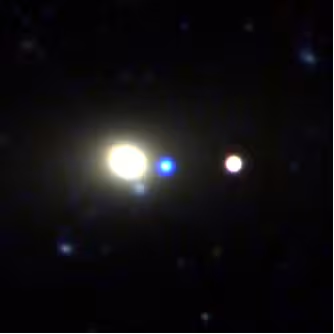
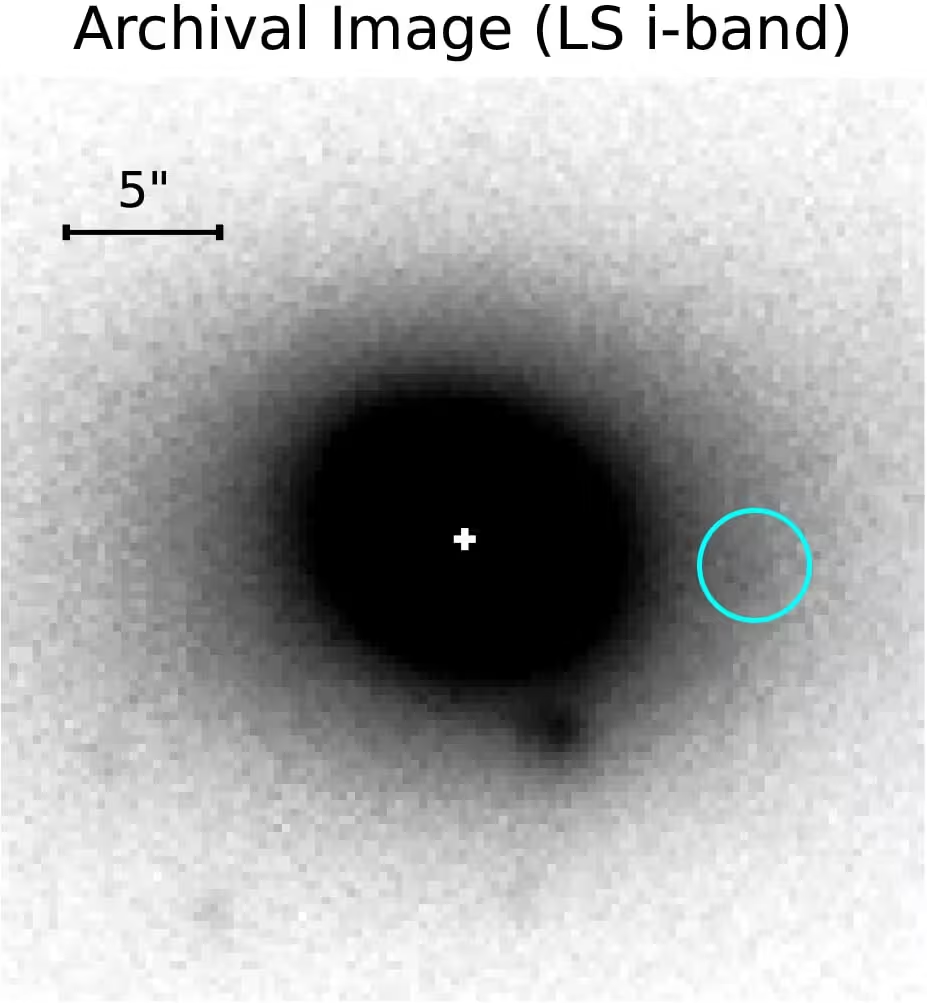
The black hole, whose mass rivals that of the Milky Way’s central behemoth, sits 9.3 kiloparsecs (≈ 30,000 light‑years) from its galaxy’s nucleus. Strikingly, no luminous galaxy surrounds the object, a fact that puzzled co‑author Sylvain Veilleux, professor of astronomy at the University of Maryland. “Seeing a black hole of this scale outside any visible galaxy is unexpected,” he noted.
The team proposes two scenarios rooted in past galaxy collisions. One envisions a massive galaxy that cannibalized a smaller companion, stripping away almost all of its stars and leaving behind only the compact core and its black hole. The alternative involves a chaotic three‑body interaction: a binary black‑hole system encounters a third black hole from another merger, and the resulting dynamics eject the smallest of the trio to the galaxy’s outskirts. Ongoing monitoring of the tidal disruption flare may help discriminate between these possibilities.
Broader Impact and Future Searches
“Most supermassive black holes we know are dormant, making them hard to spot,” said Suvi Gezari, associate professor of astronomy at the University of Maryland. “This discovery shows that machine‑learning techniques can open an entirely new window on wandering black holes, which will reshape our understanding of how galaxies and their central engines evolve.”
The finding also raises questions about the Milky Way itself. While the existence of wandering black holes in our own galaxy remains unconfirmed, Stein cautioned that encountering one within a human lifetime is unlikely. Nevertheless, the researchers plan to expand their AI‑driven hunt, aiming to map the population of off‑center black holes and refine models of galaxy assembly.
This article has been fact checked for accuracy, with information verified against reputable sources. Learn more about us and our editorial process.
Last reviewed on .
Article history
- Latest version
Reference(s)
- Stein, Robert., et al. “TDE 2025abcr: A Tidal Disruption Event in the Outskirts of a Massive Galaxy.” The Astrophysical Journal Letters, vol. 1006, no. 2, July 27, 2026, pp. L57 American Astronomical Society, doi: 10.3847/2041-8213/ae77f3. <https://iopscience.iop.org/article/10.3847/2041-8213/ae77f3>.
- “Zwicky Transient Facility Website.” <https://www.ztf.caltech.edu/>.
Cite this page:
- Posted by Farah Siddiqui