New Seismology Technique Could Map Deep Moon Ice for Future Missions
Scientists unveil a novel technique to detect hidden lunar ice, offering a fresh way to probe beneath the Moon’s surface.
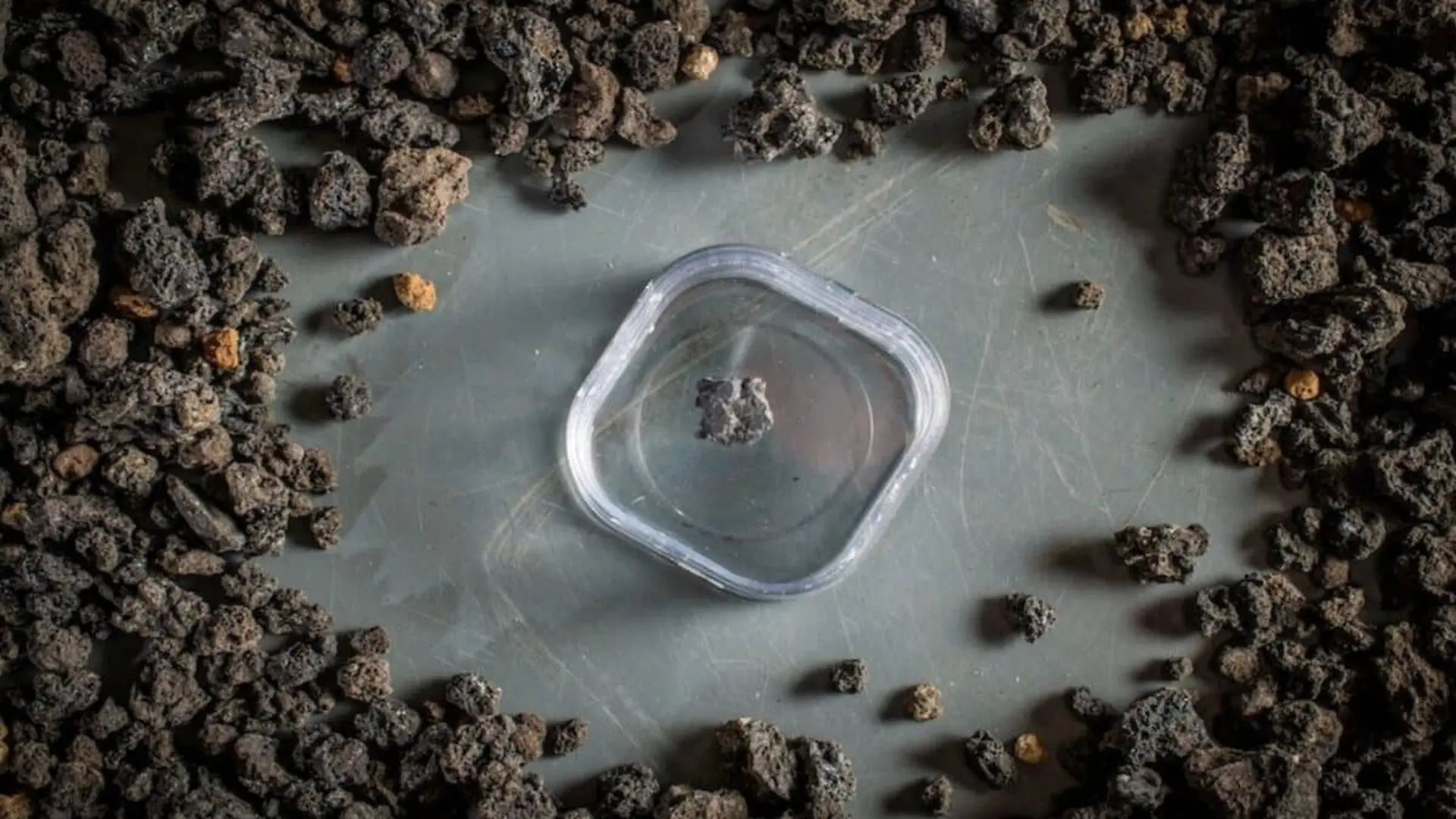
Researchers have unveiled a novel technique for locating frozen water beneath the Moon’s crust by tracking how seismic waves travel through lunar rock. Water is seen as a cornerstone for long‑term human presence on the lunar surface, and while recent observations hint at ice near the poles, the exact locations of the most extensive underground reservoirs remain uncertain. Identifying those deposits is a priority for upcoming robotic and crewed explorations.
The approach, detailed in Science Advances, brings together scientists from Lawrence Berkeley National Laboratory, the University of Maryland and the University of Hawaii. Their work shows that seismology can differentiate between icy and dry lunar material, offering a new pathway to detect subsurface ice.
Recreating Lunar Environments in a Cryogenic Test Chamber
The experiments were conducted inside the Frozen Regolith Observation and Sublimation Testbed (FROST), a vacuum‑cryogenic chamber built at Lawrence Berkeley National Laboratory. FROST reproduces the Moon’s near‑vacuum and sub‑zero temperatures while linking to the lab’s Advanced Light Source, where X‑ray microtomography captures microscopic changes in rock samples.
In the initial series of tests, Harrison Lisabeth and Nicholas Schmerr examined regolith simulant supplied by NASA’s Johnson Space Center. The synthetic material mimics lunar soil, allowing the team to observe how its internal structure evolves under lunar‑like conditions with varying ice content.
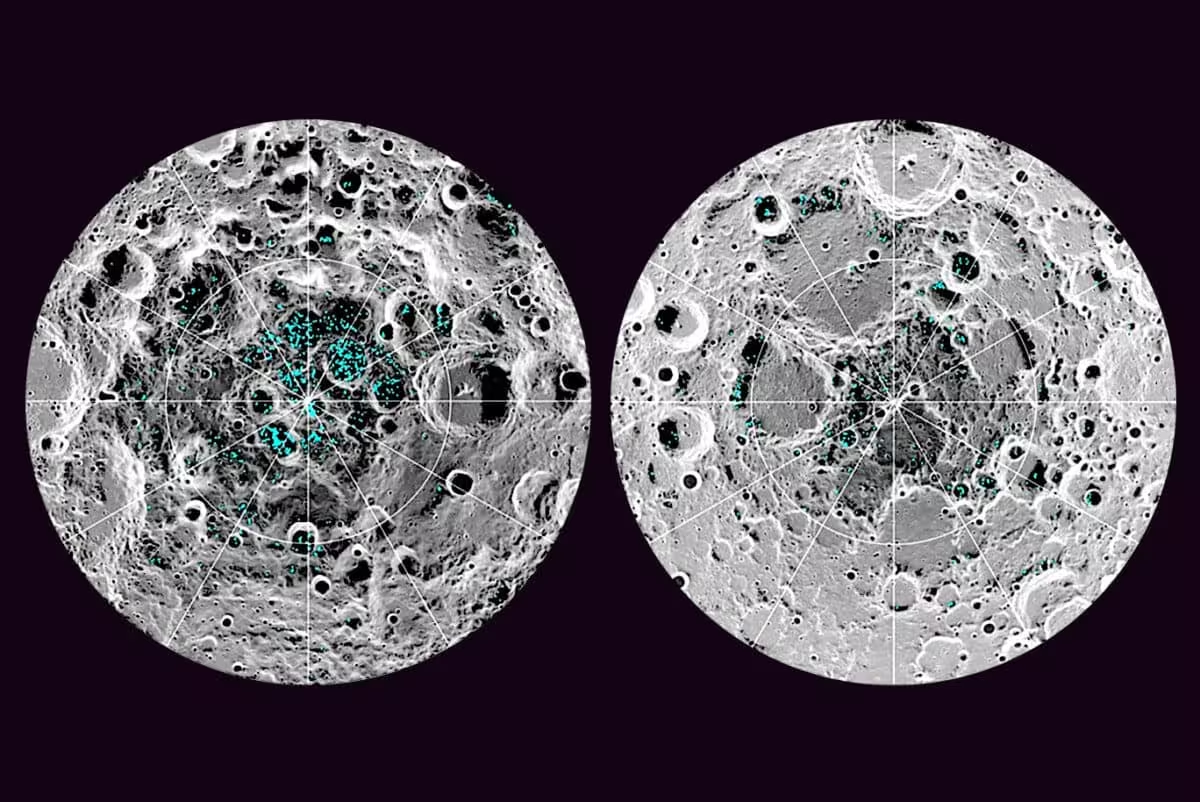
The tests showed clear seismic contrasts between ice‑rich and dry regolith. According to Lawrence Berkeley National Laboratory, these observations supply the rock‑physics data needed to interpret lunar subsurface behavior during future geophysical surveys.
“When NASA scientists want to perform geological surveys on the moon, they will need rock physics models to understand the fundamentals of how the subsurface behaves,” Lisabeth said. “But we didn’t have very good models until now because materials behave weirdly in the high vacuum and super cold environment of the moon.”
Merging Seismic, Satellite and Laboratory Insights
Matthew Siegler contributed models derived from orbital data to pinpoint regions where large ice reservoirs could persist over geological timescales, despite the threat of sublimation at higher temperatures.
Nicholas Schmerr built seismic simulations that describe how waves travel through different underground media. Those simulations were then integrated with the rock‑physics measurements obtained from the FROST experiments.
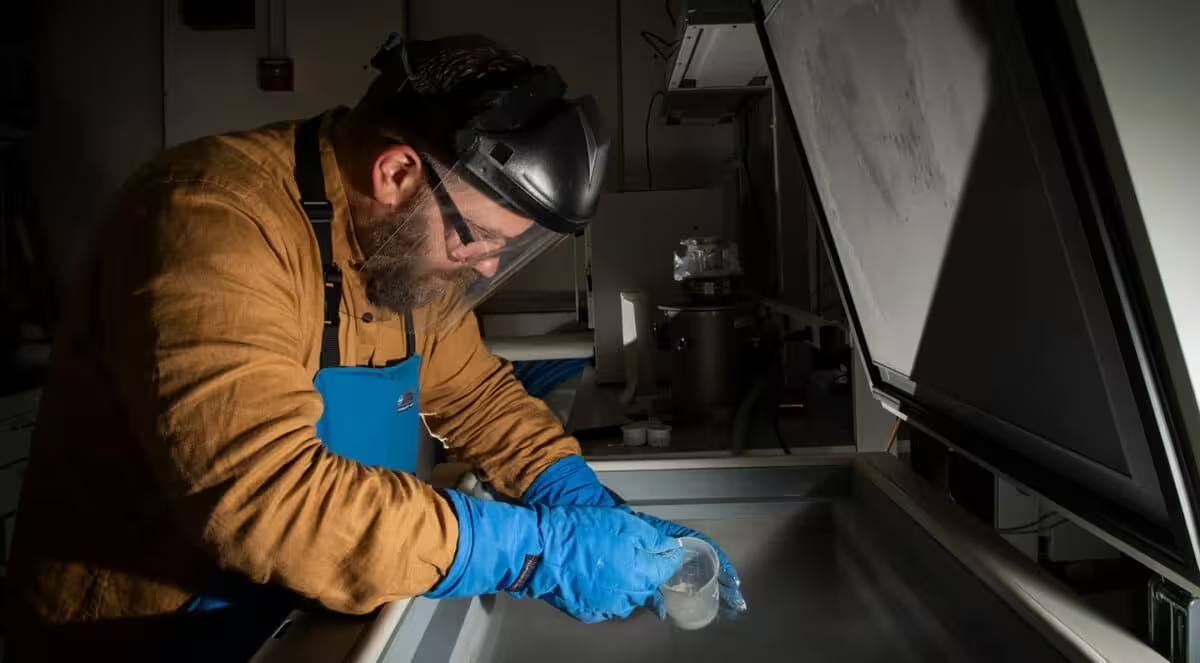
The combined framework, reported in Science Advances, can simulate lunar subsurface structures down to roughly 800 meters. The authors demonstrate that distinct ice formations generate unique seismic signatures, offering concrete hypotheses for upcoming lunar seismic surveys.
NASA’s VIPER Rover to Test the New Seismic Approach
The research team plans to apply these models during NASA’s Volatiles Investigating Polar Exploration Rover (VIPER) mission, which will probe the Moon’s south polar region with a suite of instruments designed to locate water ice.
One of VIPER’s tools is a percussive drill that generates seismic waves while retrieving samples. The rover also carries navigation accelerometers that can double as seismic sensors, recording the propagation of short‑frequency waves beneath the surface.
“Our model provides testable hypotheses to design seismic experiments looking for water on the Moon,” explained Schmerr. “We plan to use it when VIPER is delivered to the moon in the near future.”
Matthew Siegler noted that while VIPER’s existing instruments can sense ice within roughly the top meter of regolith, the seismic waves produced during drilling “might let us detect ice much deeper.” The mission could therefore deliver the first direct measurements of the Moon’s near‑surface properties using this method.
This article has been fact checked for accuracy, with information verified against reputable sources. Learn more about us and our editorial process.
Last reviewed on .
Article history
- Latest version
Reference(s)
- akovner, “Ice Ice Maybe: New Ways to Search for Frozen Water on the Moon.”, July 31, 2026 Lawrence Berkeley National Laboratory <https://newscenter.lbl.gov/2026/07/31/ice-ice-maybe-new-ways-to-search-for-frozen-water-on-the-moon/>.
- “Profile – Energy Geosciences Division.” <https://energygeosciences.lbl.gov/profile/hlisabeth/>.
- “Directory | Department of Geological, Environmental, and Planetary Sciences | University of Maryland.” <https://www.geol.umd.edu/nicholasschmerr>.
- “Matt Siegler - Planetary Science Institute.” Planetary Science Institute <https://www.psi.edu/staff/profile/matt-siegler/>.
- Lisabeth, Harrison P.., et al. “The seismic signature of lunar ice.” Science Advances, vol. 12, no. 31, July 31, 2026 American Association for the Advancement of Science (AAAS), doi: 10.1126/sciadv.adz7220. <https://www.science.org/doi/10.1126/sciadv.adz7220>.
- Cermak, Alicia. “VIPER - NASA Science.”, May 13, 2023 NASA <https://science.nasa.gov/mission/viper/>.
Cite this page:
- Posted by Farah Siddiqui