Engineers Race to Stabilize Spinning Satellite That Protects NASA’s Swift Observatory
NASA’s Swift-protecting spacecraft encounters a critical glitch, prompting engineers to work nonstop to restore full control.

A newly launched spacecraft intended to extend the scientific reach of NASA’s Neil Gehrels Swift Observatory encountered an unplanned spin shortly after reaching orbit, prompting a careful recovery effort by mission engineers. Early telemetry indicates that essential subsystems remain functional, but the outcome of the stabilization campaign will decide whether the satellite can fulfill its role as a backup for one of the most productive high‑energy astrophysics platforms.
Teams Deploy a Step‑by‑Step Stabilization Strategy
Within minutes of insertion into orbit, flight controllers observed the vehicle rotating faster than its design parameters, jeopardizing power generation, communications, and instrument pointing. Rather than executing abrupt corrective burns, the operations team prioritized a thorough assessment of the spacecraft’s status, planning incremental commands that account for its evolving orientation, power budget, and contact windows.
“Over the last 48 hours, the Katalyst team has worked to reduce LINK’s rotation while assessing current spacecraft functionality and its control system,” Katalyst representatives wrote.
The mission blog posted by Katalyst emphasizes a balance between urgency and caution, noting that every uplink must be tailored to the satellite’s present attitude and available energy. Incremental adjustments are standard practice in orbital recoveries, where even modest thruster firings can produce large changes in spin rate, making precision essential.
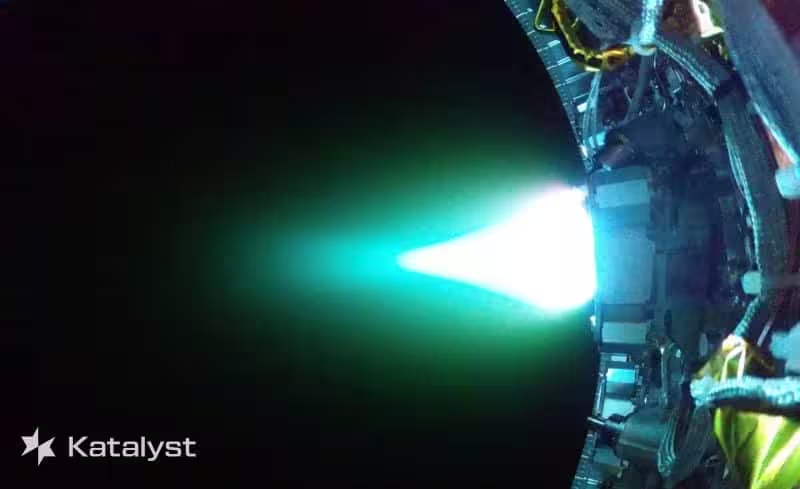
NASA Confirms Core Systems Remain Operational
Telemetry streams continue to report healthy battery levels, nominal temperatures, and functional communication hardware, easing concerns that an adverse attitude could starve the solar arrays of sunlight. NASA’s latest status update noted that the spacecraft is “power positive and in communication with the Katalyst team,” underscoring that the most critical resources are still intact.
“The spacecraft remains power positive and in communication with the Katalyst team,” NASA officials wrote in a Tuesday (July 28) update.
With reliable telemetry and sufficient power, engineers can continue to diagnose the anomaly, test recovery maneuvers, and gradually bring the vehicle back to a stable configuration. Historical precedents show that similar attitude disturbances have been resolved through disciplined engineering interventions.
We are not giving up yet. A lot of credit goes to the Katalyst Space and NASA teams working to recover the spacecraft, rendezvous with Swift, and boost the observatory.
— NASA Administrator Jared Isaacman (@NASAAdmin) July 30, 2026
This remains a very cool, very low-cost, high-potential, high-reward mission, and another step toward a more…
Scientific Stakes: Safeguarding Swift’s Legacy
The original Swift Observatory has been a workhorse for detecting gamma‑ray bursts, tracking black‑hole activity, and observing neutron‑star mergers since its launch. Its rapid repointing capability has enabled astronomers worldwide to capture fleeting high‑energy phenomena. The new satellite is designed to augment that capability, ensuring continuity of observations as Swift ages beyond its primary mission timeline.
A successful recovery would allow the vehicle to assume its intended role—supporting Swift’s high‑energy astrophysics program and preserving a critical element of NASA’s scientific infrastructure. While the spin anomaly introduces uncertainty, it does not preclude a positive outcome; many missions have overcome early‑stage technical glitches to deliver valuable science.

Outlook: Stabilization Efforts Will Shape Mission Destiny
In the coming days, controllers will continue to apply measured torque adjustments, closely monitoring each subsystem for signs of normal operation. Aggressive maneuvers are likely to be deferred until the root cause of the spin is fully understood and the control architecture proves reliable under command.
As long as communication links remain open, power generation stays positive, and engineering teams retain access to diagnostic data, the satellite stands a strong chance of returning to its planned trajectory. The space community and Swift’s scientific collaborators will be watching each update, hoping the recovery will secure the observatory’s future contributions to high‑energy astrophysics.
This article has been fact checked for accuracy, with information verified against reputable sources. Learn more about us and our editorial process.
Last reviewed on .
Article history
- Latest version
Cite this page:
- Posted by Farah Siddiqui