MAVEN Mission Captures Never-Before-Seen Phenomenon in Mars’ Atmosphere
NASA’s MAVEN mission has detected the Zwan-Wolf effect in Mars’ atmosphere for the first time, offering new insights into how the planet interacts with space weather.
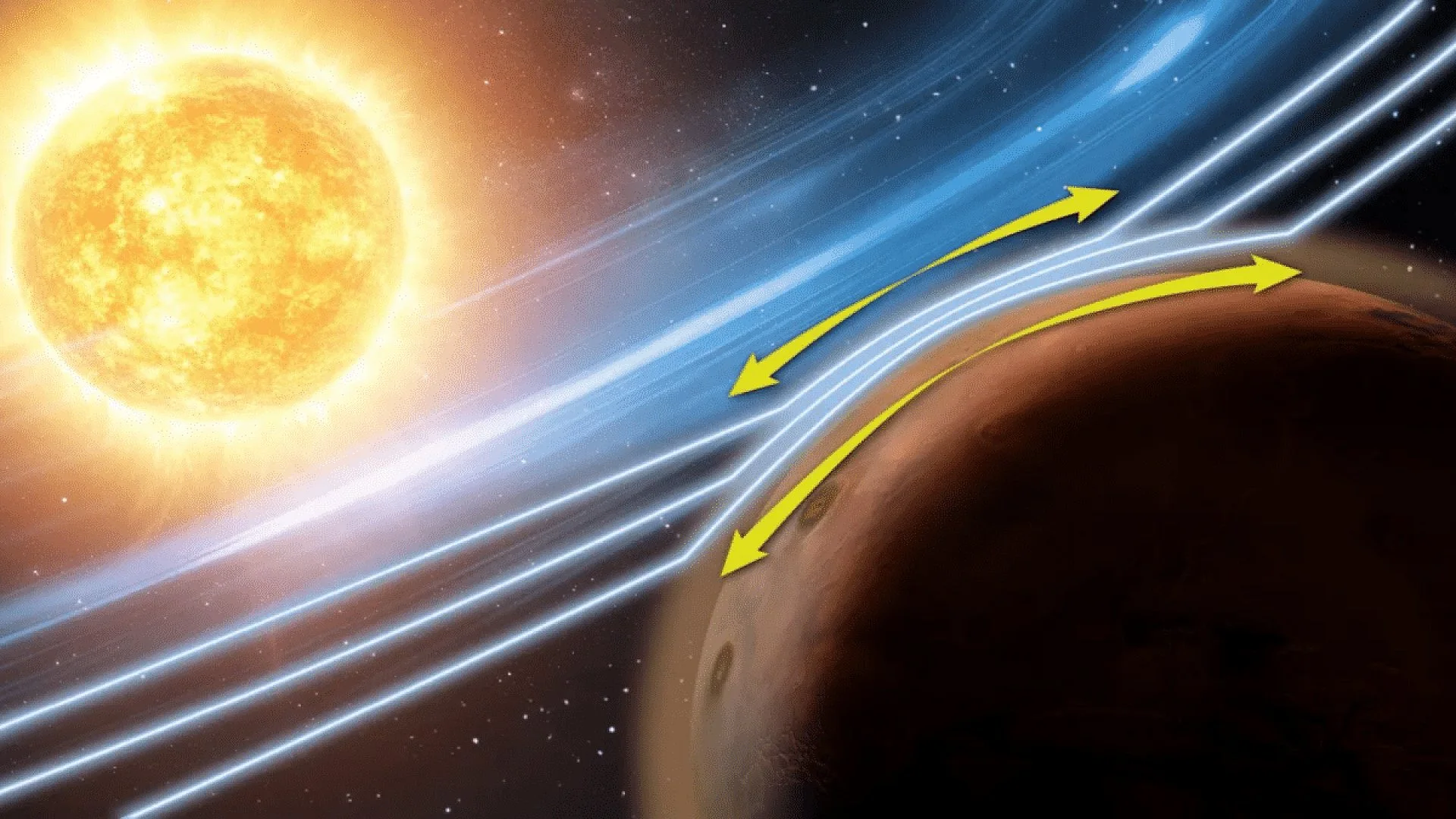
NASA’s MAVEN mission has unveiled a groundbreaking phenomenon in Mars’ atmosphere, one that has left scientists stunned. Data collected in December 2023 reveals the Red Planet experiencing a unique interaction between charged particles and magnetic structures, a phenomenon previously thought to occur solely in Earth’s magnetosphere. This pioneering discovery opens a new window into understanding space weather impacts on planets lacking global magnetic fields, offering invaluable insights into Martian atmospheric dynamics.
Unveiling the Zwan-Wolf Effect in the Martian Ionosphere
A study published in Nature Communications details the first direct observation of the Zwan-Wolf effect on Mars. Traditionally associated with Earth’s magnetosphere, this effect occurs when charged particles are compressed along magnetic flux tubes, helping deflect solar wind. Mars, lacking a global magnetic field, interacts with solar wind in a distinct manner, making this discovery unprecedented.
“When examining the data, I noticed some intriguing oscillations,” said Christopher Fowler, a research assistant professor at West Virginia University in Morgantown and lead author of the study. “I would never have suspected it would be this effect, given its rarity in a planetary atmosphere.”
Fowler and his team analyzed fluctuations in MAVEN’s magnetic field measurements, eventually tracing the patterns to the Zwan-Wolf effect within the Martian ionosphere below 200 km. The ionosphere contains electrically charged particles that respond dramatically to solar storms, amplifying the effect and allowing it to be observed.
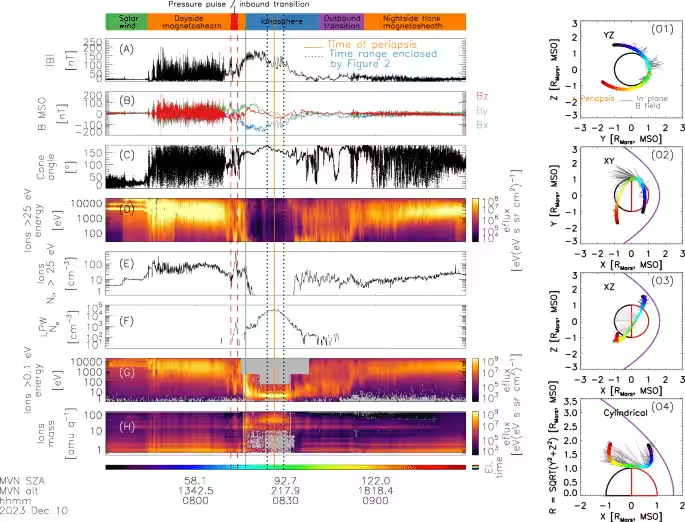
Panels show: A, B MAG magnetic field amplitude and vector; C cone angle between the magnetic field and +X MSO direction; D, E SWIA ion energy spectrum and corresponding ion density; F LPW thermal electron density; G, H STATIC ion energy and mass spectra. The orange vertical line marks periapsis; the dotted vertical lines show the time range covered by Fig. 2; the dashed red vertical lines enclose evidence of a pressure pulse impacting the ionosphere that is discussed in the “Discussion” subsection “Generation and propagation of the magnetic structures”. Eflux has units of eV (eV sr cm2 s)−1. `El. time’ stands for elapsed time. Beneath the figure, `MVN SZA’ and `MVN alt’ are the spacecraft solar zenith angle (in degrees) and altitude (in the International Astronomical Union (IAU) frame and units of km), respectively. O1–O4 MAVEN’s orbit in various planes of the MSO coordinate system, where colors map to the timebar beneath (H) for direct comparison. The gray whiskers show the projection of the magnetic vector in each plane, with the length proportional to the total magnitude. Source data are provided as a source data file.
Implications for Space Weather and Planetary Science
The discovery offers new perspectives on how solar storms and space weather influence Mars. Unlike Earth, which benefits from a robust magnetic shield, Mars has an induced magnetosphere generated by solar wind interactions with its ionosphere. This magnetic field can change dramatically in size and shape during strong solar events, significantly altering the planet’s atmospheric dynamics.
“No one anticipated that this effect could occur in the atmosphere,” Fowler explained. “That’s what makes this even more thrilling. It introduces fascinating physics that we haven’t yet explored and a new way the Sun and space weather can modify the dynamics in the Martian atmosphere.”
Scientists now suspect that the Zwan-Wolf effect may occur continuously on Mars at lower, undetectable levels, reshaping our understanding of atmospheric loss and particle dynamics on unmagnetized bodies.
Connections to Other Celestial Bodies
The findings may extend beyond Mars, offering clues about other unmagnetized planets and moons, such as Venus and Titan. By understanding how charged particles are redistributed in Mars’ atmosphere, researchers can better model the effects of space weather on planetary atmospheres across the solar system. Observing these phenomena provides critical context for future exploration and the design of spacecraft capable of withstanding extreme space weather events.
“Knowing how space weather interacts with Mars is essential,” said Shannon Curry, principal investigator of MAVEN and research scientist at the Laboratory for Atmospheric Space Physics at the University of Colorado Boulder. “The MAVEN team continues making new discoveries with our datasets and finding these links between our host star and the Red Planet.”
NASA emphasizes that insights like these inform mission planning and the protection of assets in orbit or on the surface.
This article has been fact checked for accuracy, with information verified against reputable sources. Learn more about us and our editorial process.
Last reviewed on .
Article history
- Latest version
Reference(s)
- Fowler, Christopher. “Detection of Zwan-Wolf effect in the ionosphere of Mars - Nature Communications.”, vol. 17, no. 1, May 18, 2026, pp. 4224 Nature, doi: 10.1038/s41467-026-72251-9. <https://www.nature.com/articles/s41467-026-72251-9>.
Cite this page:
- Posted by Farah Siddiqui