Saguaro Galaxy Shows Little Red Dots Are Early Supermassive Black Hole Bursts
New study shows nearby cosmic example suggests tiny red dots are a brief phase in supermassive black hole growth.
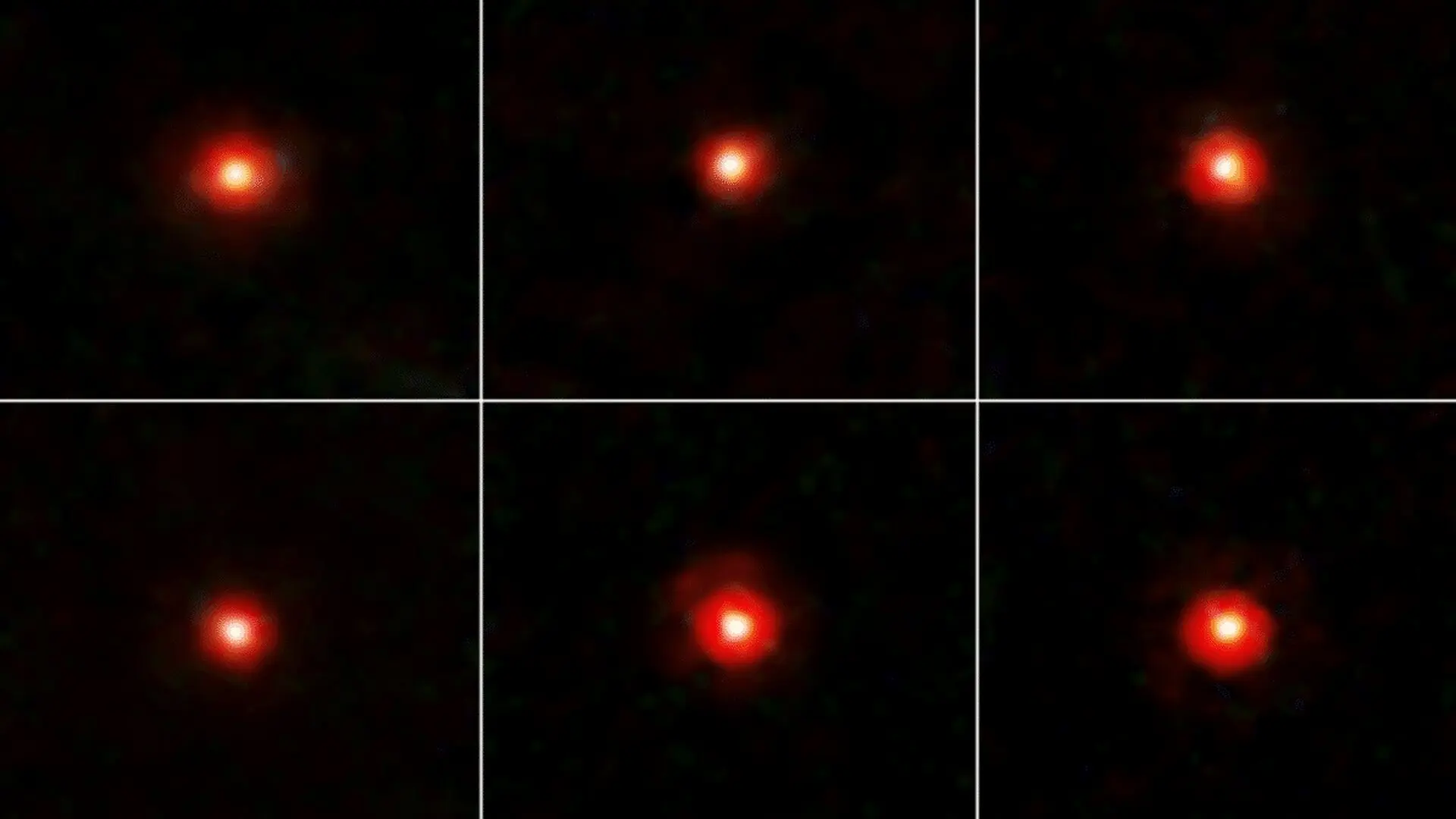
Little red dots spotted by NASA’s James Webb Space Telescope may not be a distinct galaxy class after all. New research published in The Astrophysical Journal proposes that these compact, red sources likely represent a fleeting stage of intense activity around supermassive black holes. The study highlights the spiral galaxy WISEA J123635.56+621424.2—dubbed the “Saguaro”—as a key example linking early‑universe red dots to present‑day black‑hole‑host galaxies.
A Nearby Analog Sheds Light on Red‑Dot Evolution
Since Webb’s 2022 discovery of the “little red dots,” astronomers have grappled with their nature. Their extreme distances (high redshift) mean the light we see has traversed billions of years, and many scientists suspect a connection to active galactic nuclei, where supermassive black holes devour surrounding material and unleash vast energy.
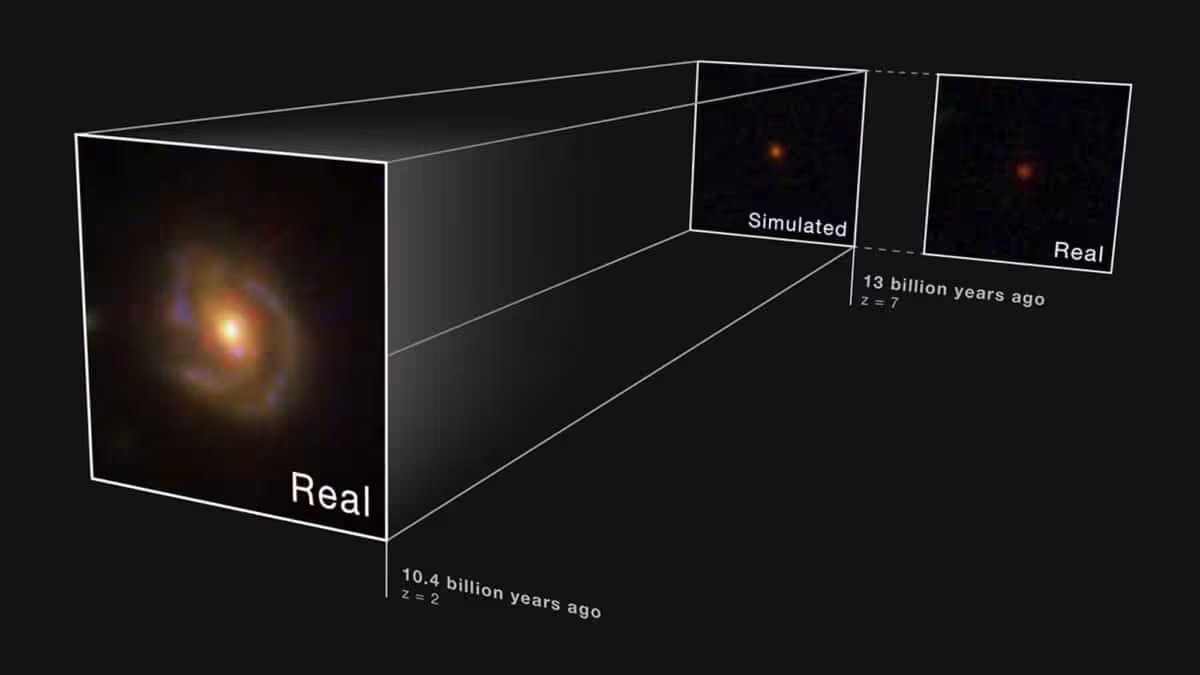
Led by Pierluigi Rinaldi of the University of Arizona’s Steward Observatory (now at the Space Telescope Science Institute), the new investigation focuses on a rare, lower‑redshift object that can be examined in greater detail. The Saguaro, with a redshift of roughly 2, existed about 3.3 billion years after the Big Bang, offering a window into a formative epoch of cosmic history.
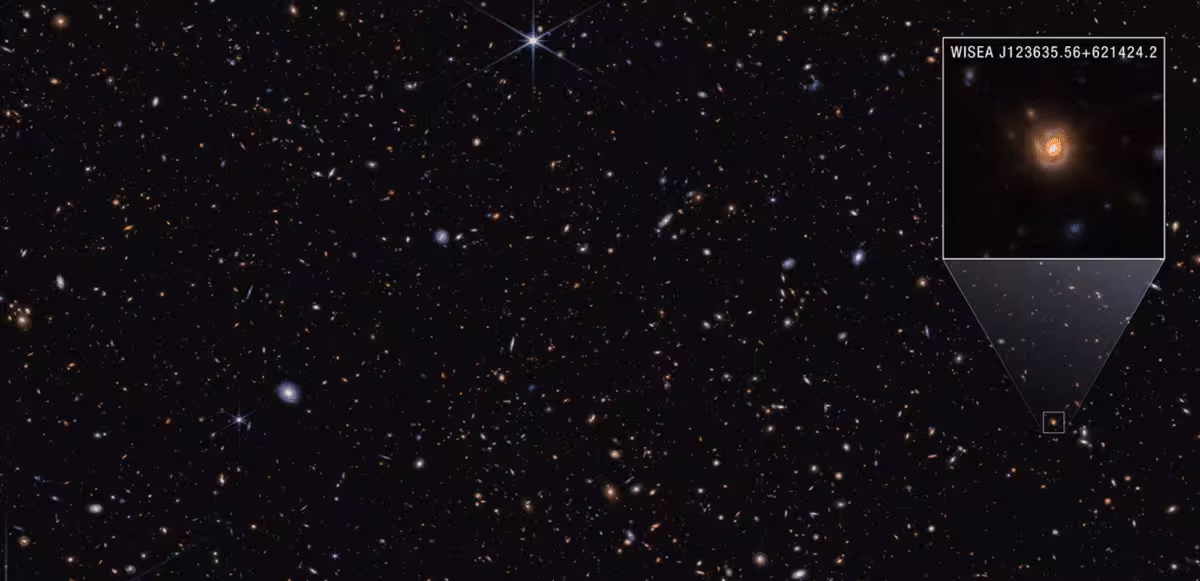
The Saguaro’s compact, red nucleus mirrors the appearance of distant red dots, yet its surrounding spiral arms remain visible. This combination makes the galaxy a valuable laboratory for probing how such objects evolve as the universe ages.
“Everything formed in the early universe must transform into something we observe today. We’ve had little insight into the fate of LRDs, but these results finally give us a roadmap to trace their descendants,” said co‑author George Rieke of the University of Arizona.
“The Saguaro is a prototypical little red dot and one of the few we’ve identified at lower redshift. It provides a test case for tracking these objects through cosmic time,” added Fabio Pacucci of the Harvard‑Smithsonian Center for Astrophysics.
Multi‑Telescope Observations Reveal a Hidden Core
To dissect the Saguaro across the electromagnetic spectrum, the team combined data from NASA’s Hubble Space Telescope, the James Webb Space Telescope, and several ground‑based surveys. By separating the galaxy’s extended light from its central red source, they uncovered a nucleus that shines unusually bright in ultraviolet and infrared bands—traits shared by the high‑redshift red dots.
The researchers also probed potential X‑ray emission to test whether an obscured active black hole could account for the galaxy’s peculiar signature.
Because the Saguaro lies at a comparatively modest redshift, its host galaxy can be resolved in high‑resolution images—a feat impossible for most distant red dots, whose surrounding stars and gas fade below detection thresholds.
“The lower redshift lets us capture the beautiful, bright host galaxy in detail with Webb and Hubble,” noted Zihao Wu of the Harvard‑Smithsonian Center for Astrophysics. “Webb’s observations help us connect the galaxy to its little red‑dot‑like nucleus.”
Simulating how the Saguaro would appear if shifted to the early universe’s higher redshift revealed that its surrounding structure would virtually vanish, leaving only the compact red core. This experiment supports the idea that many distant red dots seem isolated simply because current telescopes cannot detect their faint outskirts.
Weak X‑Rays Hint at an Enshrouded Active Nucleus
Observations from NASA’s Chandra X‑ray Observatory added another piece to the puzzle. While most Webb‑detected little red dots lack strong X‑ray signatures, the Saguaro emitted faint X‑rays consistent with a heavily obscured, yet active, galactic nucleus.
The team proposes that dense layers of gas and dust could veil the central black hole, suppressing X‑ray output and making these objects hard to recognize through conventional surveys.
Together, the weak X‑ray emission and strong obscuration suggest an early evolutionary stage in which black holes grow rapidly while still embedded within thick galactic cocoons.
“The X‑ray data show an active nucleus that is both heavily obscured and X‑ray weak,” explained Carys Gilbert, a master’s student at the University of Cape Town. “That combination could account for the lack of X‑ray detections in other little red dots and fits the emerging picture nicely.”
Observational Bias May Mask Host Galaxies
The authors argue that little red dots are not a separate galaxy class but rather a brief episode in the life cycle of galaxies harboring vigorously accreting supermassive black holes. As the universe expands, the bright central cores become easier to isolate, while their faint host galaxies remain elusive at high redshift.
Consequently, many distant red dots could be the visible tips of much larger systems, with their surrounding structures falling below the detection limits of even Webb’s most sensitive instruments.
“Our hypothesis is that cosmological dimming creates an observational bias,” said Pierluigi Rinaldi. “We simply cannot sample the immediate environment of high‑redshift little red dots because their surroundings are too faint. These dots are just the tip of the iceberg—representing a supermassive black hole interacting with its nearby environment.”
This article has been fact checked for accuracy, with information verified against reputable sources. Learn more about us and our editorial process.
Last reviewed on .
Article history
- Latest version
Cite this page:
- Posted by Farah Siddiqui