NASA’s Juno Mission Unlocks Secrets of Particle Acceleration Beyond Earth
Juno’s Jupiter observations reveal how electrons hit near-light speeds, linking planetary foreshocks to cosmic ray origins.
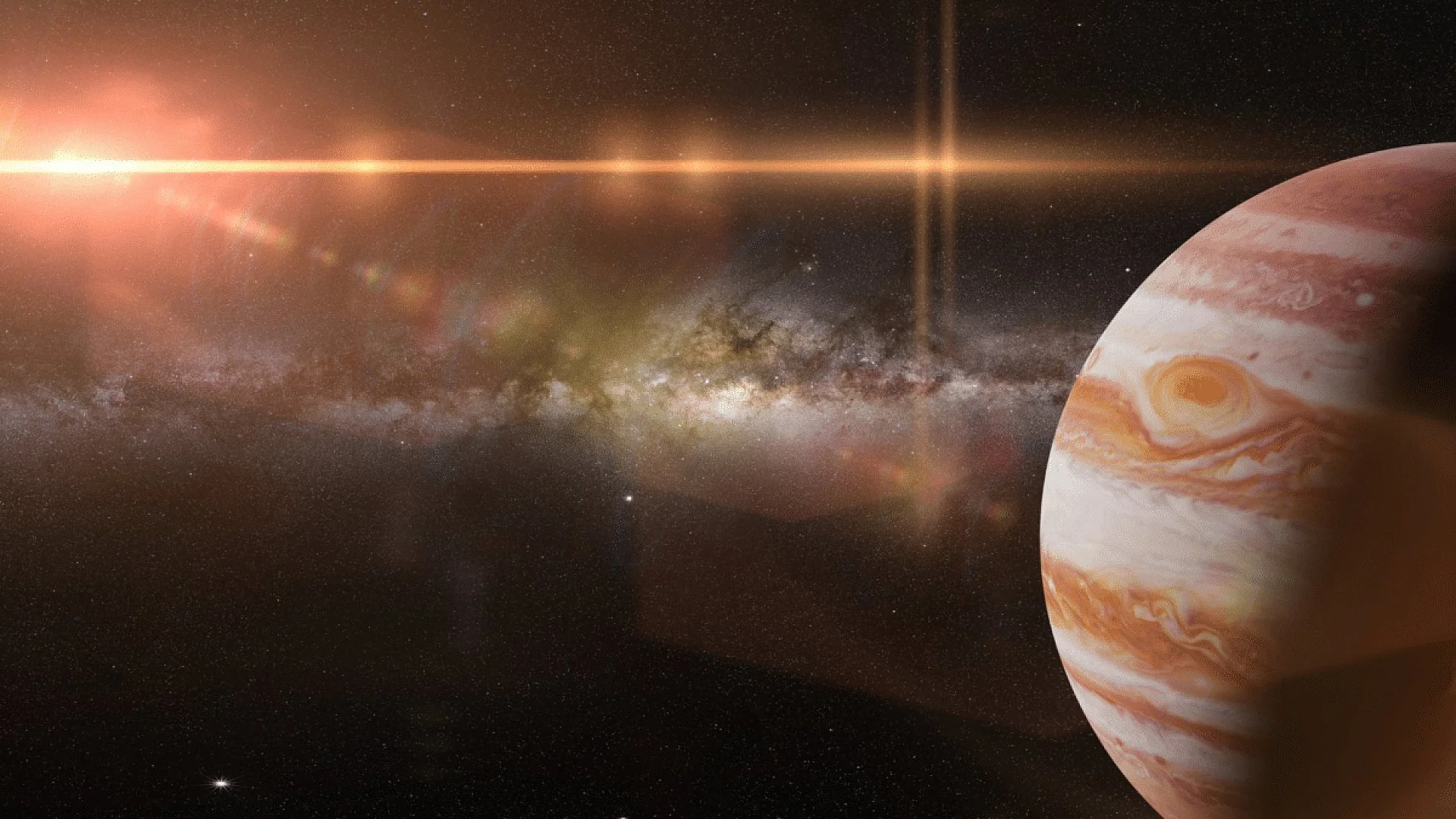
Juno’s instruments have recorded electrons traveling at velocities close to the speed of light inside Jupiter’s magnetic environment, delivering the first direct proof of how high‑energy particles are accelerated in space. The results, published in Nature, back long‑standing theories and point to a universal mechanism that may operate throughout the galaxy.
Jupiter’s Foreshock Works as a Natural Accelerator
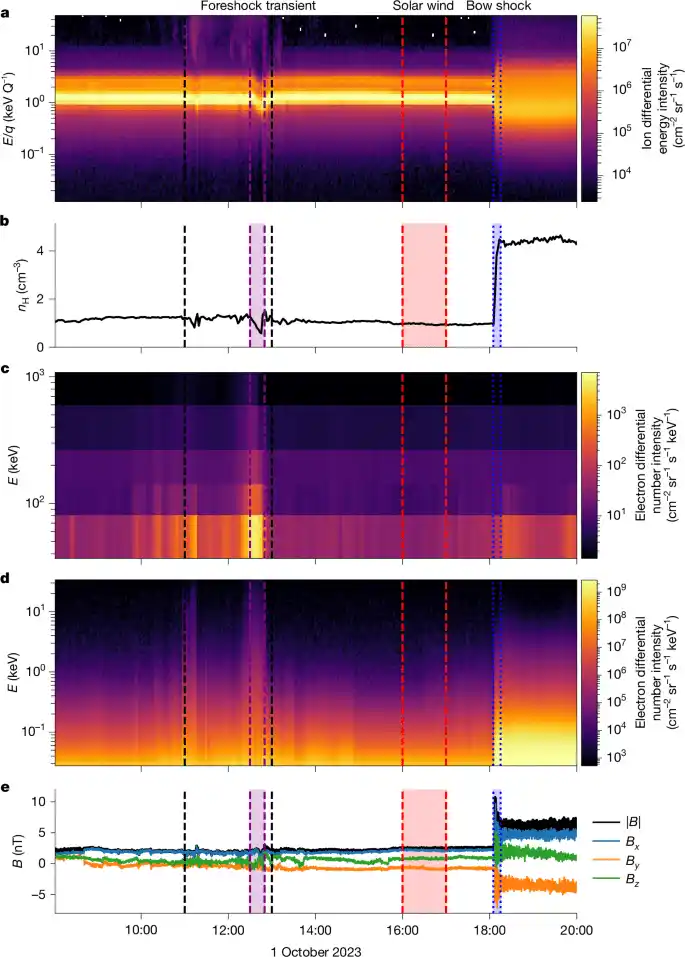
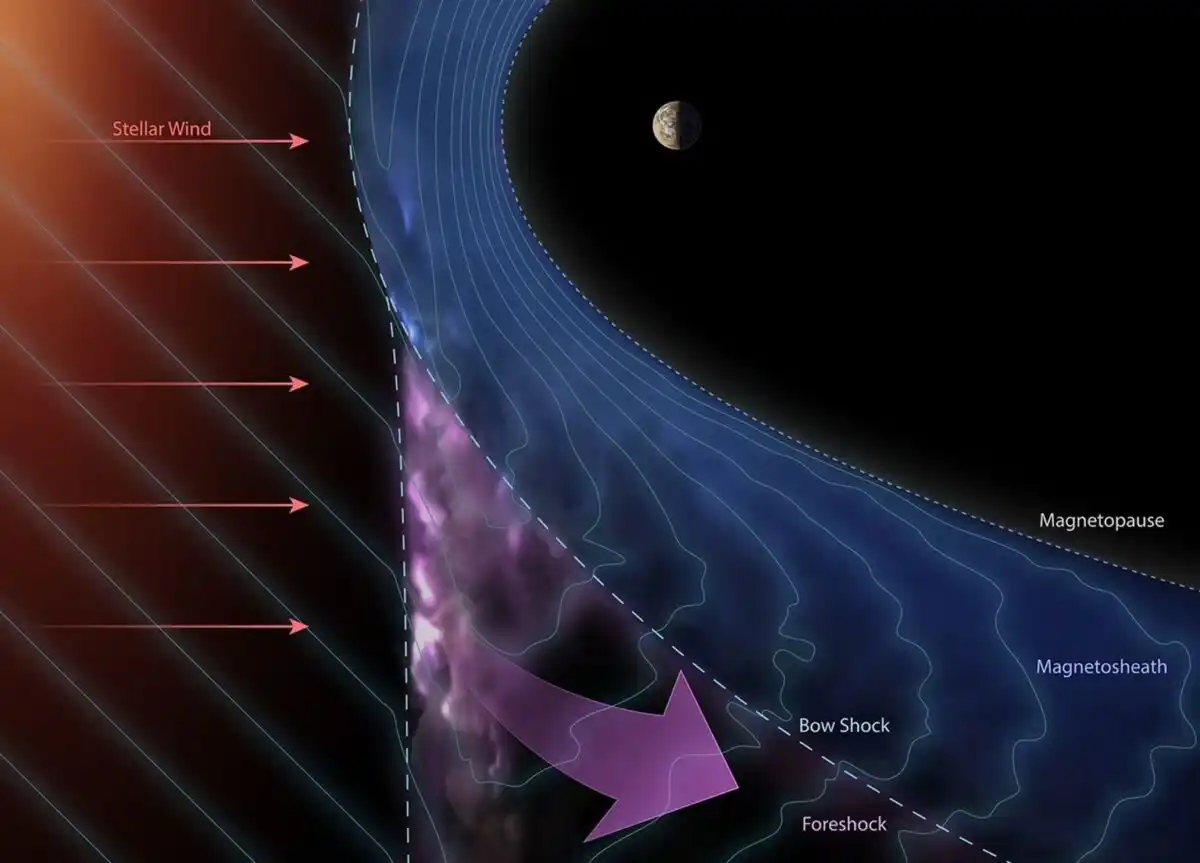
For many years scientists have suggested that the region where the solar wind first encounters a planet’s magnetosphere—the foreshock—could serve as a particle‑speeding zone. Earth‑orbiting missions such as MMS and THEMIS have mapped energetic electrons locally, but comparable data from another planet were missing until Juno’s recent measurements.
Credit: Nature
Juno’s sensor suite captured electrons with energies surpassing those recorded near Earth, reflecting the enormous scale of Jupiter’s bow shock. The shock forms where the giant planet’s magnetic field collides with the solar wind and extends far beyond Earth’s equivalent, allowing particles to acquire higher energies.
These measurements confirm that foreshock regions can both energize particles and act as natural laboratories for probing fundamental plasma processes.
Connecting Planetary Shocks to Galactic Cosmic Rays
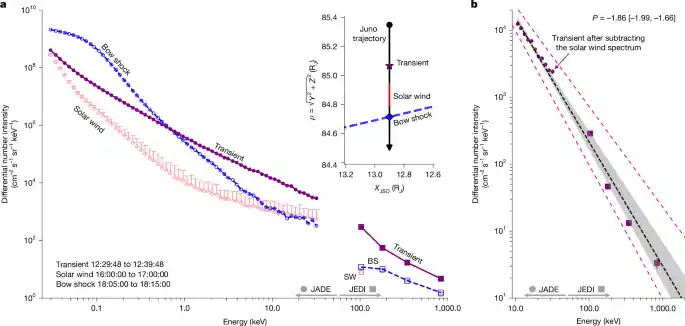
The Jovian observations shed light on the long‑standing puzzle of cosmic‑ray origins. By linking electron speeds to the size of Jupiter’s foreshock, researchers uncovered patterns that echo the properties of cosmic rays detected throughout the Milky Way. This scaling implies that the same acceleration mechanisms operating near Jupiter may also be active in far larger magnetic environments such as supernova remnants.
The study suggests that phenomena observed in our solar system could be mirrored in distant astrophysical sites, providing a bridge between local and extragalactic particle physics.
Credit: Nature
By linking observations from the solar system to high‑energy phenomena millions of light‑years away, the research narrows the divide between planetary space physics and astrophysics.
Space‑Weather Insights for Earth and Technology
Understanding how electrons attain extreme velocities near planets has direct implications for space‑weather forecasting and the protection of technological assets. High‑energy particles that reach Earth can disrupt satellites, interfere with communications, and even affect power grids. Demonstrating the acceleration process in Jupiter’s foreshock gives scientists a template for refining models of particle storms that threaten Earth’s infrastructure.
Credit: Nature
Improved predictions could aid satellite operators and electricity providers in mitigating radiation hazards, and they also inform the planning of future missions to Jupiter’s moons, where intense radiation already poses a major challenge.
A Unified Perspective on Particle Acceleration
The Nature article marks a milestone by confirming that foreshocks are a universal feature capable of accelerating particles, offering a natural setting for studying extreme physics. The scaling relationship observed at Jupiter’s bow shock, now linked to cosmic‑ray sources such as supernovae, suggests a continuity of processes from the solar system to interstellar space.
Scientists anticipate that this insight will sharpen models of particle acceleration, improve forecasts of cosmic‑ray fluxes, and guide upcoming exploratory missions to other planetary systems. Juno’s deep‑space observations thus provide fresh answers to questions that have lingered for more than a century, showing that even the largest planets can reveal fundamental truths about the universe.
This article has been fact checked for accuracy, with information verified against reputable sources. Learn more about us and our editorial process.
Last reviewed on .
Article history
- Latest version
Reference(s)
- Raptis, Savvas. “Relativistic electron acceleration at the bow shock of Jupiter and beyond - Nature.”, vol. 654, no. 8117, pp. 47-51. Nature, doi: 10.1038/s41586-026-10473-z. <https://www.nature.com/articles/s41586-026-10473-z>.
Cite this page:
- Posted by Farah Siddiqui