Astronomers Spot First Interstellar Sugar: Erythrulose Detected in Milky Way Central Cloud
Scientists find raspberry‑linked sugar near the Milky Way’s core, revealing a surprising interstellar chemical trail.
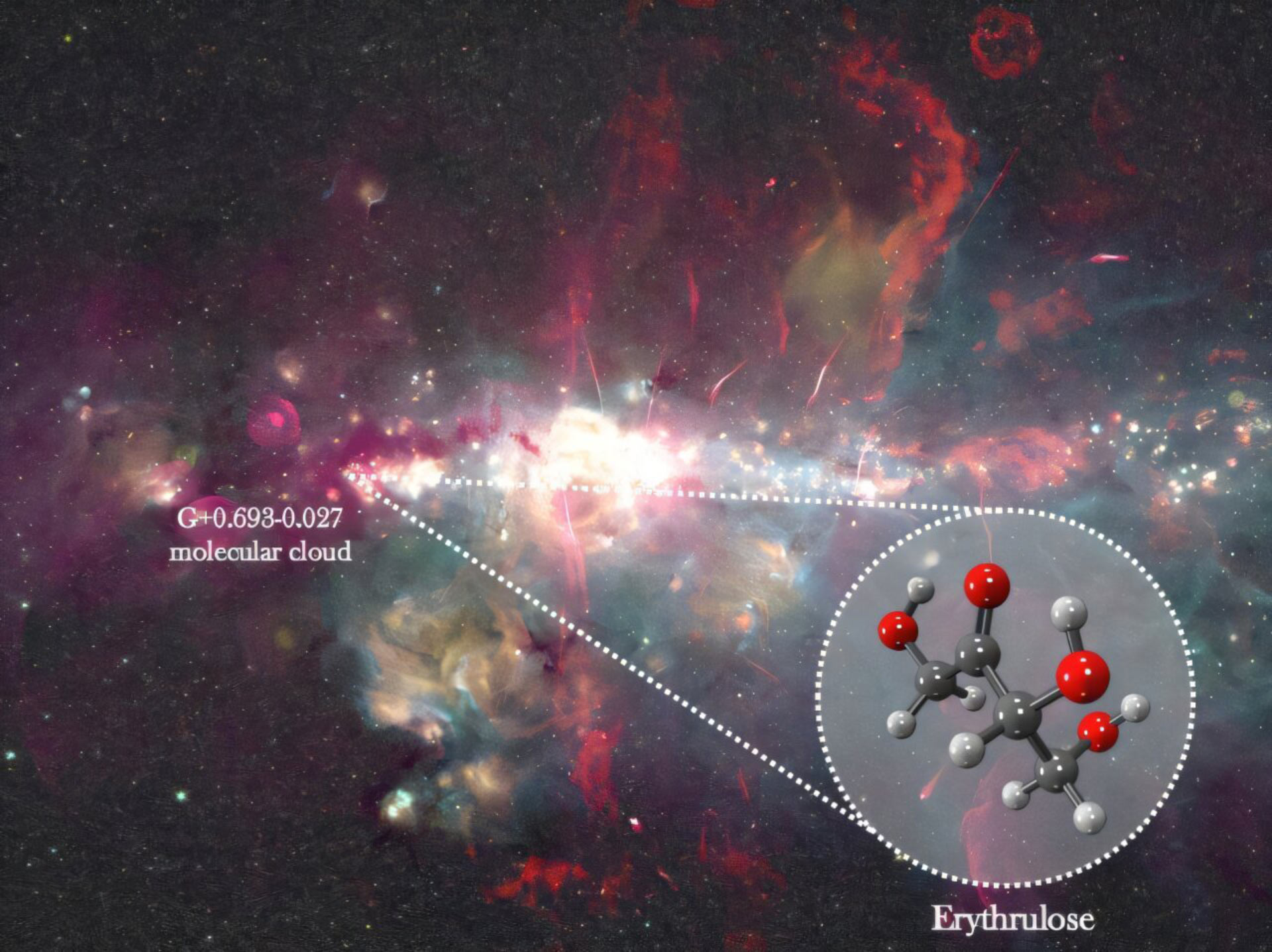
A team of astronomers has reported the first unequivocal identification of a sugar molecule, erythrulose, inside a dense cloud of gas and dust located near the Milky Way’s core. The cloud, known as G+0.693‑0.027 and situated roughly 26,750 light‑years from Earth, revealed the molecule through radio observations carried out with two Spanish telescopes.
Ground‑based radio arrays capture the molecule’s spectral signature
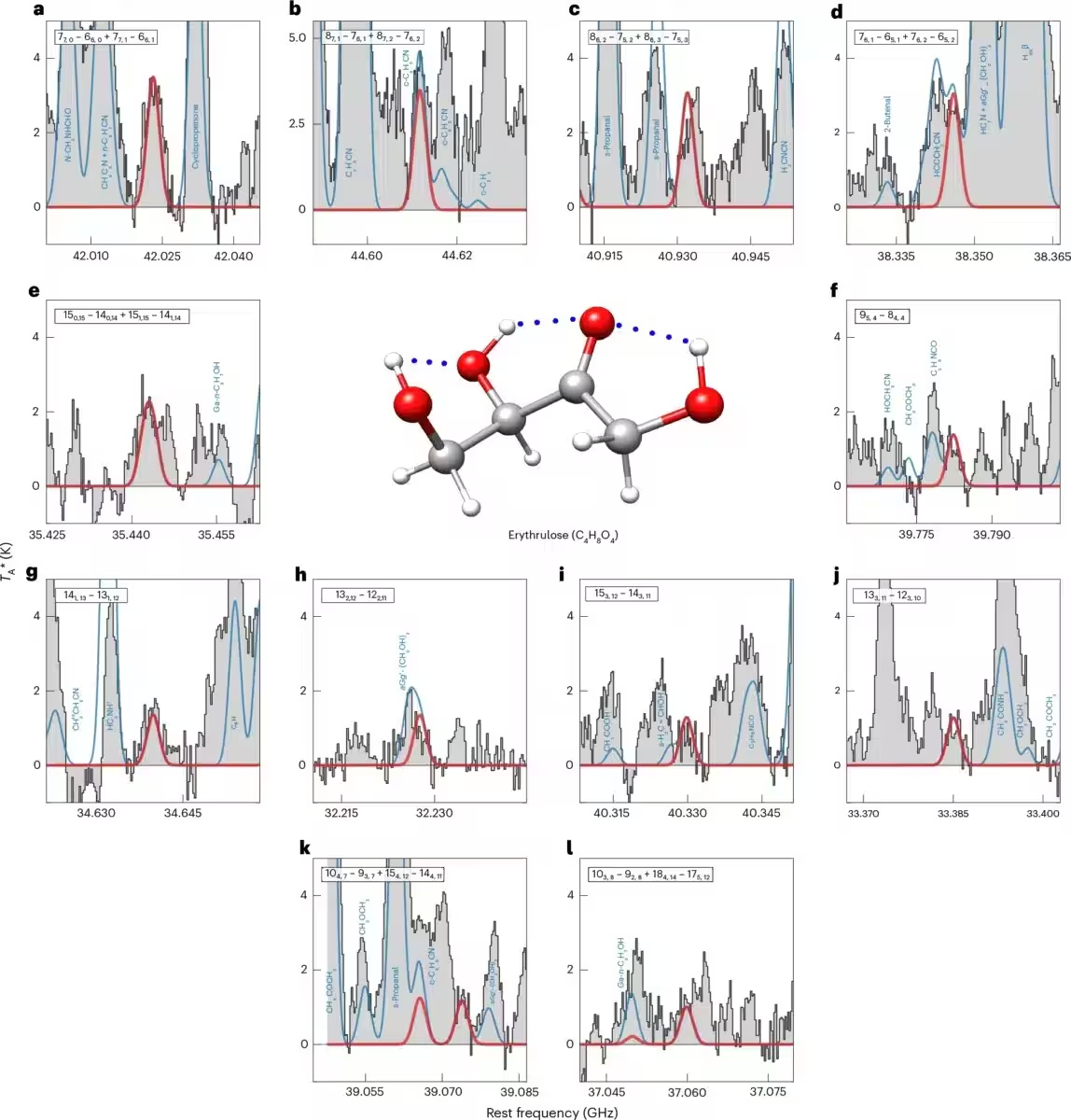
Using the 40‑meter Yebes dish and the 30‑meter IRAM telescope, researchers measured the characteristic radio frequencies emitted as erythrulose rotates. Twelve distinct groups of lines matched laboratory spectra, allowing the team to differentiate the sugar from more than 180 other known interstellar species that share overlapping signals.
The molecule’s formula, C₄H₈O₄, makes it the largest non‑cyclic compound detected in interstellar space to date, as well as the first four‑oxygen species and only the second chiral molecule observed beyond Earth.
Why chirality matters in cosmic chemistry
A chiral molecule exists in two mirror‑image forms, analogous to left‑ and right‑handed versions. Biological systems typically favor one enantiomer over the other, a preference that can influence the development of life‑related chemistry. Although the observations could not resolve which enantiomer of erythrulose is present, the detection confirms that chiral chemistry can arise under the extreme conditions of a molecular cloud.
Possible pathways on icy dust grains
Chemical models suggest that erythrulose may assemble on microscopic dust particles coated with ice. Simpler precursors such as glycolaldehyde and ethylene glycol—both already known in space—could react on these surfaces, building up the four‑carbon skeleton without any biological catalysts.
Surprisingly, the abundance of erythrulose appears to be at least eight times higher than that of two related three‑carbon sugars, glyceraldehyde and dihydroxyacetone, which were not detected even though the survey was sensitive enough to capture weak emissions. This counter‑intuitive result hints that larger sugars might persist longer in the gas phase or be released more efficiently from icy grains.
“This finding was unexpected, as the prevailing view in astrochemistry is that interstellar molecules grow in size through the sequential addition of carbon atoms,” said study lead Izaskun Jiménez‑Serra in a report on the discovery. The authors propose that differing formation, desorption, and re‑adsorption rates could make a four‑carbon sugar more observable than its smaller counterparts.
Implications for pre‑biotic chemistry
While erythrulose is not a direct component of DNA or RNA, ketose sugars like it can isomerize into aldose forms under aqueous conditions, potentially feeding into synthetic routes that generate ribonucleotide precursors. Its presence in a star‑forming cloud adds to a growing inventory of extraterrestrial organic molecules that may seed nascent planetary systems.
Previous detections of biologically relevant sugars have come from meteorites and samples returned from asteroid Bennu, but those environments differ from the interstellar medium. The identification of erythrulose marks the first time a bona fide sugar has been observed directly within a molecular cloud.
“The detection of erythrulose is very exciting because it opens up the possibility of discovering in space other sugars such as ribose, which is part of RNA,” noted co‑author Carlos Briones.
From interstellar clouds to planetary surfaces
Molecular clouds serve as cradles for star and planet formation. Organic compounds synthesized on icy dust grains can become incorporated into protoplanetary disks, later preserved in comets, asteroids, and other small bodies that deliver material to emerging planets. Demonstrating that a complex sugar can arise before a planetary system forms supports the notion that essential organic ingredients may be inherited from the interstellar medium.
The study does not claim that erythrulose triggered life on early Earth, but it does highlight a plausible abiotic pathway for sugar formation that could enrich nascent planetary environments via cometary and asteroidal impacts.
On Earth, erythrulose is found in modest amounts in red raspberries and is employed in certain sunless tanning formulations. In the distant cloud G+0.693‑0.027, its spectral signature records a purely non‑biological synthesis of a sugar within a frigid region near the galaxy’s center.
This article has been fact checked for accuracy, with information verified against reputable sources. Learn more about us and our editorial process.
Last reviewed on .
Article history
- Latest version
Reference(s)
- “Image 14913e Erythrulose.” <https://cdn.sci.news/images/enlarge13/image_14913e-Erythrulose.jpg>.
- Anderson, Natali. “Astronomers Detect Sugar in Interstellar Space for First Time.”, July 13, 2026 Sci.News <https://www.sci.news/astronomy/sugar-interstellar-space-14913.html>.
Cite this page:
- Posted by Bilal Abbasi