Devonian Amber Found in Chinese Coal Sets Record as Oldest Known Resin
Ancient microscopic plant fragments, dating back hundreds of millions of years, prompt scientists to reconsider the timeline of a key survival adaptation.
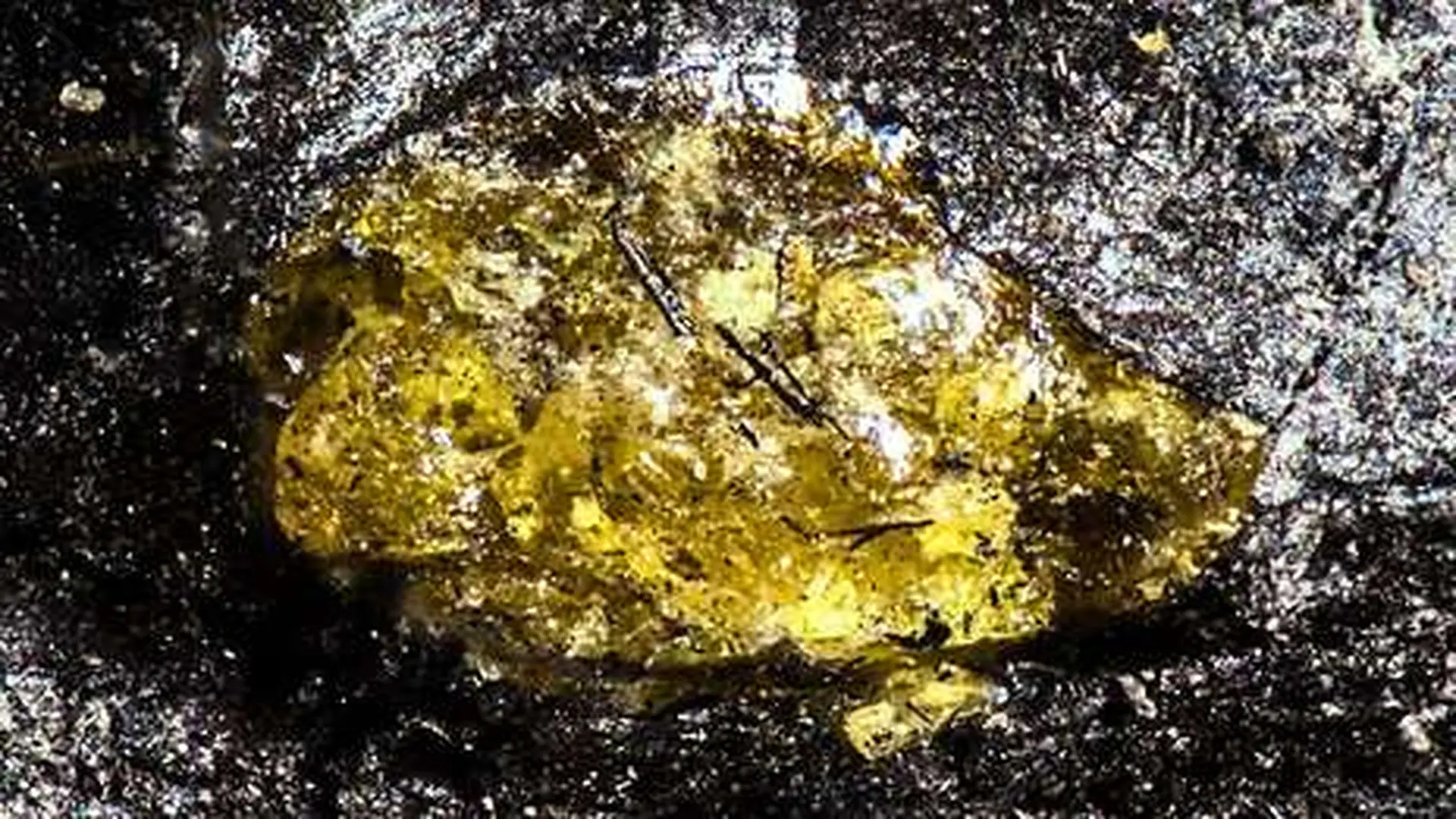
Deep within a coal seam of the Hujiersite Formation in Xinjiang, China, researchers have identified 241 microscopic amber pieces that date to the Middle Devonian, roughly 385 million years ago. The fragments, extracted from about 10 kg of coal near Hoxtolgay in the country’s far northwest, range from 0.1 mm to 1.5 mm in size and are invisible to the naked eye.
The findings, released on 15 July in Science Advances, push the earliest confirmed amber back by roughly 65 million years. The previous record, a Late Carboniferous specimen dated to about 320 million years ago, was linked to early seed plants. By contrast, the new material predates the evolution of seed‑bearing plants, opening a new chapter in the history of plant resin production.
Because resin synthesis has long been associated with seed plants, the presence of chemically complex amber from a time before such plants existed raises fresh questions about which early plant groups first possessed the biochemical pathways needed to generate it.
Uncovering the Tiny Fossils
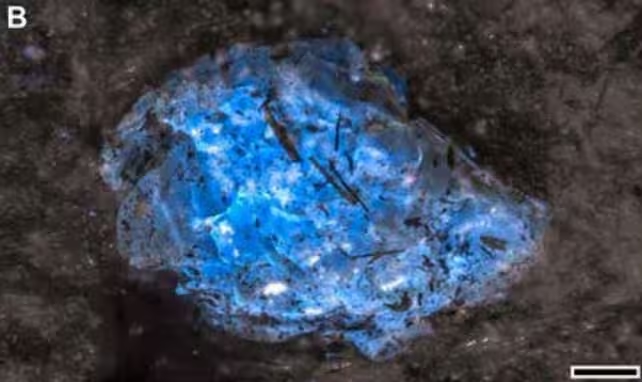
The amber did not reveal itself through any obvious visual cue. Led by Dr. Cihang Luo of the Nanjing Institute of Geology and Palaeontology (Chinese Academy of Sciences), the team scanned the processed coal under ultraviolet light, causing the fragments to glow bright blue against the darker matrix. Each glowing speck was then isolated by hand under a microscope.
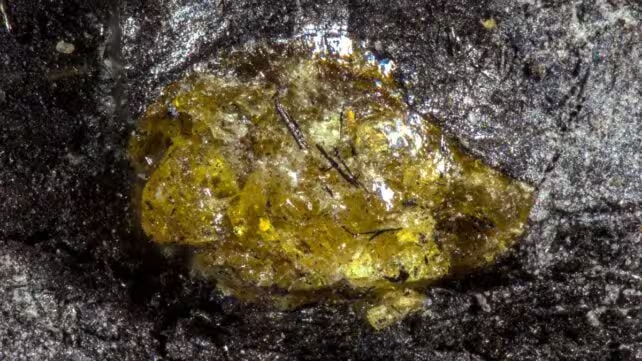
The pieces display a range of translucency and hues, from pale yellow to dark brown, and some contain tiny gas bubbles. Visual traits alone could not confirm their nature, so the scientists turned to chemical analysis. Using Fourier transform infrared spectroscopy and gas chromatography–mass spectrometry, they verified that the molecular signature matched that of conifer‑type resins.
Luo described the initial excitement as tempered by rigorous verification. Recognizing that a Middle Devonian amber discovery would be extraordinary, the team treated the material as resin‑like until the analytical results left no room for doubt.
A Resin Profile That Defies Known Plant Evolution
The chemical composition of the Hujiersite amber closely mirrors the terpenoid‑based resins produced by modern conifers and their fossil relatives. This similarity is striking because conifers and other seed plants did not appear until the Late Devonian, approximately 372–359 million years ago—well after the coal layer that housed the amber was deposited.
The authors suggest two plausible progenitors among the flora known from that interval. Progymnosperms, an extinct lineage of seedless vascular plants that gave rise to seed plants, and lycopsids, ancient tree‑like plants common in Devonian forests, have both been reported from the Hujiersite Formation. Without direct plant tissue alongside the amber, however, a definitive source remains elusive.
If the resin originated from a progymnosperm or a lycopsid, it would represent the earliest known fossil resin produced outside the seed‑plant lineage, extending the record of complex terpenoid chemistry in terrestrial plants by tens of millions of years.
Why Early Plants Might Have Produced Resin
Today, plant resin is often interpreted as a defensive barrier against insect herbivory, yet fossil evidence for insect feeding on plants does not appear until the Carboniferous, well after the Hujiersite amber formed. The researchers propose that other pressures—such as fungal pathogens and increasing wildfire frequency as Devonian forests expanded—could have driven the evolution of resin as a wound‑sealing secretion.
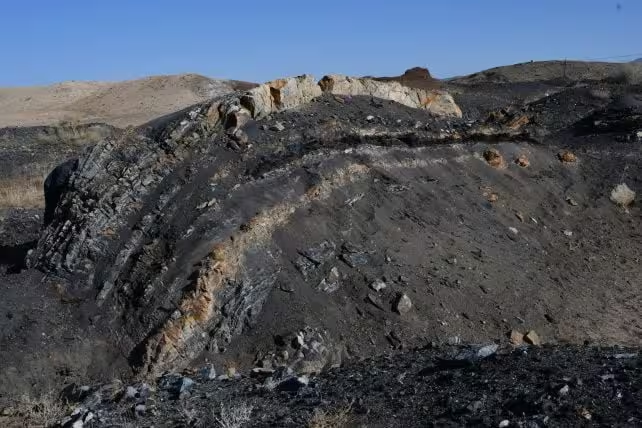
Luo described the coal layer as reflecting a moist, organic‑rich setting punctuated by early vascular vegetation. While fungi and simple arthropods were present, the ecosystems were far less intricate than later forests. Simultaneously, plants were developing height, wood, and deeper root systems, reshaping the planet’s surface. In this context, resin production may have been one of several adaptations facilitating survival during a period of rapid ecological change.
Looking for Even Older Amber
Molecular studies suggest that the genetic toolkit for terpene synthesis existed before the Middle Devonian, implying that yet‑earlier resin may be hidden in existing collections. The tiny grain size of the Hujiersite fragments aligns with broader patterns observed in Paleozoic amber, raising the possibility that similar material remains undetected in other coal or fine‑grained sediment samples.
The authors highlight Early Devonian organic‑rich coals, coaly shales, and well‑preserved plant‑bearing sediments as promising targets for future investigations. The combination of ultraviolet fluorescence screening, infrared spectroscopy, and mass spectrometry employed in this study could serve as a roadmap for uncovering older amber records.
While the current discovery sets a new benchmark, the team emphasizes that the search is ongoing and that applying these techniques more broadly may reveal resin deposits predating even the Hujiersite specimens.
This article has been fact checked for accuracy, with information verified against reputable sources. Learn more about us and our editorial process.
Last reviewed on .
Article history
- Latest version
Reference(s)
- Luo, Cihang., et al. “The earliest amber from the Middle Devonian of China.” Science Advances, vol. 12, no. 29, July 17, 2026 American Association for the Advancement of Science (AAAS), doi: 10.1126/sciadv.aeh1266. <https://www.science.org/doi/10.1126/sciadv.aeh1266>.
Cite this page:
- Posted by Bilal Abbasi