Astronomers Discover Massive Black Hole Wandering Far From Its Galaxy Center
A star shredded far from its galaxy’s center has revealed a massive black hole, challenging our understanding of how these giants roam through space.
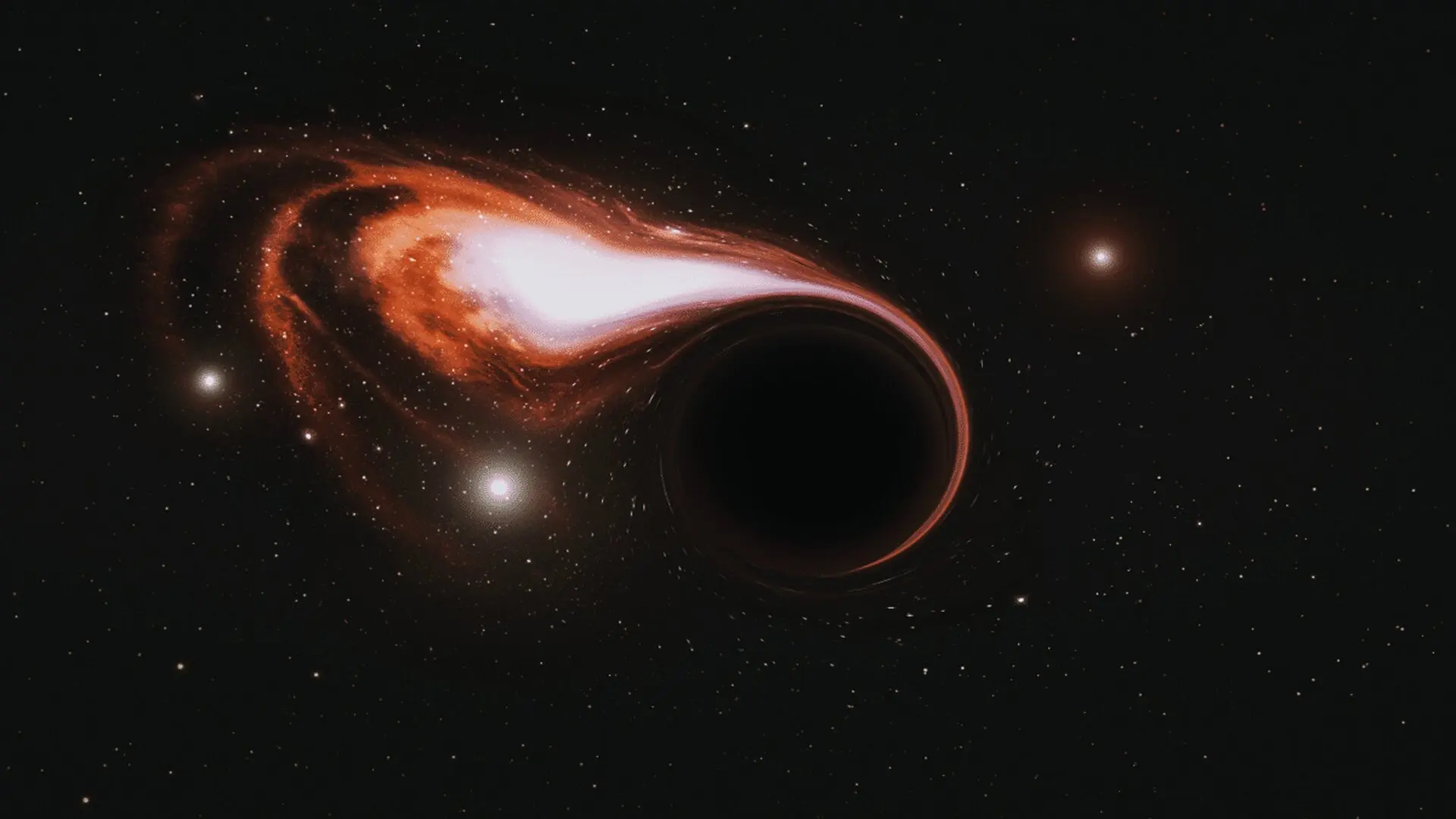
Astronomers have uncovered a massive black hole lurking 3,500 light-years away from the center of its host galaxy, a discovery made possible only after the gravity of the hidden object shredded a passing star. The finding, documented in a study currently available on arXiv, offers a rare glimpse into the behavior of supermassive black holes that reside in the outer reaches of galaxies rather than their nuclei.
Stellar Destruction Exposes a Hidden Giant
Typically, massive black holes are found at the heart of galaxies, exerting a gravitational dominance over the gas and stars nearby. When these giants exist far from the galactic core, they often remain invisible to modern telescopes. This changed with the detection of TDE 2023mfm, a tidal disruption event (TDE) first identified by the Zwicky Transient Facility (ZTF).
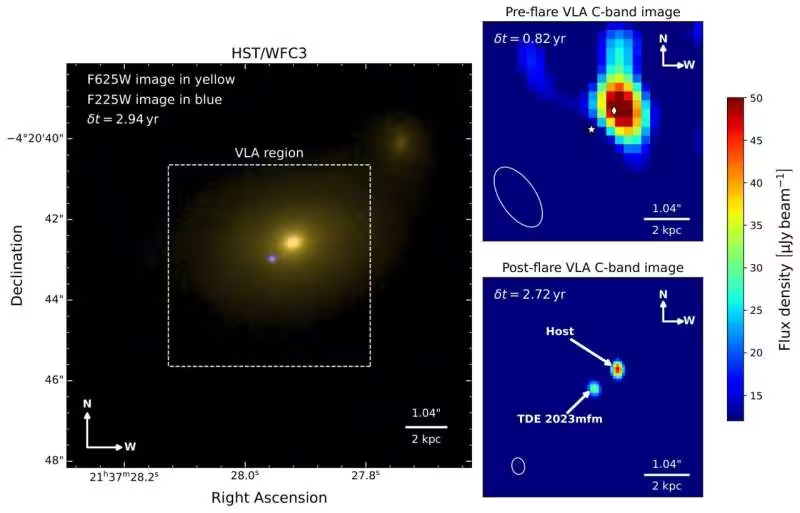
The event occurred when a star ventured too close to the black hole, leading to a catastrophic tidal disruption. As the star was torn apart, the resulting debris heated up, creating a brilliant flare that shone across multiple wavelengths. A research team led by Itai Sfaradi of the University of California utilized a robust array of observatories—including the Hubble Space Telescope, the Keck and Lick Observatories, the Swift and Chandra X-ray satellites, XMM-Newton, and the Very Large Array—to analyze the phenomenon. Their data confirmed the event took place approximately 1.08 kiloparsecs from the galactic center.
The flare hit peak brightness within a month and spent the subsequent 100 days gradually fading. Throughout this period, the temperature held steady at roughly 20,000 Kelvin, and researchers identified a distinct, broad hydrogen emission line, confirming the event as an off-nuclear tidal disruption.
Tracing the Origin of a Wandering Black Hole
The research team employed three independent methods to calculate the black hole’s mass, placing it between one million and ten million times that of our Sun. This mass range is characteristic of many known tidal disruption events, yet the object’s location suggests a complex history. One primary theory is that the galaxy previously absorbed a smaller companion, leaving the smaller galaxy’s central black hole stranded in a displaced orbit.
Evidence for this includes a compact cluster of stars near the disruption site, weighing between 10 million and 100 million solar masses. This could be the remnant core of a smaller galaxy that was stripped of its outer layers during a past merger. Alternatively, the researchers suggest the black hole could have been ejected from the center following a “gravitational-wave recoil” event, where the merger of three black holes resulted in a powerful slingshot effect. However, because the host galaxy’s primary nucleus still contains its own active black hole, the minor-merger hypothesis remains the most compelling explanation for the existence of this dual-black-hole system.
Anomalous Radio Signals and Lingering Mysteries
The behavior of TDE 2023mfm at radio wavelengths has provided researchers with further puzzles. Unlike other off-center disruptions, this event showed no initial radio activity. It was not until 991 days later—nearly three years after the initial flare—that a faint radio signal finally appeared. This delay contrasts sharply with other recorded events like TDE 2024tvd, suggesting that the environment surrounding this specific black hole may be unique.
The team hypothesizes that the delayed signal could be the result of stellar debris only now encountering surrounding gas, or perhaps an initial outflow that was either too weak or incorrectly oriented to be detected early on. Furthermore, the event’s lack of X-ray emission stands in contrast to many other tidal disruptions, deepening the mystery of the physical conditions at play.
As researchers continue to monitor the system, they hope to use these radio signatures to precisely map the relationship between the displaced black hole and its host. TDE 2023mfm underscores that galaxies may hide massive, wandering black holes for eons, only revealing them through the violent destruction of stars that wander too close to their event horizons.
This article has been fact checked for accuracy, with information verified against reputable sources. Learn more about us and our editorial process.
Last reviewed on .
Article history
- Latest version
Reference(s)
- Sfaradi, Itai. “An Off-Nuclear Tidal Disruption Event Discovered At Late Times: The Case Of TDE 2023mfm.” arXiv.org, doi: 10.48550/arXiv.2609.35998?utm_source=chatgpt.com. <https://doi.org/10.48550/arXiv.2609.35998?utm_source=chatgpt.com>.
Cite this page:
- Posted by Aisha Ahmed