Rare Cosmic Flare Could Be A Mini Black Hole Winking At Us, Astronomers Say
Astronomers may have spotted a tiny primordial black hole, hinting at a hidden population of lunar-mass objects lurking in the Milky Way.
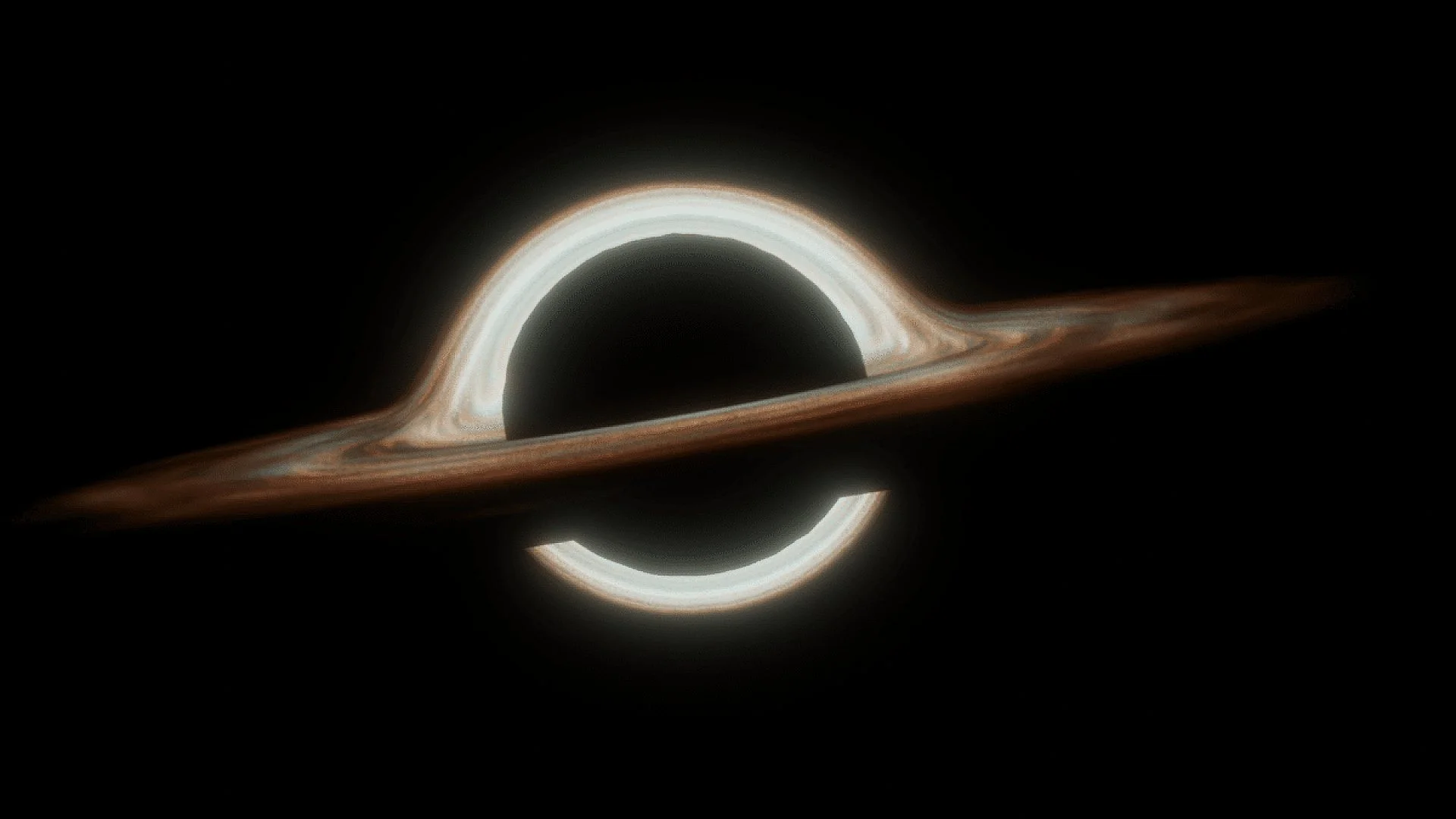
In 2019, a team of astronomers observed a star in the Large Magellanic Cloud that suddenly increased its brightness for roughly an hour, a pattern that does not match any known stellar activity. Detailed investigation suggests the burst may be the imprint of a primordial black hole—a relic object from the universe’s infancy—potentially exposing a hidden swarm of moon‑mass black holes. The results appear in a preprint on arXiv, offering a rare view into an obscure region of the cosmos.
An Unusual Flash from a Distant Star
For about sixty minutes, the flux from a star 163,000 light‑years distant rose gently before returning to baseline. Its light curve differed from conventional stellar flares, supernovae, or recognized variability. The anomaly was recorded by the Dark Energy Camera (DECam) during the Asteroid‑Mass Primordial black hole Microlensing (AMPM) survey.
Lead researcher Renee Key of Swinburne University of Technology and colleagues examined a range of explanations, from instrumental artefacts to normal stellar processes. “Phoebe suggests a population of compact, lunar‑mass objects associated with the dark matter distribution of the Milky Way, and potentially opens a new window to the physics of inflation,” they write in a preprint posted to arXiv. Their modeling favours a black hole roughly three times the Moon’s mass acting as a temporary gravitational lens, a classic microlensing effect.
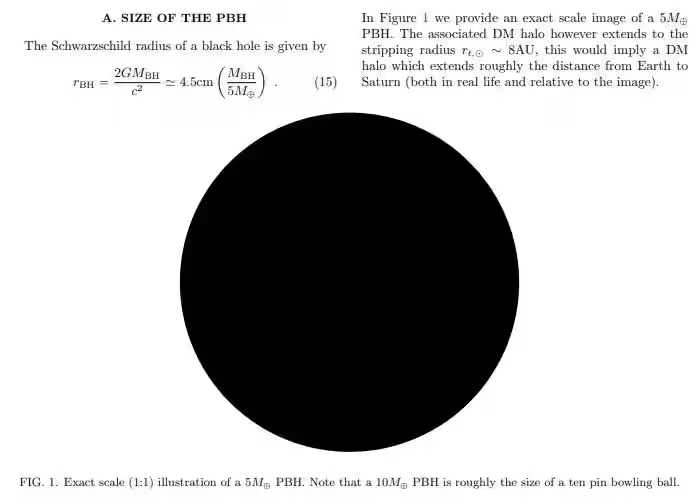
(Scholtz and Unwin, arXiv, 2019)
Tiny Ancient Black Holes Offer Clues to Cosmic Origins
Primordial black holes differ from the stellar remnants that typically form after a star collapses; they may have originated from quantum fluctuations shortly after the Big Bang. These objects are minuscule, with event horizons comparable to a marble. Direct detection is extremely challenging; even if they accreted material, the emitted radiation would be faint.
Nevertheless, their gravity can bend light from background stars, briefly amplifying the star’s brightness. This is precisely what DECam captured in the episode now referred to as Phoebe. Such observations could yield valuable information about dark matter and the conditions of the early universe.
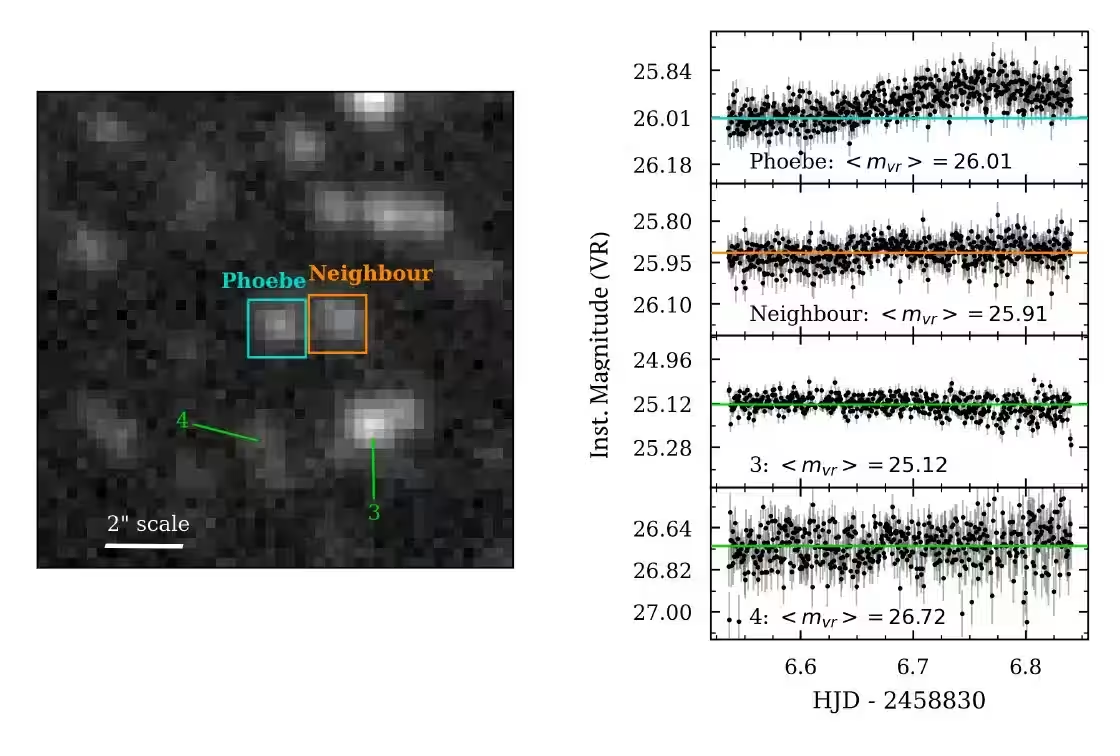
(Key et al., arXiv, 2026)
Gravitational Microlensing as a Tool to Uncover Dark Objects
Microlensing events are uncommon, yet they provide a unique method for spotting otherwise invisible masses. Key’s team performed extensive simulations to dismiss alternatives such as rogue exoplanets or faint stars. Their analysis indicates that Phoebe is five orders of magnitude more likely to belong to the Milky Way’s dark matter halo than to any known stellar group.
The finding adds momentum to the ongoing debate over the existence of primordial black holes. Earlier 2026 work with the Subaru Telescope reported possible microlensing signals in Andromeda that might be attributable to similar objects, though some researchers argued for conventional stellar explanations. Phoebe strengthens the case for a population of small black holes lurking in galactic halos and paves the way for future high‑precision observations.
This article has been fact checked for accuracy, with information verified against reputable sources. Learn more about us and our editorial process.
Last reviewed on .
Article history
- Latest version
Reference(s)
- Key, Renee. “AMPM II. A Lunar-Mass Primordial Black Hole Microlensing Candidate in the Milky Way Halo.” arXiv.org, doi: 10.48550/arXiv.2605.19375. <https://doi.org/10.48550/arXiv.2605.19375>.
- Staff, ScienceAlert. “What Is Planet Nine, And Does It Even Exist?.”, August 3, 2021 ScienceAlert <https://www.sciencealert.com/what-is-planet-nine>.
- Scholtz, Jakub. “What if Planet 9 is a Primordial Black Hole?.” arXiv.org, doi: 10.48550/arXiv.1909.11090. <https://doi.org/10.48550/arXiv.1909.11090>.
Cite this page:
- Posted by Farah Siddiqui