This Soviet Rover Was Thought Lost on the Moon, Then It Started Sending Signals Again Nearly 40 Years Later
Lost 40 years ago Soviet Moon rover found in fresh satellite images
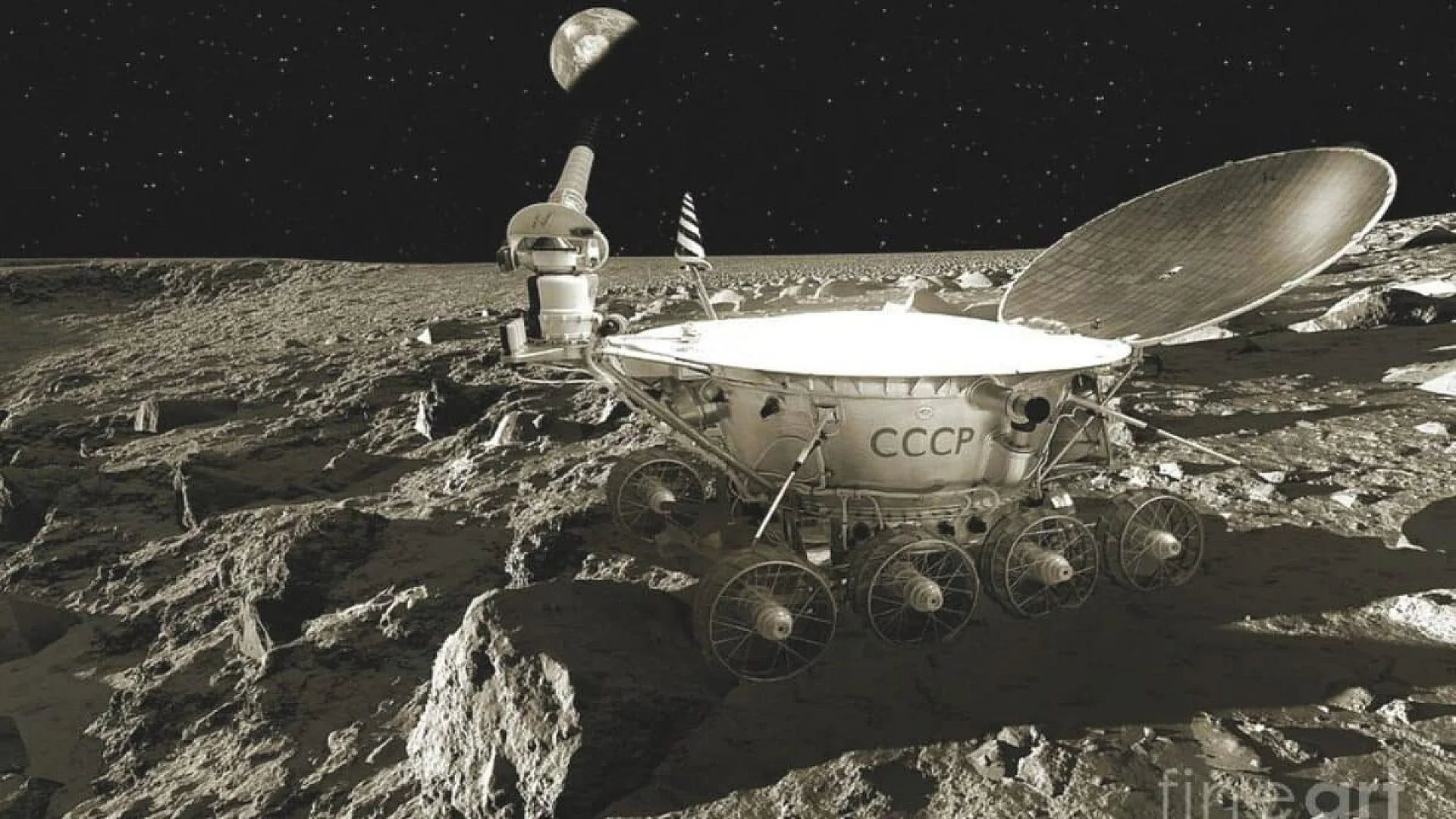
For almost four decades the Soviet lunar rover Lunokhod 1 lay hidden, not because it was dismantled but because its exact coordinates were unknown. In 2010 a team of scientists finally pinpointed its site and succeeded in bouncing a laser signal off its built‑in reflector, reviving its role in lunar science.
The vehicle itself never powered up again; the discovery concerned only its passive mirror, which continued to return light to Earth after more than thirty years of silence.
Lunokhod 1 rode to the Moon on the Luna 17 probe on 17 November 1970, marking the first time a remote‑controlled rover operated on another world. Engineered for a brief mission, it survived eleven lunar day‑night cycles before contact was lost in 1971.
A French‑made laser retroreflector was mounted on the rover’s chassis. This optical device requires no power and simply reflects incoming laser pulses back toward their source. The difficulty lay in the fact that nobody knew the exact spot where the rover had halted.
Mission Closed, Yet the Reflector Remains Functional
During its operational phase the rover traversed the Mare Imbrium region, covering roughly 10.5 kilometres before it was retired.
According to data released by the Lunar Reconnaissance Orbiter Camera team, attempts to re‑establish contact stopped after the lunar night began on 14 September 1971, with the mission officially concluding on 4 October.
Lunar laser ranging works by sending a laser pulse from Earth to a reflector on the Moon and timing the return trip, which lasts about 2.5 seconds. By measuring this interval, scientists can detect minute variations in the Earth‑Moon distance and track lunar motion.
Unlike the fixed arrays placed during the Apollo missions, Lunokhod 1’s reflector moved with the rover, making its final position increasingly hard to locate. Tom Murphy, associate professor of physics at UC San Diego, described the difficulty:
“We routinely use the three hardy reflectors placed on the moon by the Apollo 11, 14 and 15 missions, and occasionally the Soviet‑landed Lunokhod 2 reflector, though it does not work well enough to use when illuminated by sunlight. But we yearned to find Lunokhod 1.”
Orbital Imaging Pinpoints the Lost Rover
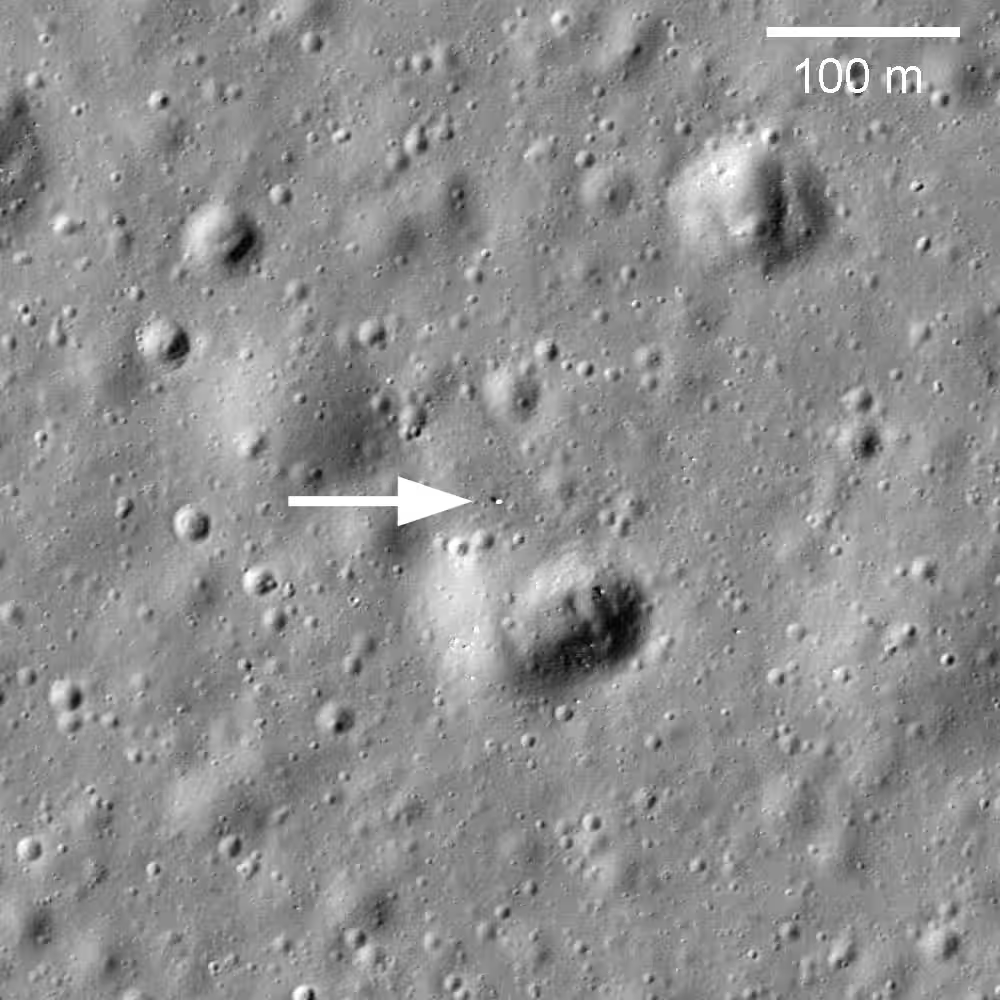
The breakthrough came almost forty years later. High‑resolution photographs from the Lunar Reconnaissance Orbiter (LRO) revealed the precise coordinates of both the rover and its landing platform.
Armed with the new location data, researchers at the Apache Point Observatory Lunar Laser‑ranging Operation (APOLLO) in New Mexico aimed laser pulses at the site in April 2010 and recorded a clear return from the reflector.

ScienceDaily reported that earlier ranging attempts with Lunokhod 2 yielded roughly 750 returned photons, whereas the first successful measurement from Lunokhod 1 produced about 2 000 photons.
Rediscovery Enhances Lunar Laser Ranging
NASA notes that lunar laser ranging is one of the longest‑running scientific programs linked to lunar exploration, with reflectors left by Apollo 11, 14, 15 and the Soviet rovers still providing data today.
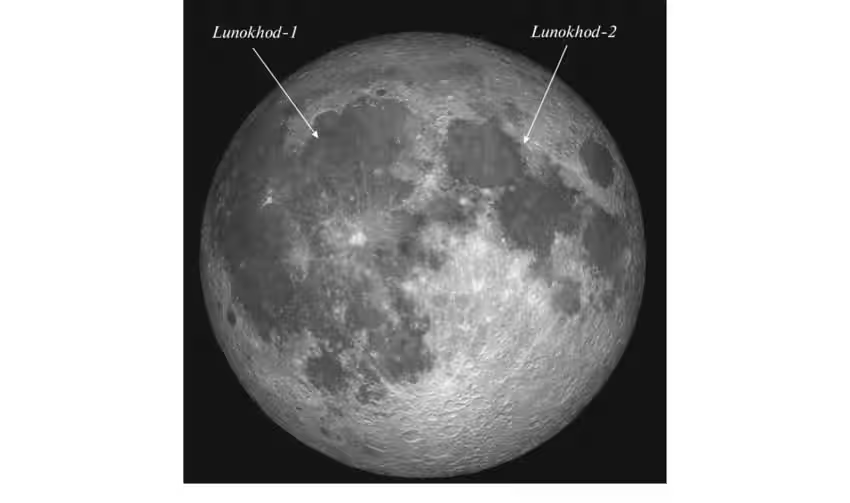
Scientists with the APOLLO project highlighted that Lunokhod 1’s position near the lunar limb improves measurements of lunar libration and helps refine models of the Moon’s interior. Murphy added another point of interest raised by the reflector’s recovery:
“Near full Moon, the strength of the returning light decreases by a factor of ten,” he said. “We need to understand what is causing this if we are contemplating putting additional scientific equipment on the Moon. Finding the Lunokhod 1 reflector will add important clues to this study.”
Long‑term laser‑ranging observations have shown that the Moon is receding from Earth at about 3.8 centimetres per year, a finding that also supports the presence of a fluid core inside the Moon.
This article has been fact checked for accuracy, with information verified against reputable sources. Learn more about us and our editorial process.
Last reviewed on .
Article history
- Latest version
Reference(s)
- “Featured Sites | Lunar Reconnaissance Orbiter Camera.” <https://lroc.im-ldi.com/featured_sites/57>.
- “Tom Murphy.” <https://tmurphy.physics.ucsd.edu/>.
- Barry, Caela. “Lunar Reconnaissance Orbiter - NASA Science.”, November 29, 2017 NASA <https://science.nasa.gov/mission/lro/>.
- “APOLLO.” <http://physics.ucsd.edu/~tmurphy/apollo/>.
- “Physicists locate long lost Soviet reflector on moon.” ScienceDaily <https://www.sciencedaily.com/releases/2010/04/100426203545.htm>.
- “3127 Faller Paper.” <https://ilrs.gsfc.nasa.gov/lw19/docs/2014/Papers/3127_Faller_paper.pdf>.
Cite this page:
- Posted by Farah Siddiqui