NASA’s Fermi Captures Gamma Rays From Record-Breaking Supernova
Fermi’s detection of gamma rays emitted by a nearby hypernova has exposed the magnetar powerhouse driving certain of the cosmos’s most dazzling stellar detonations.
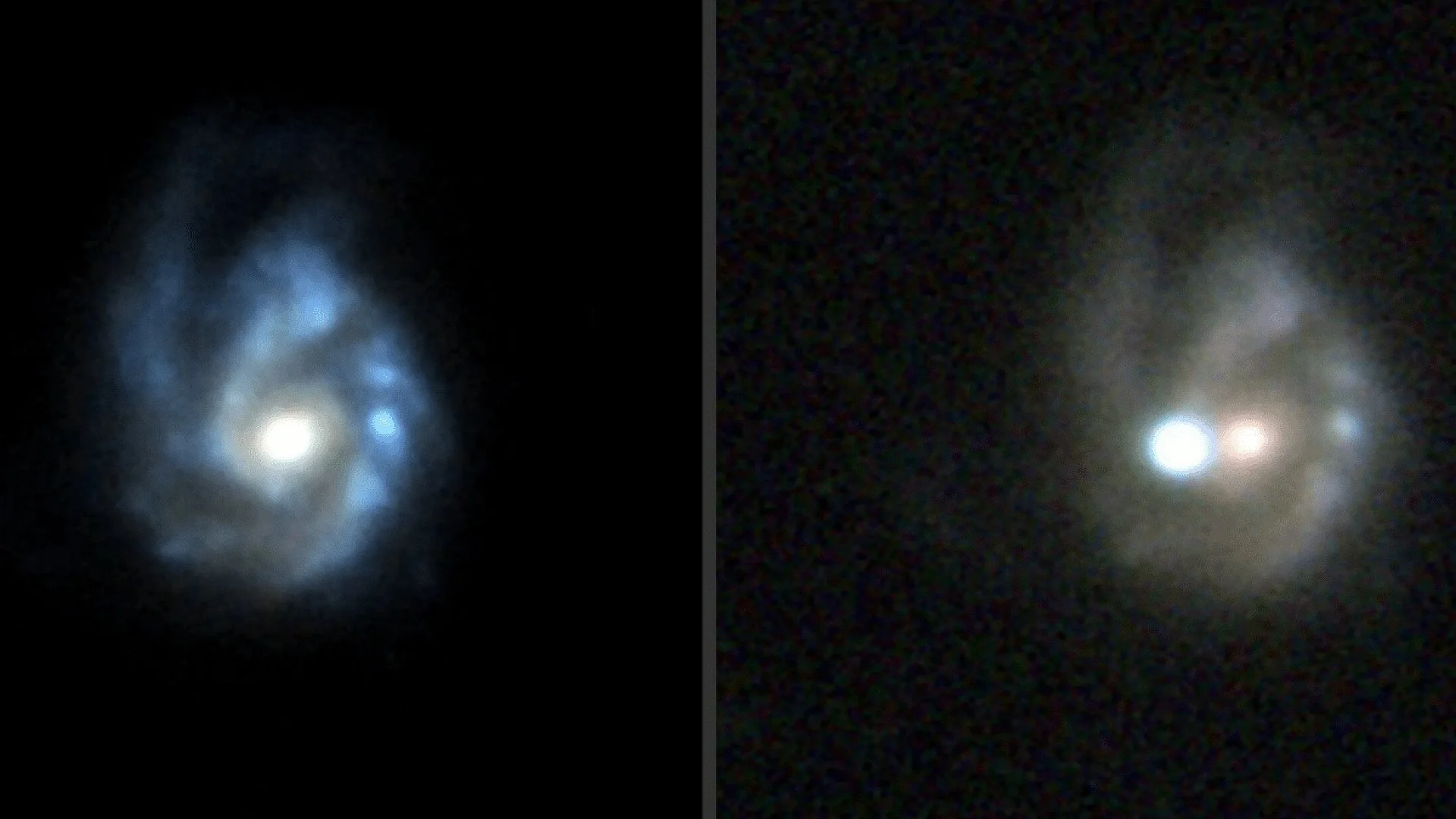
NASA’s Fermi Gamma-Ray Space Telescope has made a groundbreaking discovery, potentially marking the first clear detection of gamma rays from a superluminous supernova. This breakthrough offers a unique glimpse into the extreme physics driving these cosmic explosions, as reported in Astronomy & Astrophysics.
Unlocking the Secrets of Superluminous Supernovae
Superluminous supernovae are incredibly bright explosions that release ten times or more the visible light of typical supernovae. Until now, detecting gamma rays from these events has remained elusive. The discovery of SN 2017egm, a supernova that briefly outshone its entire host galaxy, NGC 3191, located about 440 million light-years away in Ursa Major, has opened a new window into understanding the magnetars, ultra-magnetized neutron stars, that power the universe’s most luminous stellar outbursts.
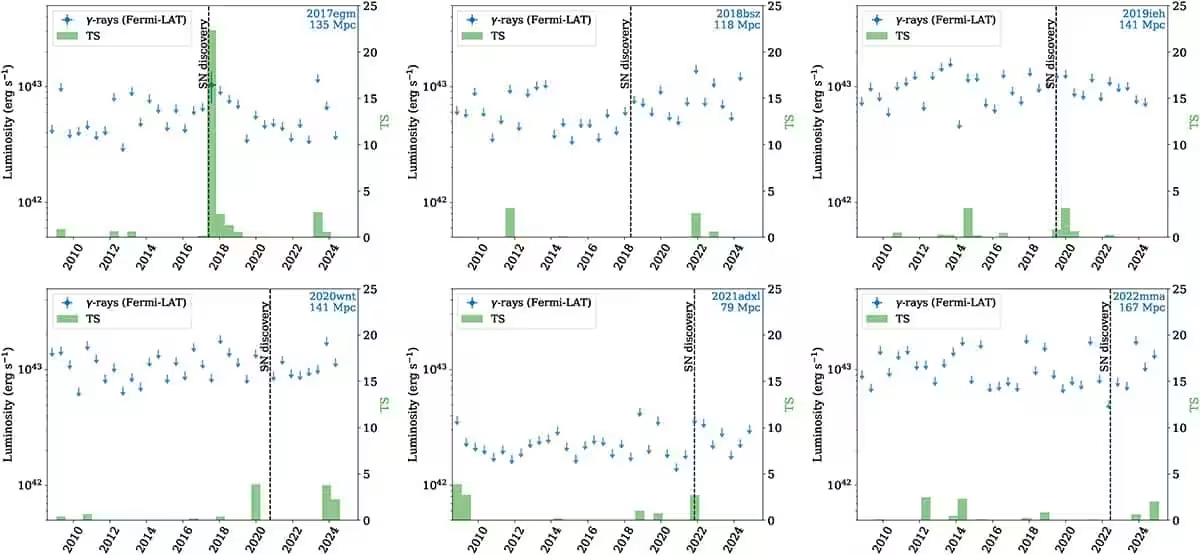
An international research team combed through Fermi’s first 16 years of data, focusing on the six nearest superluminous supernovae. The team’s findings, led by Fabio Acero at the University of Paris-Saclay, have provided a tangible connection between theoretical predictions and actual observations, offering insights into the physics powering these rare events.
“We searched for gamma rays from the six nearest superluminous supernovae seen during the first 16 years of Fermi’s mission,” explained Guillem Martí-Devesa, formerly of the University of Trieste and now at the Institute of Space Sciences in Barcelona. Remarkably, SN 2017egm was the only event showing evidence of gamma rays, confirming that some supernovae can shine as brightly in high-energy light as they do in visible wavelengths. “This opens up a new window for studying these fascinating events,” Martí-Devesa added.
Credit: Astronomy & Astrophysics
Magnetars: The Hidden Engines of Cosmic Explosions
Theorists have long suspected that magnetars, neutron stars with magnetic fields a thousand times stronger than normal, could power superluminous supernovae. When a massive star collapses, the core may form a magnetar spinning hundreds of times per second, releasing energy through high-speed winds of electrons and positrons. These particles create a magnetar wind nebula, which interacts with the supernova debris and produces gamma rays.
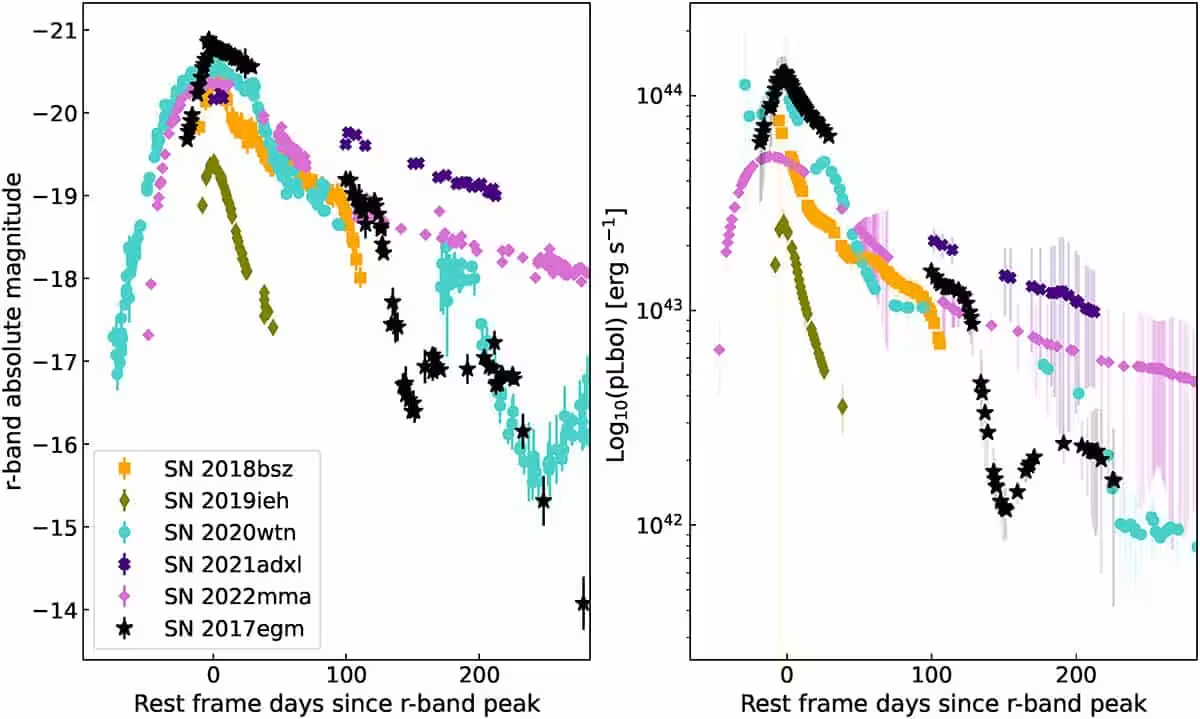
“About three months after the collapse, as the supernova debris expands and cools, the gamma rays can begin to leak out,” Acero said. “This magnetar model best reproduces the supernova’s luminosity and the arrival time of its gamma rays during the first months, but we see room for improvement at later times, when the visible light fades quite irregularly.” The detection offers a tangible connection between theoretical predictions and actual observations, providing insights into the physics powering these rare events.
Unveiling the Secrets of Superluminous Supernovae Engines
Observing gamma rays from superluminous supernovae allows astronomers to study their inner mechanisms more directly than ever. “Gamma rays give us a direct probe of the central engine powering these explosions,” said Manos Chatzopoulos, associate professor at LSU. He noted that models predicted high-energy emissions would appear once the ejecta became transparent enough, but until SN 2017egm, there was no sufficiently nearby event to confirm this. “This detection may represent some of the clearest evidence yet that we are directly observing these processes in action.”
Researchers also explored additional contributing processes, such as fallback debris onto the magnetar and interactions with material expelled by the star before its collapse. Combining these insights with advanced modeling and long-term gamma-ray data, the team aims to refine predictions for future supernovae and understand how magnetars sculpt the brightest explosions in the universe.
Credit: Astronomy & Astrophysics
A New Era of Supernova Research
The detection underscores the value of long-term monitoring and coordination between space-based and ground-based observatories. Scientists analyzed how facilities like the Cerenkov Telescope Array Observatory could detect similar supernovae, estimating that events like SN 2017egm could be observed out to roughly 500 million light-years with sufficient exposure time.
“Fermi continues to surprise us even after nearly two decades of observations,” said Michela Negro, assistant professor at LSU. This breakthrough highlights the promise of next-generation gamma-ray telescopes, which will further illuminate the inner workings of magnetars and superluminous supernovae, providing new perspectives on how massive stars die and seed the universe with energy and elements.
This article has been fact checked for accuracy, with information verified against reputable sources. Learn more about us and our editorial process.
Last reviewed on .
Article history
- Latest version
Reference(s)
- Acero, F.. “Gamma-ray signature of superluminous supernovae: Fermi-LAT GeV detection of SN 2017egm and evidence of a central engine.”, vol. 709, May 1, 2026, pp. A229, doi: 10.1051/0004-6361/202558547. <https://www.aanda.org/articles/aa/full_html/2026/05/aa58547-25/aa58547-25.html>.
Cite this page:
- Posted by Farah Siddiqui