Europe’s Euclid Telescope Just Stumbled Upon A Hidden Comet 1.3 Billion Kilometers Away
A powerful new space telescope designed to map 1.5 billion galaxies has unexpectedly captured a mysterious, unidentified streak in our cosmic backyard.
Europe’s Euclid Telescope Just Found a Comet 1.3 Billion Kilometers Away, and It Wasn’t Even Looking for One | Dungrela Publishing
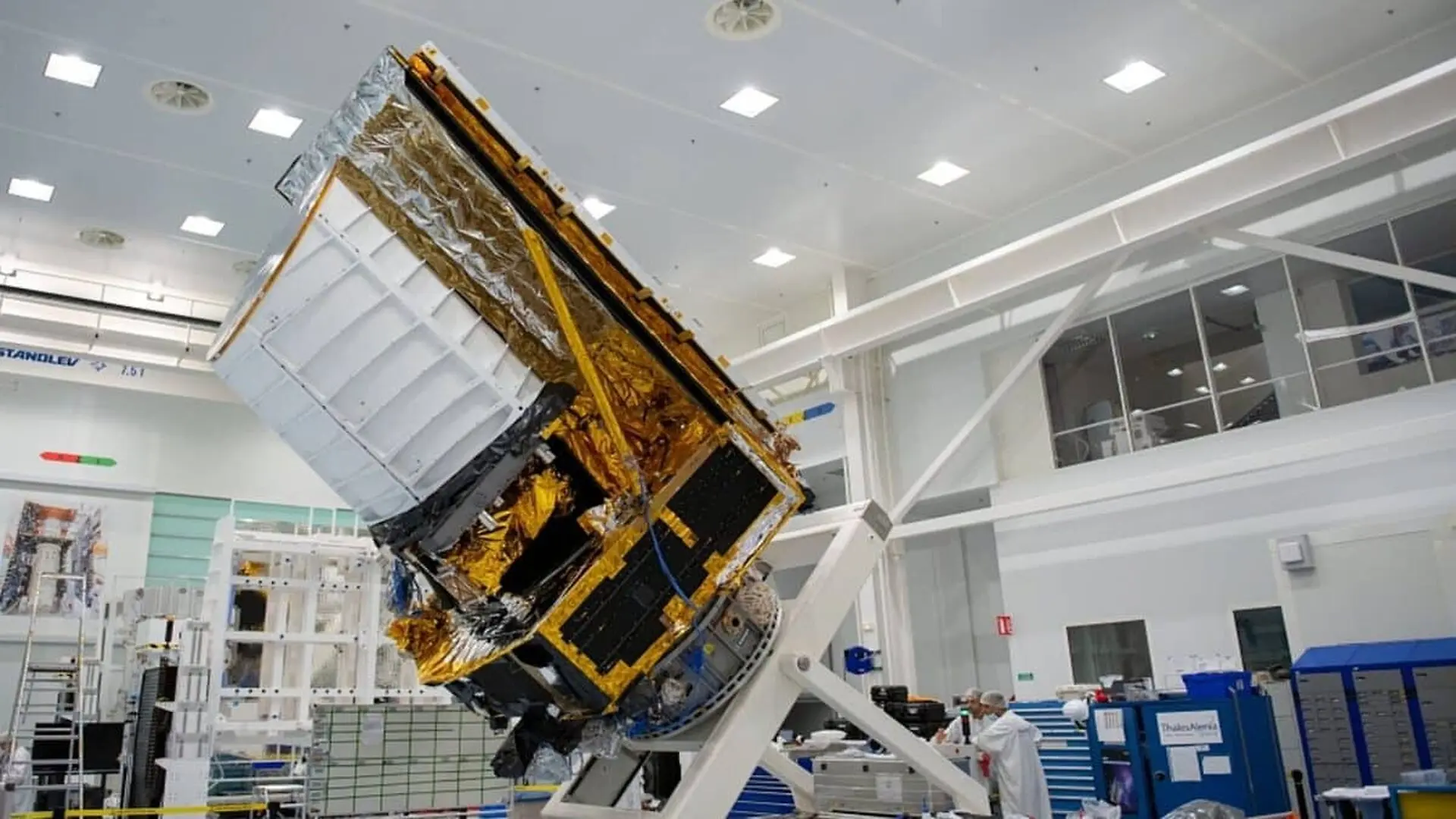
The European Space Agency’s Euclid space telescope has unexpectedly expanded its scientific legacy by identifying its first-ever comet. The object, officially designated C/2026 S1 (Euclid), was detected in mid-September 2026 while the observatory was surveying deep-space regions approximately 1.3 billion kilometers from Earth.
Although Euclid’s primary mission is to map roughly 1.5 billion galaxies to probe the nature of dark energy and the evolution of the universe over the last 10 billion years, its sensitive imaging hardware occasionally captures foreground objects. While the telescope has previously imaged known comets, C/2026 S1 (Euclid) marks the first time the instrument has identified a previously uncatalogued visitor to our solar system.
An Accidental Discovery
The discovery emerged from data collected between September 16 and 24, 2026. Specialized software, engineered by Mikko Pöntinen of the University of Helsinki, flagged a distinct motion-induced streak across several images. By cross-referencing the object’s trajectory, researchers were able to locate the body across five different observation sets.
“I was excited to see my software flag a ‘streak’ smeared across several images – the result of a fast-moving object,” Pöntinen explained. But the streak wasn’t the only clue. “ Further inspection revealed that it had a fuzzy cloud around it, indicative of an active object like a comet that is shedding dust and gas.”
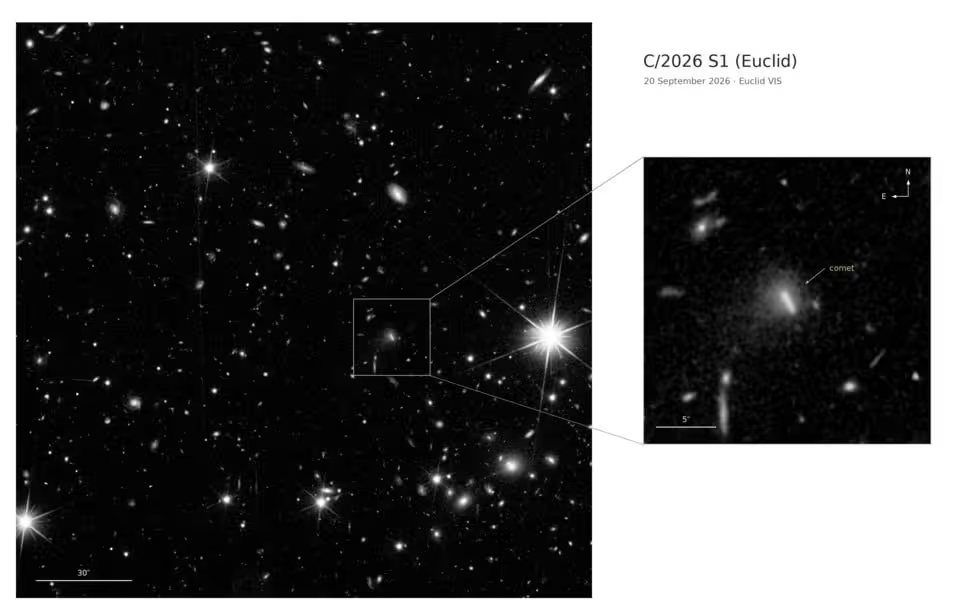
ESA’s Euclid space telescope captured comet C/2026 S1 (Euclid) on September 20, 2026. Credit: ESA
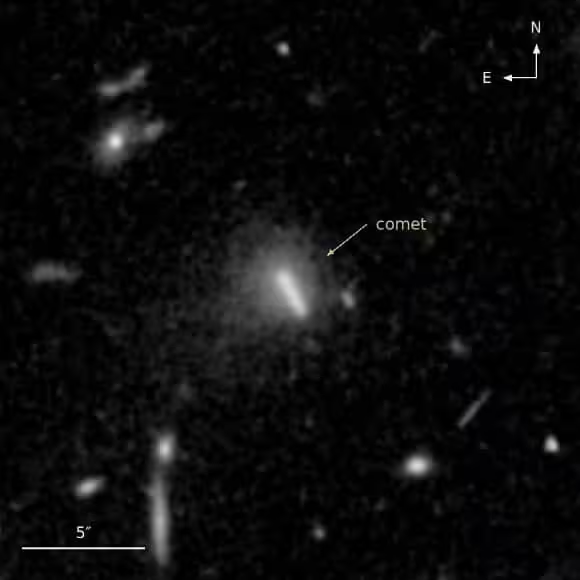
The presence of a coma—the hazy envelope of dust and gas surrounding the nucleus—confirmed the object’s identity as an active comet. After a thorough search of existing astronomical databases yielded no matches, the findings were submitted to the Minor Planet Center, where ground-based observations eventually solidified the discovery.
Defying the Usual Trajectory
Euclid is strategically operated to avoid the plane of the Milky Way to minimize interference from galactic dust, which typically limits its exposure to solar system debris. However, C/2026 S1 (Euclid) followed a highly inclined orbital path that brought it directly into the telescope’s line of sight within the Euclid Deep Field North, located in the constellation Draco. This region was previously scanned by the now-retired Spitzer Space Telescope.
According to Bruno Altieri, a scientist with the Euclid Archive, the encounter was a matter of serendipity. The comet’s unique path intersected with the observatory’s deep-space schedule, offering a rare opportunity to observe an ancient, icy relic from the early solar system.
Comet C/2026 S1 (Euclid) appears in an image taken by ESA’s Euclid space telescope. Credit: ESA/Euclid/Euclid Consortium/NASA/Pöntinen & al.
Testing Future Protocols
While this specific comet is not an target for future missions like Comet Interceptor, the event has served as a valuable exercise in operational coordination. By identifying and reporting the transient object, the Euclid team has successfully stress-tested its alert and verification protocols for future, high-priority discoveries.
“While this particular comet is not a suitable candidate for Comet Interceptor, the process of discovery and alert gives us a real test case for how our two mission teams will coordinate in the future. And we are of course happy to have discovered a previously unknown comet for the Solar System community to follow-up on,” said, Euclid Project Scientist, Valeria Pettorino.
#Euclid has discovered its first previously unknown comet.
C/2026 S1 appeared in September images about 1.3 billion km from Earth, complete with a faint coma of dust and gas.
A telescope built to study the dark universe just found a new neighbour.
#Space #SpaceExploration https://t.co/Wo8ZrU3O99
Ahmed, Aisha. “Europe’s Euclid Telescope Just Stumbled Upon A Hidden Comet 1.3 Billion Kilometers Away.” BioScience. BioScience ISSN 2521-5760, 25 October 2026. <https://www.bioscience.com.pk/en/subject/astronomy/europes-euclid-telescope-just-found-a-comet-1-3-billion-kilometers-away-and-it-wasnt-even-looking-for-one>.
Ahmed, A. (2026, October 25). “Europe’s Euclid Telescope Just Stumbled Upon A Hidden Comet 1.3 Billion Kilometers Away.” BioScience. ISSN 2521-5760. Retrieved October 25, 2026 from https://www.bioscience.com.pk/en/subject/astronomy/europes-euclid-telescope-just-found-a-comet-1-3-billion-kilometers-away-and-it-wasnt-even-looking-for-one
Ahmed, Aisha. “Europe’s Euclid Telescope Just Stumbled Upon A Hidden Comet 1.3 Billion Kilometers Away.” BioScience. ISSN 2521-5760. https://www.bioscience.com.pk/en/subject/astronomy/europes-euclid-telescope-just-found-a-comet-1-3-billion-kilometers-away-and-it-wasnt-even-looking-for-one (accessed October 25, 2026).