Large Neutrino Detectors May Reveal Boosted Dark Matter Signatures
New calculations reveal how underground liquid scintillator detectors can hunt for relativistic dark matter particles by tracking knocked-out neutrons.
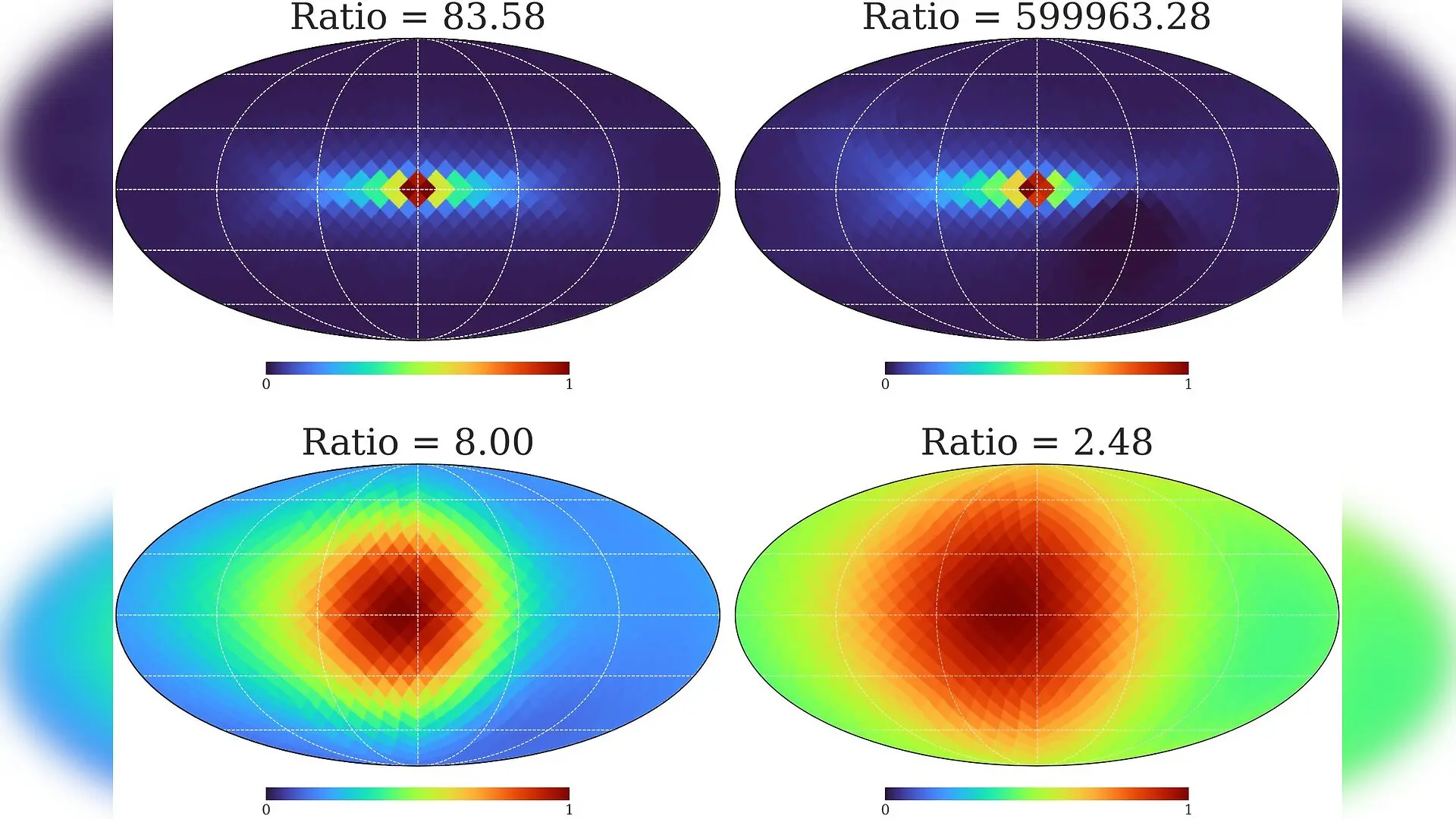
Dark matter remains one of the greatest enduring mysteries in modern physics. Although astrophysical observations from galactic rotation curves to cosmic microwave background radiation confirm its gravitational dominance, its microscopic particle nature is still unknown. Conventional direct-detection experiments designed to spot slow-moving galactic halo particles struggle to register sub-GeV masses because the resulting nuclear recoil energies fall below detector thresholds. To bypass this barrier, researchers increasingly study cosmic-ray-boosted dark matter, a scenario where energetic cosmic rays collide with cold galactic dark matter and propel it to relativistic velocities.
When these boosted particles stream toward Earth, they possess enough energy to trigger large underground detectors. Large liquid scintillator detectors offer distinct advantages for catching these rare interactions due to their expansive target volumes and low energy thresholds. The detailed research is available on the arXiv preprint server, published in the study titled Boosted Dark Matter Directionality in Large Liquid Scintillator Detectors. In this work, the authors focus on quasi-elastic scattering interactions where incoming boosted dark matter strikes carbon-12 nuclei inside the scintillator, knocking out a bound neutron while leaving an excited residual nucleus behind.
Tracking Neutrons through Prompt-Delayed Coincidence
Detecting these elusive collisions relies on a sophisticated chain of particle tracking. When a boosted dark matter particle knocks out a neutron, the interaction generates prompt scintillation light from secondary charged particles. The liberated neutron then propagates through the liquid scintillator, undergoing multiple collisions until it slows down and thermalizes, typically after roughly two hundred microseconds. At that point, the neutron is captured by a proton or carbon nucleus, releasing a characteristic delayed gamma ray that creates a secondary interaction vertex.
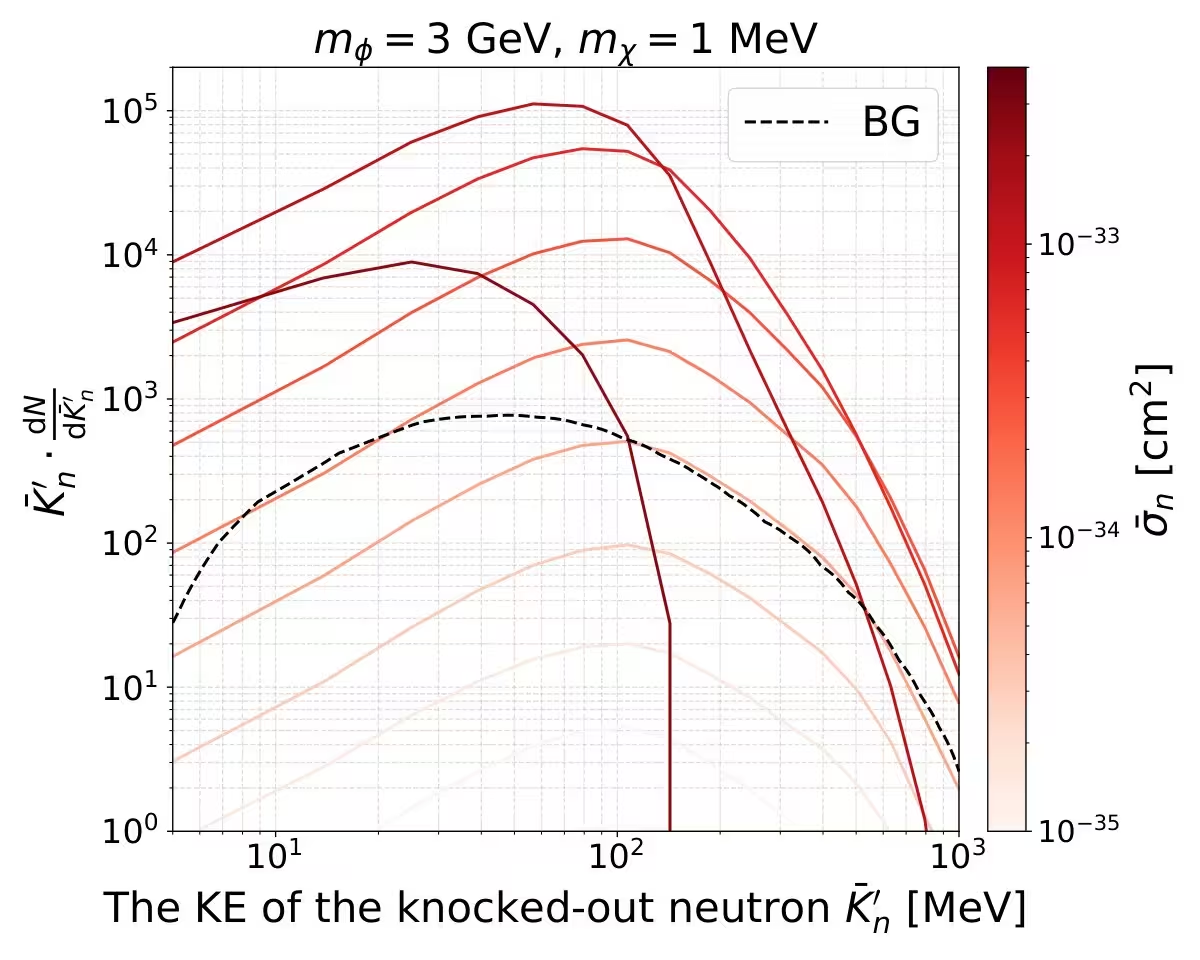
By pairing the prompt signal with the delayed gamma-ray capture, scientists establish a powerful coincidence requirement that drastically suppresses background noise from single, isolated energy depositions. Furthermore, the number of bound neutrons available in organic liquid scintillator outnumbers free protons significantly, and the nuclear target density provides a much higher interaction rate. To model this complex transport and capture process, the team utilized advanced Monte Carlo simulations via the Geant4 toolkit, mapping out expected event rates and accounting for vertex reconstruction resolutions and optical quenching effects.
The Limits of Directional Sensitivity
Overcoming Background Noise from Atmospheric Neutrinos
Even with advanced coincidence tagging, detectors must contend with irreducible backgrounds. The primary source of indistinguishable background noise comes from atmospheric neutrino neutral-current quasi-elastic scattering off carbon, which produces an identical signature involving an invisible neutrino, a knocked-out neutron, and an excited residual nucleus. To evaluate the discovery potential, the research team calculated expected sensitivity limits for a standard exposure of one hundred kiloton-years.
The calculations demonstrate that the neutron-knockout channel yields stronger constraints on spin-independent dark matter-nucleon cross sections than previous studies focusing solely on free-proton scattering. For a mediator mass of one gigaelectronvolt, the projected sensitivity approaches the levels anticipated for next-generation facilities like Hyper-Kamiokande, highlighting the immense power of kiloton-scale liquid scintillator architectures.
Why Directionality Offers Only Marginal Gains
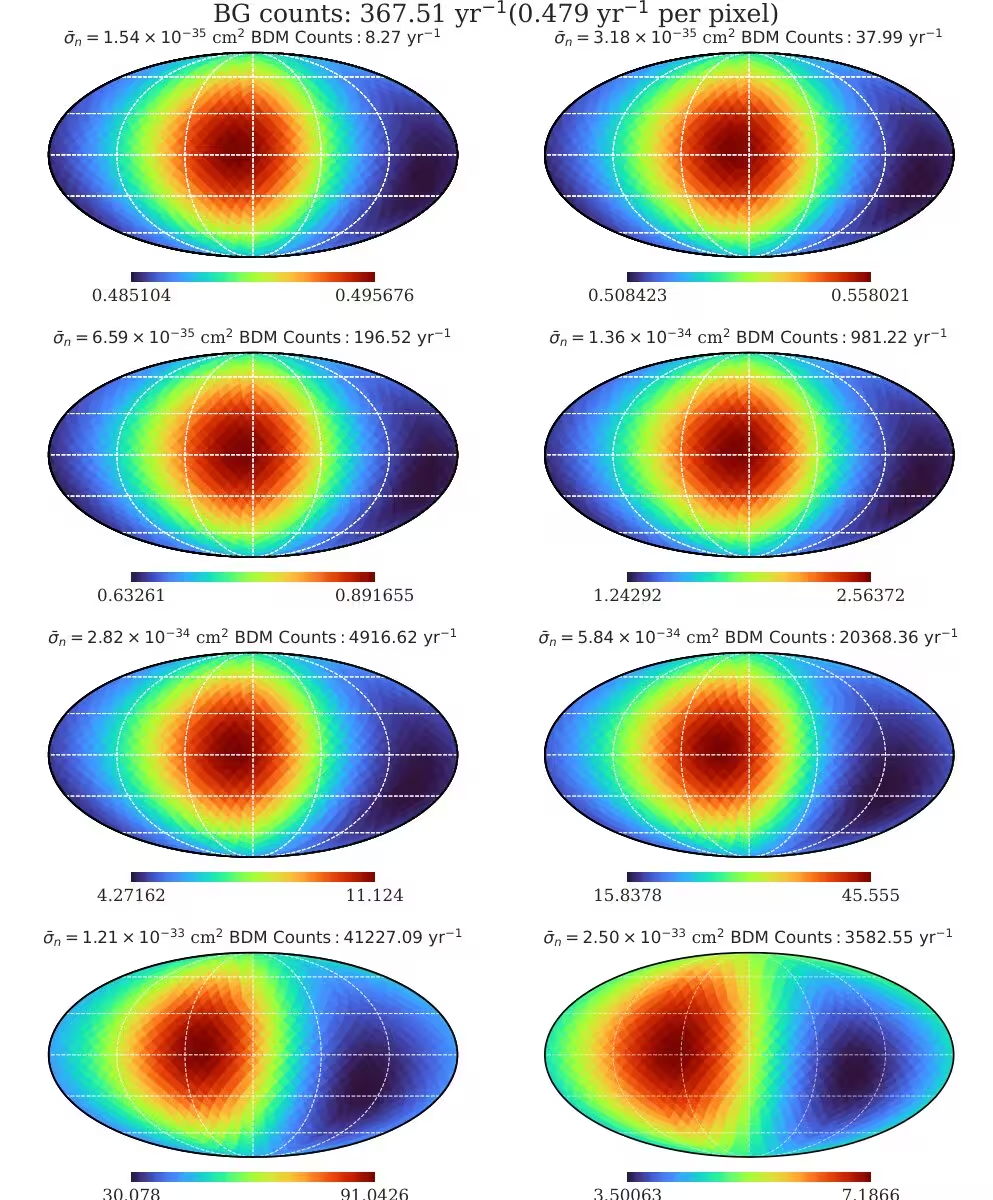
A major focus of the investigation was whether utilizing the directional orientation of the knocked-out neutron could enhance signal-to-background separation. Because galactic dark matter is concentrated toward the galactic center, boosted dark matter should exhibit a directional preference. The authors analyzed whether tracking the displacement vector between the initial emission vertex and the final capture vertex could preserve this directional memory.
Surprisingly, the analysis reveals that incorporating directional information improves sensitivity by only about three percent. The underlying reason is rooted in nuclear physics, as the initial nucleon scattering angle inherently smears the trajectory of the knocked-out neutron. Combined with diffusion effects and vertex reconstruction uncertainties, the directional contrast of the incoming flux is largely washed out before it can be exploited. Consequently, while tracking neutron directionality comes at virtually no additional experimental cost, it cannot dramatically boost constraints on its own. Researchers suggest that future gains may instead require looking toward alternative channels with sharper directional profiles, such as dark matter annihilation modes.
The study was posted to the arXiv preprint server on October 22, 2026.
This article has been fact checked for accuracy, with information verified against reputable sources. Learn more about us and our editorial process.
Last reviewed on .
Article history
- Latest version
Reference(s)
- Tse, Samuel. “Boosted Dark Matter Directionality in Large Liquid Scintillator Detectors.” arXiv.org <http://arxiv.org/abs/2610.31666v1>.
Cite this page:
- Posted by John Williams