Astronomers Discover Mysterious Dragon Egg That Could Reveal How Massive Stars Are Born
Astronomers have discovered a dense object 16,300 light-years away that appears to be capturing a massive star in its earliest stage of formation.
Astronomers have peered deep into the “Dragon Cloud,” a dense, frigid nebula located approximately 16,300 light-years away, to capture an unprecedented look at a mysterious, compact object dubbed the “dragon egg.” This celestial feature, known to researchers as C2c1a, serves as a high-stakes laboratory for understanding the volatile, poorly understood origins of the universe’s most massive stars.
Decoding the Origins of Stellar Giants
The nature of how stars exceeding eight times the mass of our Sun emerge remains one of astrophysics’ most significant puzzles. Current scientific debate centers on two primary models: whether these giants originate from the collapse of a single, massive, pre-existing core, or if they begin as smaller stellar embryos that steadily aggregate matter from their surroundings over time. Finding a dense, massive core before the ignition of stellar activity is essential to validating either theory.
According to a study recently accepted for publication in Astronomy & Astrophysics, the Dragon Cloud is an ideal testing ground. The cloud’s parent clump contains roughly 1,061 solar masses but exhibits a remarkably low radiation output for its size, signaling that it is still in a primitive, pre-stellar state.
High-Resolution Insights from ALMA
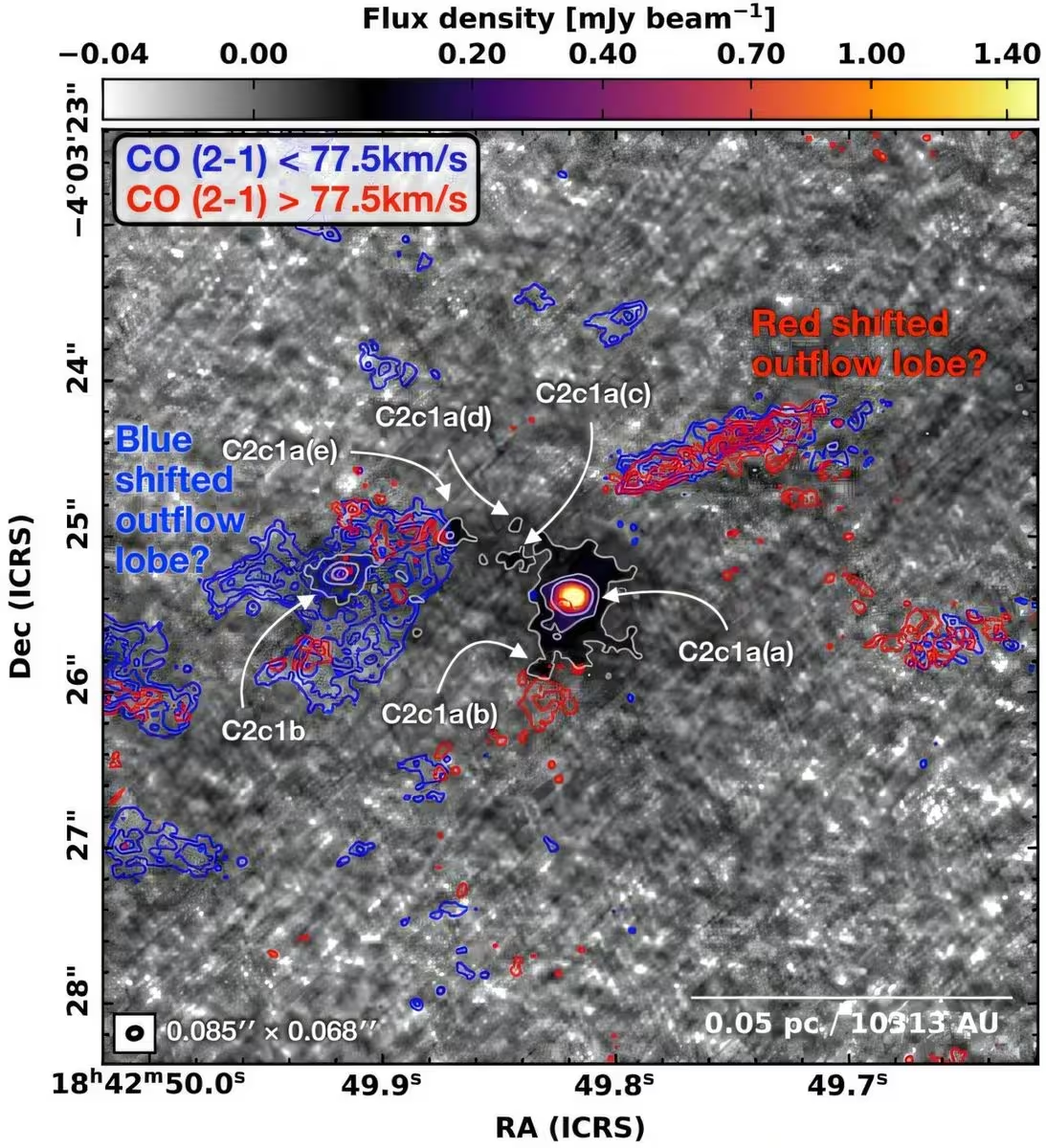
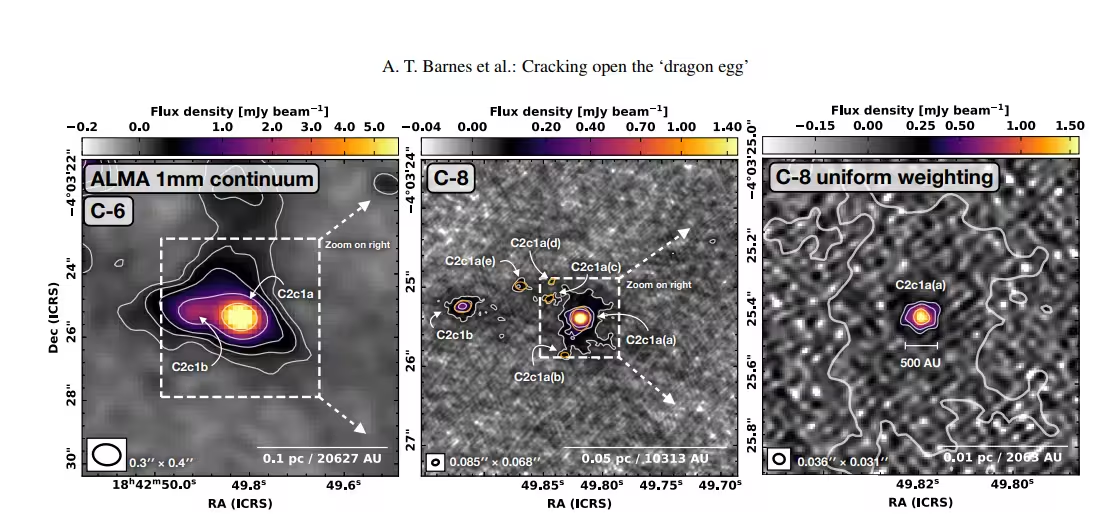
Led by Ashley Thomas Barnes of the European Southern Observatory (ESO), the research team utilized the Atacama Large Millimeter/submillimeter Array (ALMA) to resolve the core with unprecedented sensitivity. The data indicates that the region is far more intricate than previously assumed, revealing a complex assembly of six distinct components. At its heart lies C2c1a(a), a primary structure anchored within a massive, cold reservoir containing at least 110 solar masses of gas and dust.
Despite this high-resolution clarity, the team faced a lingering ambiguity: is there actually a protostar inside? Typically, young stars announce their presence through high-energy jets and molecular outflows as they pull in surrounding material. However, spectral analysis of the “dragon egg” showed no clear evidence of such outflows or the distinct molecular emission associated with active heating.
A Primeval Stage of Development
The lack of these signatures could mean one of two things: either the core is so cold that a protostar has not yet formed, or the sheer density of the surrounding dust is effectively cloaking the activity. Furthermore, without precise temperature readings, scientists cannot confirm whether the object is a genuinely massive, frigid core or a smaller, warmer entity obscured by a much colder shroud.
The cloud’s luminosity-to-mass ratio sits at approximately 0.5, a value significantly lower than the standard threshold for active star-forming regions. This suggests that the Dragon Cloud remains in an exceptionally early, pristine state of gravitational assembly. While the findings align with models of monolithic core-accretion, the ultimate question of whether the “dragon egg” will grow into a massive star or dissipate remains open, marking it as a rare, invaluable window into the very dawn of stellar life.
This article has been fact checked for accuracy, with information verified against reputable sources. Learn more about us and our editorial process.
Last reviewed on .
Article history
- Latest version
Reference(s)
- Barnes, A.. “Cracking open the "dragon egg": ALMA 1.3mm observations of a compact, young high-mass core candidate at 30mas resolution.” arXiv.org <https://arxiv.org/abs/2610.07138>.
Cite this page:
- Posted by Aisha Ahmed