Scientists Have Found a Way to Turn Plastic Into Tiny Diamonds Using Lasers
Researchers have discovered that ordinary plastic can transform into diamonds under extreme pressure, mimicking the conditions found deep inside giant planets.
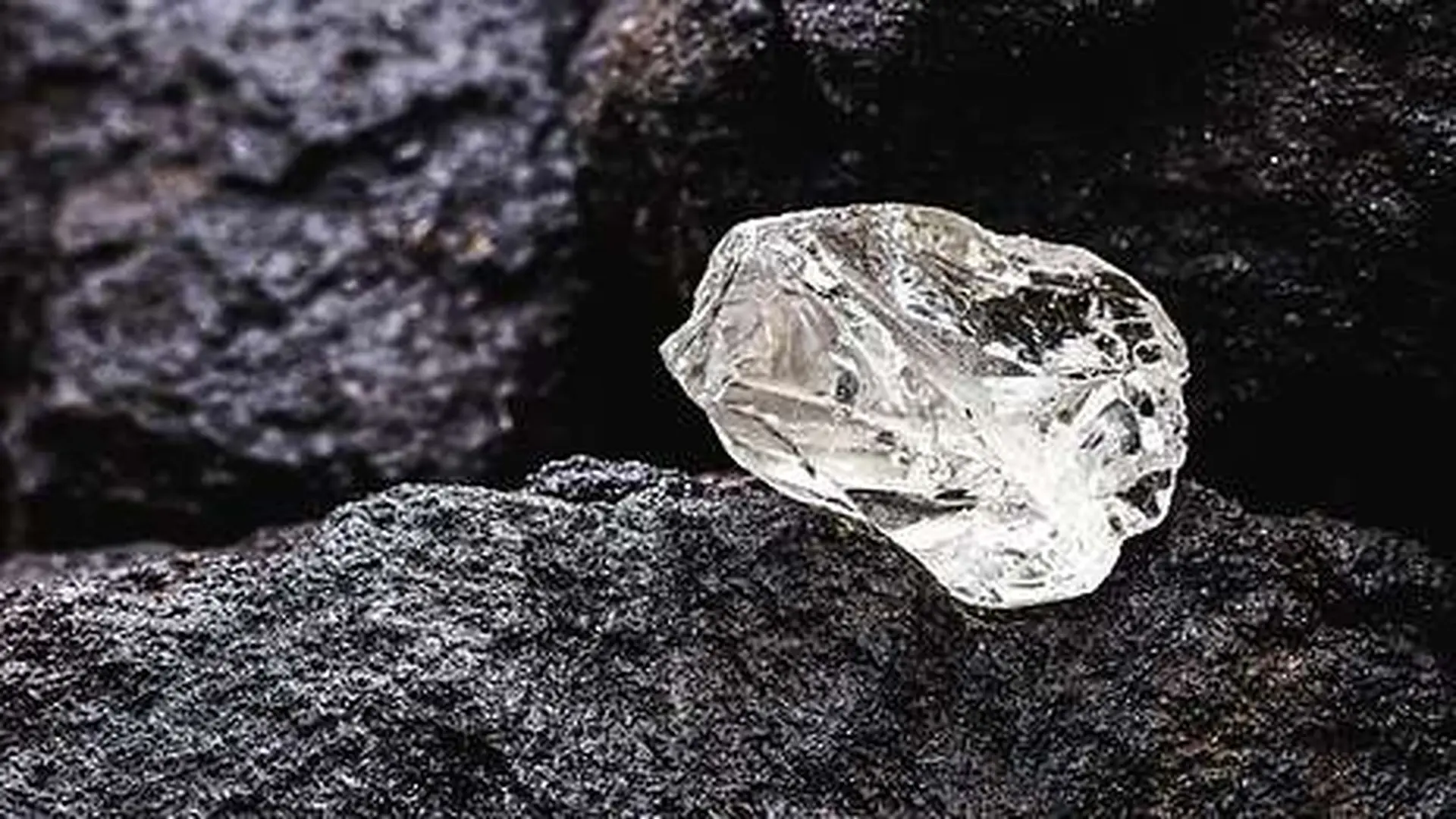
Researchers have successfully transformed common plastic into trillions of microscopic diamonds using high-intensity laser technology. In a breakthrough for materials science, the team managed to capture these crystals intact, even as they were ejected at staggering velocities exceeding 22,000 miles per hour.
This achievement comes from a collaborative effort between the Helmholtz-Zentrum Dresden-Rossendorf (HZDR) and the University of Rostock. While the experiments were originally conceived to simulate the extreme pressures and temperatures found deep within ice giants like Neptune and Uranus, the project has evolved into a practical method for synthesizing high-purity nanodiamonds.
From Planetary Simulations to Nanoscale Manufacturing
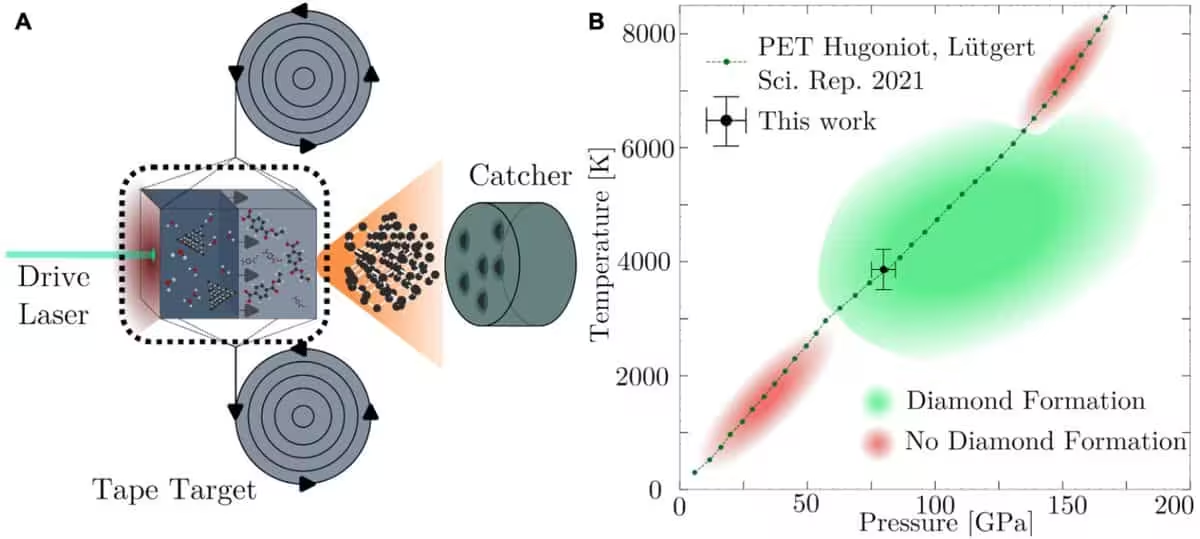
The study, recently published in Diamond and Related Materials, utilized thin films of polyethylene terephthalate (PET) plastic. By subjecting this material to rapid, intense laser pulses, the researchers generated shock waves that compressed the carbon atoms into crystalline structures. Earlier efforts had observed these diamonds fleetingly, but this study marks the first time they have been successfully recovered for analysis.
“We did expect nanodiamonds to form under these conditions. What surprised us, however, was how quickly it happened,” noted Dominik Kraus, a professor at the University of Rostock.
Capturing Particles at Hypersonic Speeds
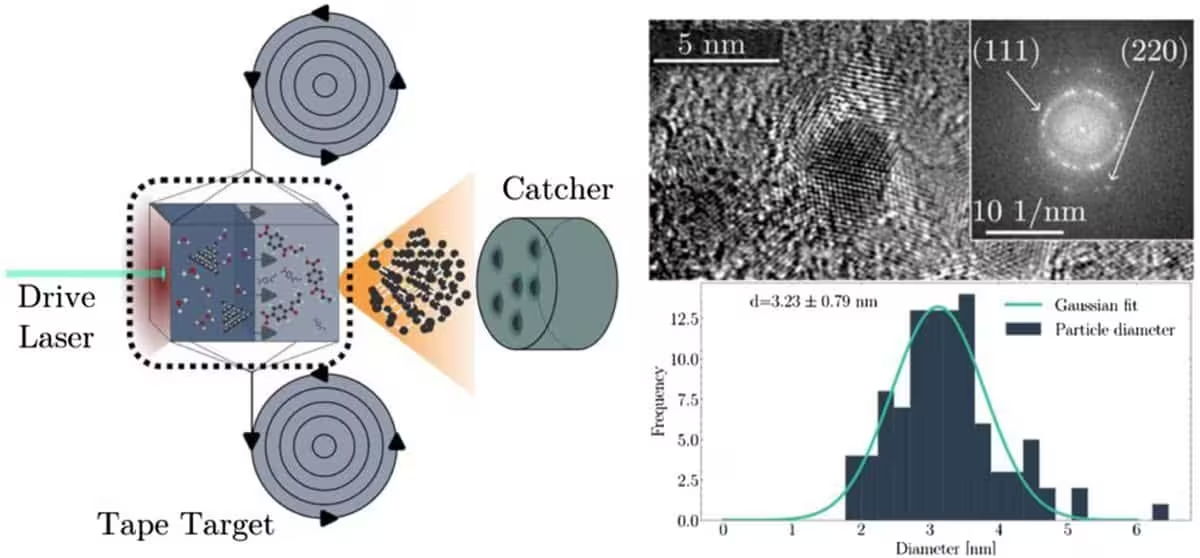
The experimental setup at the Extreme Light Infrastructure (ELI) facility required an ingenious solution to prevent the destruction of the nanodiamonds. As the shock waves exited the 100-micrometer-thick plastic, the newly formed diamonds were propelled into a vacuum at speeds reaching 10 kilometers per second—a velocity akin to a meteorite impact. To save these delicate structures, the team utilized a water-soluble ionic gel that acted as a soft landing pad, allowing the crystals to be extracted and purified.
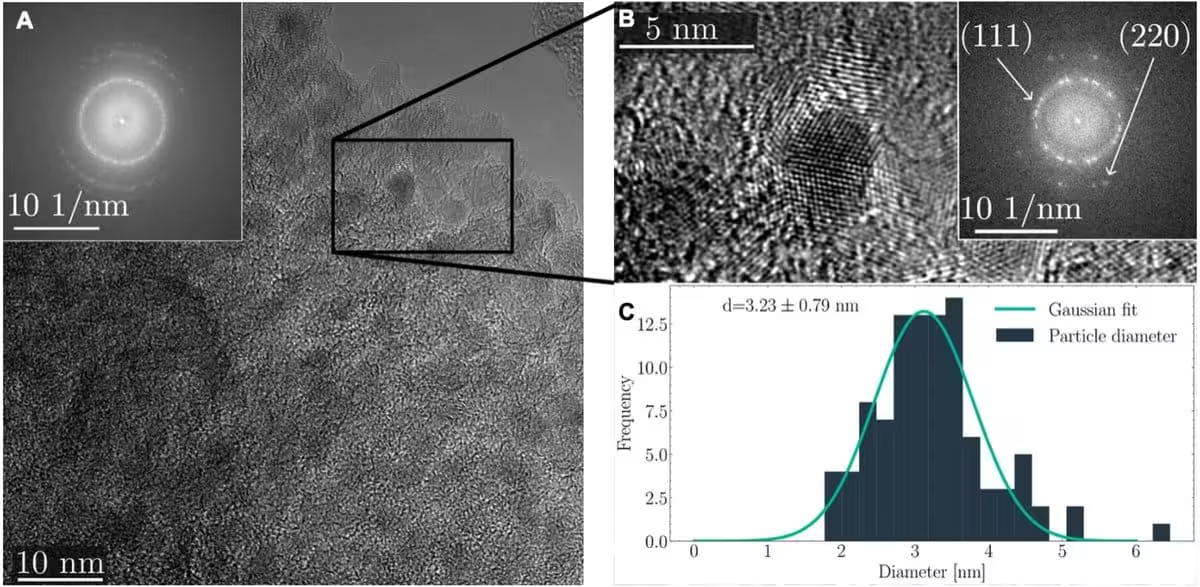
The resulting particles measure approximately three nanometers across, each composed of roughly 3,000 carbon atoms. While each laser shot generates nearly 10 trillion particles, the current recovery rate is in the microgram range. The team analyzed their harvest using an ELMI-MV electron microscope, which allowed them to visualize individual atoms within the crystals.
Future Applications in Quantum and Medical Tech
The high purity and uniform size of these laser-synthesized diamonds offer distinct advantages over traditional manufacturing techniques. Because of their immense surface-to-volume ratio, these particles are highly effective for chemical catalysis, such as sunlight-driven carbon dioxide conversion. Furthermore, through precise doping, these diamonds could serve as sophisticated contrast agents in MRI imaging or as high-precision quantum sensors.
“That was a special moment we had been working towards for years,” said Ben Heuser, the study’s lead author, reflecting on the first time the team successfully examined the captured samples.
As the team looks to increase production to the milligram scale, they are also setting their sights on more ambitious projects. Future experiments are slated to investigate the creation of BC8—a theoretical, ultra-dense carbon structure that is predicted to be harder than diamond—by applying even more intense pressures to plastic precursors.
This article has been fact checked for accuracy, with information verified against reputable sources. Learn more about us and our editorial process.
Last reviewed on .
Article history
- Latest version
Reference(s)
- “Schematic collision ERDA - Helmholtz-Zentrum Dresden-Rossendorf, HZDR.”, October 18, 2022 <https://www.hzdr.de/db/Cms?pOid=67439&pNid=0>.
- “Physics - Institut für Physik - University of Rostock.” <https://www.physik.uni-rostock.de/en/>.
- <https://www.sciencedirect.com/science/article/pii/S0925963526008022?via%3Dihub>.
- “Dominik Kraus.” <https://scholar.google.com/citations?user=IdoqT6sAAAAJ&hl=de>.
Cite this page:
- Posted by Bilal Abbasi