Physicists Reveal Whether A Black Hole Can Actually Split In Two
Can a black hole split into two? A new theoretical study explores the physics of entropy and rotation to see if such a phenomenon is physically possible.
Black holes are famous for their appetite, constantly merging to form more massive entities. However, the prospect of the reverse process—a single black hole fracturing into two distinct bodies—remains a profound theoretical puzzle. According to the standard interpretation of Einstein’s general relativity, such a division is fundamentally forbidden. A new study, however, is mapping the specific conditions and theoretical loopholes that might permit such an event.
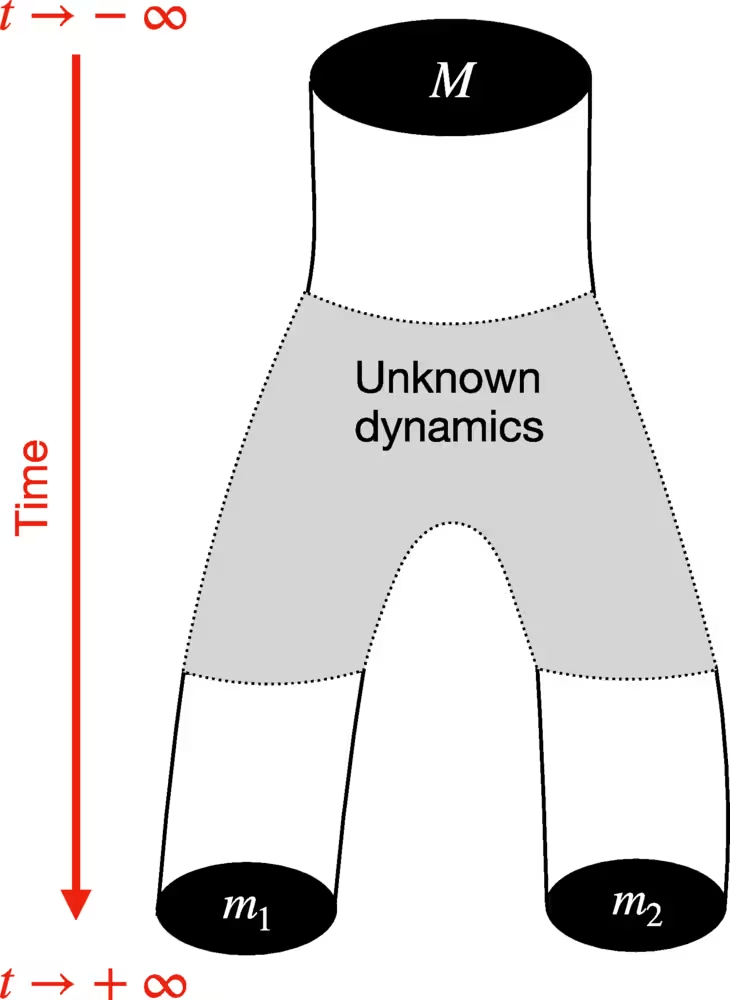
The research, published in Physical Review D, was conducted by an international team from the University of Southern Denmark, the University of Naples Federico II, and the CNRS–Sorbonne Université laboratory LPTHE. The authors, including Francesco Sannino, Giacomo Cacciapaglia, Manuel Del Piano, and Vania Vellucci, explore what they term “pair-of-pants topologies”—a geometric representation where a single black hole horizon branches into two separate “legs” over time.

The Entropy Barrier
At the heart of the resistance to fragmentation lies the principle of entropy. In the realm of general relativity, the entropy of a black hole is directly linked to the surface area of its event horizon. For a nonrotating black hole, the area scales with the square of its mass. Mathematically, this means a single, large black hole possesses more entropy than two smaller ones of equivalent total mass. Consequently, the second law of thermodynamics strongly disfavors a spontaneous split, as it would represent a decrease in total entropy.
Stephen Hawking’s classical area theorem reinforces this, positing that the area of an event horizon cannot decrease over time under standard conditions. While these rules provide a robust barrier, they rely on specific assumptions regarding the behavior of spacetime and matter. The new study tests whether those assumptions can be relaxed to allow for a different outcome.
Rotation as a Potential Catalyst
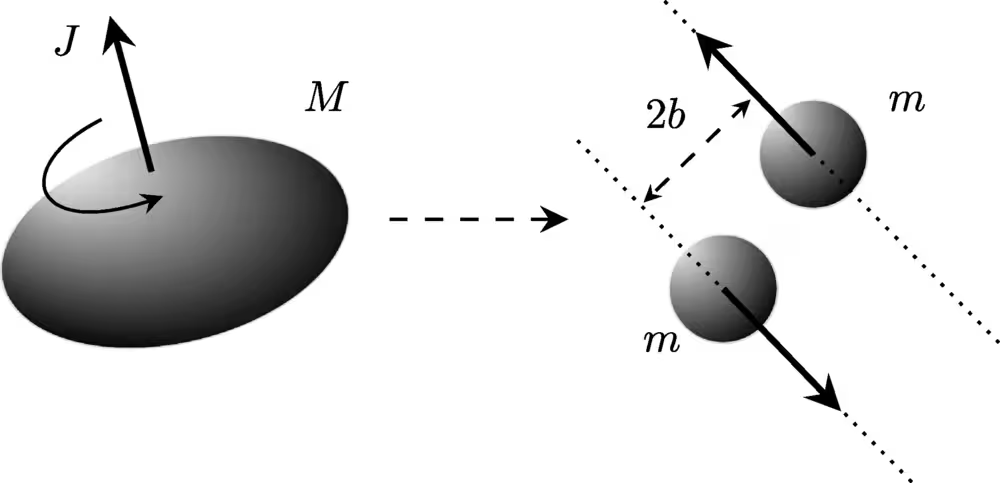
The researchers identify rotation as a critical variable. Rotating black holes possess different thermodynamic properties than their nonrotating counterparts, potentially offering a way to bypass the entropy bottleneck. If a rapidly spinning black hole could shed its angular momentum into the orbital motion of two resulting fragments, the total entropy of the system might remain stable or even increase.
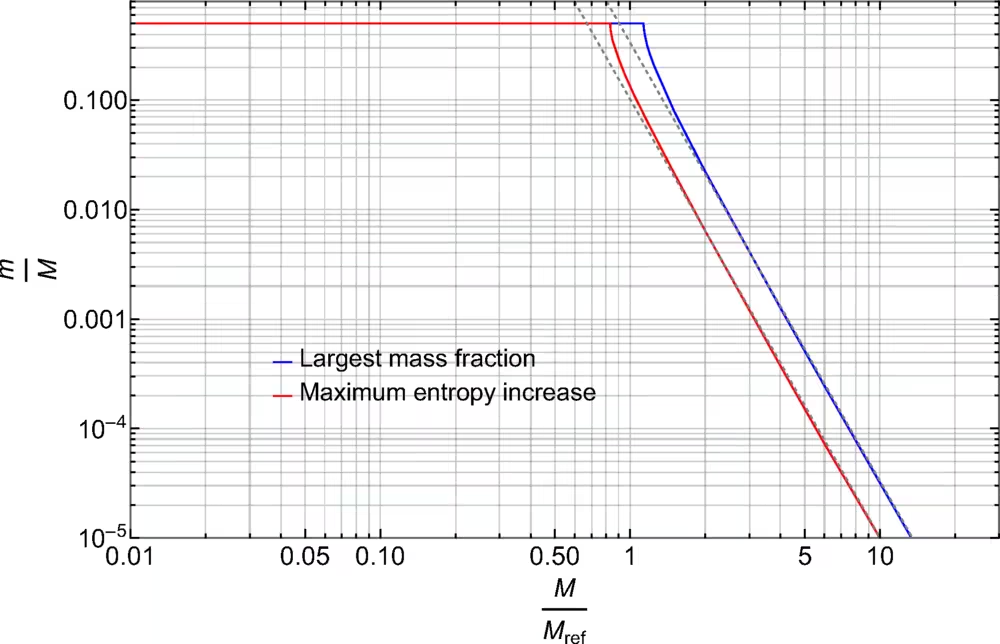
However, this path is fraught with physical constraints. The team modeled a scenario where a large, ultra-spinning black hole releases a much smaller fragment. For this to work, the fragment must have enough kinetic energy to escape the gravitational pull of the parent body without simply falling back in. Their analysis reveals that these conditions only align when the parent black hole is spinning near its theoretical maximum limit, suggesting that even in ideal scenarios, such events would be exceptionally rare or impossible in typical astrophysical environments.
Beyond the Horizon
The “pair-of-pants” model remains a hypothetical construct. Even if the thermodynamics were to allow for a split, the geometry of the event horizon itself presents a major hurdle. Standard gravitational theory prevents an event horizon from bifurcating toward the future. A physical split would likely require a breakdown in the predictability of spacetime, potentially resulting in the formation of a “naked singularity”—a point of infinite density not hidden behind a horizon.
The authors point to higher-dimensional physics, such as the Gregory–Laflamme instability observed in black strings, as evidence that fragmentation behavior is highly dependent on the underlying theory of gravity. By adjusting mass-entropy relationships or incorporating higher-curvature corrections, it becomes possible to find mathematical solutions where fragmentation is favored. However, these models currently serve more as a guide for what would need to change in our laws of physics to allow such phenomena, rather than proof that they actually occur in our universe.
Future Directions for Observation
While the study does not claim to have discovered a mechanism for black hole fission, it opens a dialogue about the signatures such an event might leave behind. If primordial black holes or smaller fragments were to form during mergers, they might exhibit unique Hawking radiation patterns detectable by observatories like Fermi-LAT. For now, the work acts as a theoretical framework, defining the boundaries of what is possible and highlighting where our current understanding of gravity may be incomplete.
This article has been fact checked for accuracy, with information verified against reputable sources. Learn more about us and our editorial process.
Last reviewed on .
Article history
- Latest version
Reference(s)
- Cacciapaglia, Giacomo., et al. “When black holes admit pair-of-pants topologies.” Physical Review D, vol. 114, no. 8, October 22, 2026 American Physical Society (APS), doi: 10.1103/cx69-t466. <https://journals.aps.org/prd/abstract/10.1103/cx69-t466>.
- “University of Southern Denmark, SDU.”, October 23, 2026 sdu <https://www.sdu.dk/en/>.
- “Università degli Studi di Napoli Federico II.” <https://www.international.unina.it/>.
- “Welcome to the LPTHE.” <https://www.lpthe.jussieu.fr/static/en/index.html>.
Cite this page:
- Posted by Aisha Ahmed