Scientists Reveal The Sun’s Spinning Jets May Actually Be Massive Folded Plasma Curtains
New solar simulations reveal that the Sun’s spinning jets are actually folded plasma curtains shaped by powerful, unseen magnetic swirls.
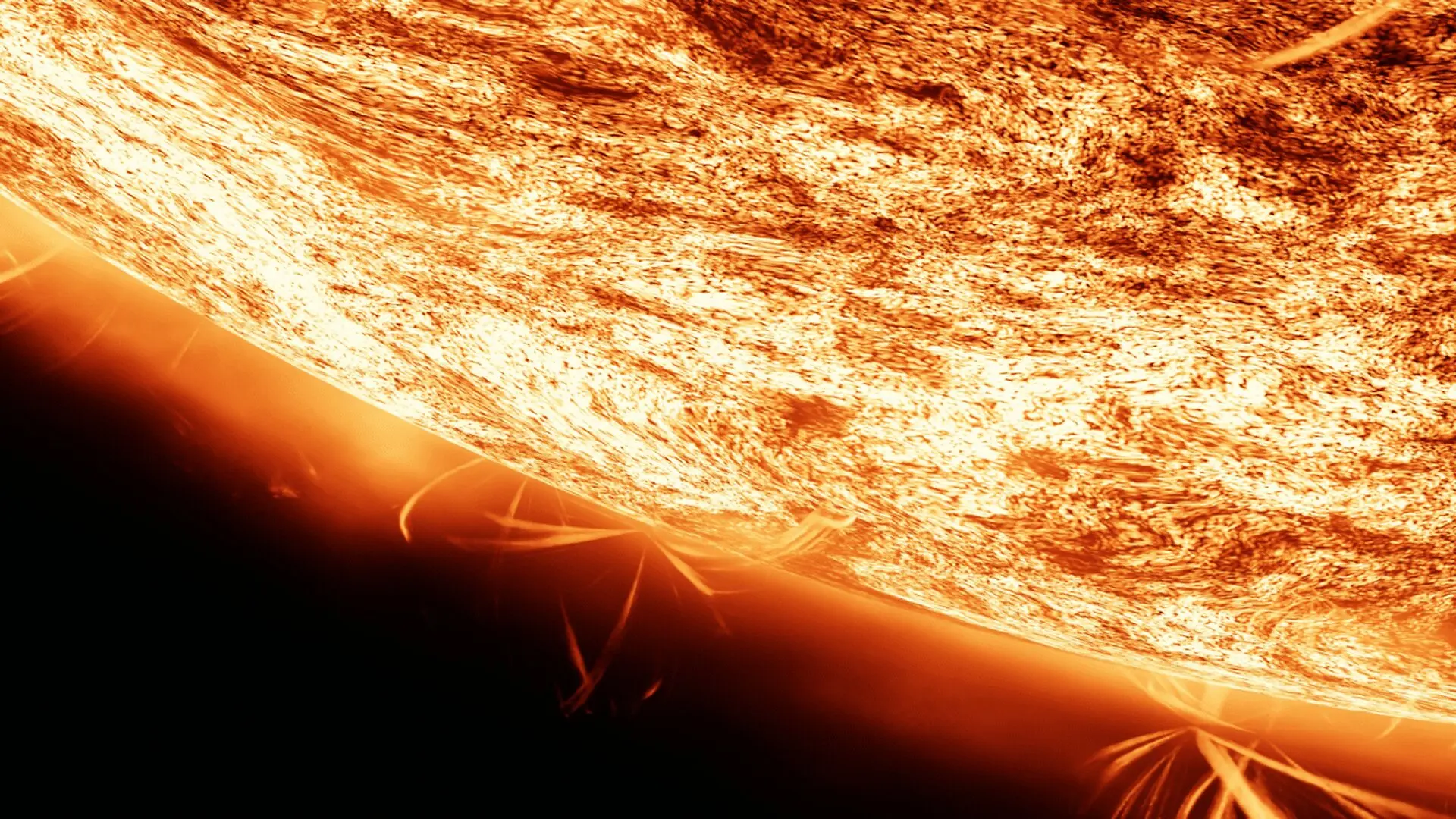
Scientists may have solved a long-standing mystery regarding the Sun’s dynamic plasma jets, revealing that these towering features are not the spinning cylinders they appear to be. A new international study suggests these structures are actually complex, folded sheets of plasma, shaped by swirling forces that could play a pivotal role in feeding energy into the solar corona.
Solar Jets May Be Vast Curtains Rather Than Narrow Spikes
For decades, researchers have tracked thousands of bright, slender jets known as spicules that erupt from the Sun’s lower atmosphere. Typically reaching heights of 6,000 to 8,000 kilometers (3,700–5,000 miles), these structures were traditionally interpreted as cylindrical columns of hot plasma that shoot upward before gravity pulls the material back down. However, recent numerical simulations suggest this familiar model is an illusion created by our perspective.
Collaborative research involving the University of Sheffield, the Indian Institute of Astrophysics, and the University of Newcastle in Australia indicates that spicules are actually warped, pleated curtains of plasma. These overlapping folds produce deceptive visual effects when observed from a single vantage point, leading astronomers to misidentify simple projections as rapid rotational movement. These findings, now published in The Astrophysical Journal, suggest that the apparent spin is a 3D phenomenon flattened into 2D imagery.
“The actual formation of the spicules and the associated rotating plasma draperies are currently very hard to observe directly, because they require ultrahigh-resolution telescopes for satellite observations from multiple vantage points,” notes Dr. Sahel Dey, a postdoctoral researcher at the University of Newcastle.
Credit: The Astrophysical Journal
Enormous Solar Swirls Could Explain the Illusion of Rotation
The simulations also uncovered a secondary phenomenon: widespread spiraling plasma columns, which the researchers have dubbed coronal swirling conduits (CoSCos). These structures, which can span hundreds of kilometers in diameter, behave similarly to atmospheric cyclones, although they operate within a highly magnetic solar environment. Some of these conduits appear to extend deep into the solar corona, effectively acting as bridges between different atmospheric layers.
Professor Robertus Erdélyi of the University of Sheffield emphasizes that these swirling motions are a universal constant. “These rotating motions are everywhere in the universe, from sinking water in domestic faucets with a size of centimeters, to tornadoes on Earth and on the sun, solar jets and spiral galaxies with a size of up to 520,000 light-years,” he explains.
Credit: The Astrophysical Journal
A Possible Route for Energy Into the Sun’s Outer Atmosphere
The discovery of CoSCos provides a compelling lead in solving one of the most stubborn puzzles in astrophysics: why the Sun’s outer atmosphere, the corona, is significantly hotter than the surface below it. It is believed that spicules and their associated waves act as conduits for energy, and these new simulations suggest that swirling conduits may play a key role in this heating process.
“These jet-induced CoSCos in our model draw energy from the thermal and magnetic energy reservoirs of the jets and transport it into the solar corona,” explains Dr. Piyali Chatterjee of the Indian Institute of Astrophysics. While the theoretical model is robust, confirming these structures will require high-resolution data on coronal magnetic fields and plasma velocity.
Professor Erdélyi adds that the research provides the first theoretical evidence for how these atmospheric swirls generate magnetic plasma waves, driving energy from the lower atmosphere toward the corona. “We believe these Britain-sized coronal swirling magnetic plasma conduits are also very promising candidates not just for energy but also for mass transportation between the lower and upper layers of the solar atmosphere,” he says.
As the scientific community continues to probe the Sun’s atmosphere, this collaborative effort marks a significant step toward mapping the complex energy flows that sustain our star’s outer layers.
This article has been fact checked for accuracy, with information verified against reputable sources. Learn more about us and our editorial process.
Last reviewed on .
Article history
- Latest version
Reference(s)
- Dey, Sahel., et al. “Solar Spicule Rotation Driven by Plasma Curtain–Vortex Interactions.” The Astrophysical Journal, vol. 1008, no. 1, August 31, 2026, pp. 132 American Astronomical Society, doi: 10.3847/1538-4357/ae8999. <https://iopscience.iop.org/article/10.3847/1538-4357/ae8999>.
Cite this page:
- Posted by Farah Siddiqui