Scientists Have Created The World First Washable Touchscreen Clothing
Researchers have developed a revolutionary fiber that functions as both a display pixel and a touch sensor, paving the way for interactive smart fabrics.
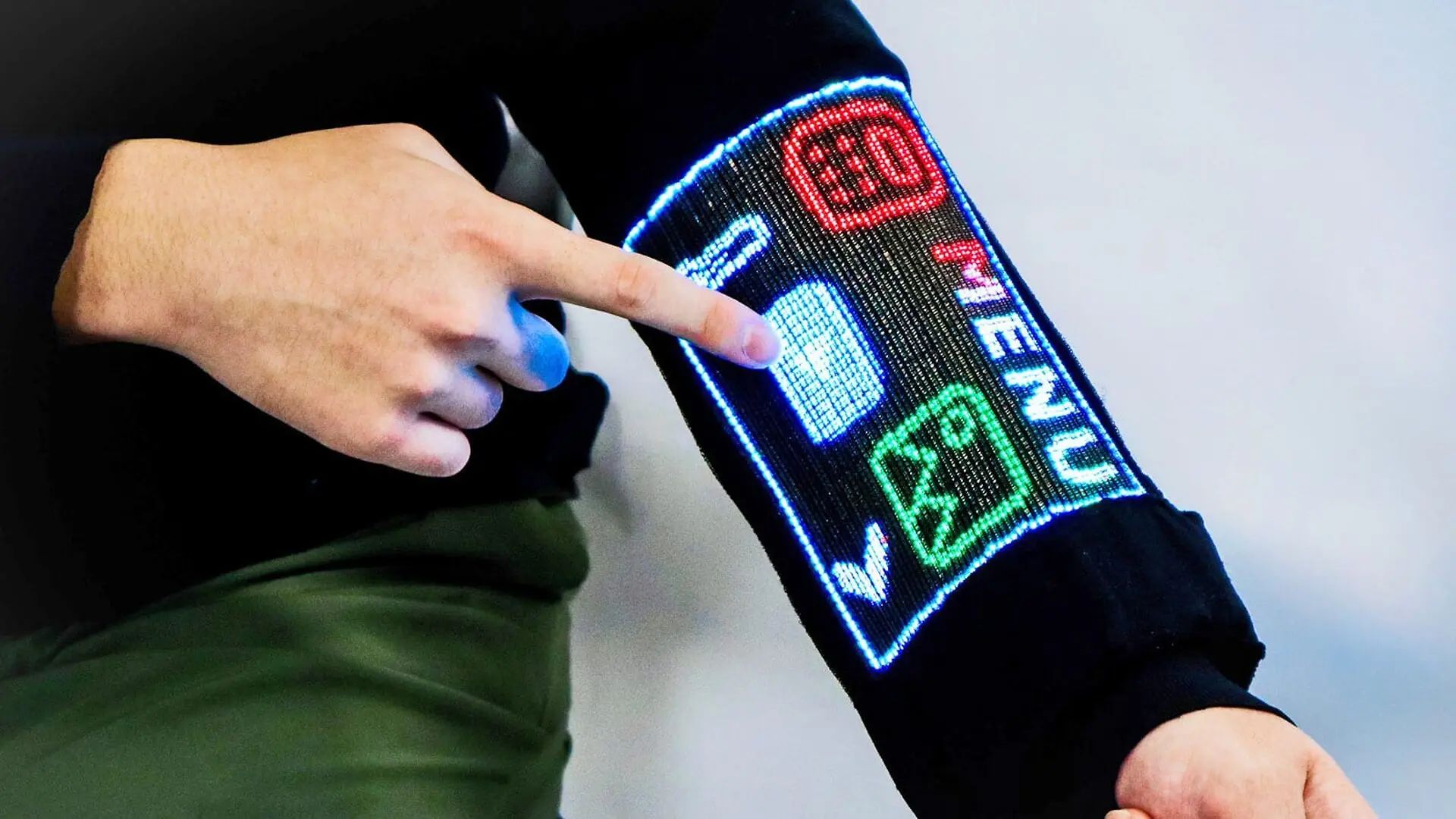
Next-Generation Smart Textiles Transform Everyday Clothing Into Interactive Displays
Engineers at the National University of Singapore (NUS) have successfully integrated a fully functional touchscreen directly into a garment, marking a significant leap forward in wearable technology. By embedding 54 custom-engineered fibers into a standard fabric sleeve, the team has created a flexible, breathable, and washable interface capable of displaying high-definition video while simultaneously processing touch inputs.
This breakthrough, recently detailed in the journal Nature, effectively bridges the gap between static textiles and the rigid graphical user interfaces (GUIs) found on modern smartphones. Unlike previous wearable tech that relied on bulky attachments, this system uses fibers that function as both individual pixels and tactile sensors.
“What made this possible was our ability to construct the GUI system from electronic building blocks in fibre form—similar to traditional yarn, but with the sophisticated electronic functionality built directly into the fibers,” says Assistant Professor Tural Khudiyev of the National University of Singapore’s College of Design and Engineering (CDE).
Precision Engineering at the Fiber Level
The complexity of the system lies in how the team managed to weave thousands of microscopic components into a thread only one millimeter thick. To achieve this, the researchers developed a programmable manufacturing method that utilizes laser ablation to expose specific locations on thin, insulated wires. Controlled surface wetting then allows molten solder to bond microchips exactly at these programmed connection points. This process enabled the integration of more than 5,000 individual chips across over 20,000 distinct electrical junctions.
The resulting display is remarkably robust. The prototype features a 96 by 54-pixel screen capable of refreshing at 30 frames per second with 8-bit color depth. Because each fiber operates on its own dedicated control channel, the garment remains functional even if one line is damaged. Furthermore, the textile design allows for multi-touch interaction; pressing the fabric completes a local circuit, signaling the system to register the touch location and trigger the corresponding pixel response.
Beyond the Screen: A Multi-Sensory Wearable
Beyond visual output, the sleeve serves as a comprehensive data hub. The research team integrated peripheral fibers equipped with a suite of sensors, including a microphone, speaker, movement tracker, magnetometer, and ambient light sensor. The garment is capable of executing standard smartphone tasks, such as running a calculator, displaying photo galleries, and responding to voice commands via Bluetooth connectivity.
Crucially, the electronic components do not compromise the garment’s integrity. The researchers subjected the fabric to 50 detergent wash cycles and 1,000 bending tests around a 5 mm radius, finding that light output and touch sensitivity remained nearly unchanged. The material maintains the breathability of traditional cotton or polyester, meeting safety standards for prolonged skin contact.
The Future of Health-Focused Smart Apparel
The potential implications for healthcare are profound. By weaving health-monitoring sensors directly into clothing, the technology could allow for continuous, unobtrusive physiological data collection. When paired with artificial intelligence, such garments could provide real-time health insights, allowing wearers to access and manage their vitals directly through their sleeve.
“Health care is one particularly promising application,” Khudiyev notes. “A garment could continuously collect physiological information through fibre-based sensors and allow the wearer to access and interact with that information directly through their clothing. Combined with artificial intelligence (AI), this could enable personalized health monitoring, feedback and assistance.”
Looking ahead, the team aims to enhance the resolution of these textile displays and incorporate on-device AI. As these fibers become even thinner, they can be processed using standard industrial knitting and weaving machinery, potentially paving the way for a future where our clothing acts as a seamless extension of our digital lives, capable of interpreting both our physical state and our surrounding environment.
This article has been fact checked for accuracy, with information verified against reputable sources. Learn more about us and our editorial process.
Last reviewed on .
Article history
- Latest version
Reference(s)
- Fu, Heng., et al. “Touch-sensing digital pixel fibre enables interactive garment GUI.” Nature, October 21, 2026 Springer Science and Business Media LLC, doi: 10.1038/s41586-026-11128-9. <https://doi.org/10.1038/s41586-026-11128-9>.
Cite this page:
- Posted by Asif Iqbal