NASA Scientist Claims Discovery of New Force That Could Defy Gravity Without Fuel
Researchers are investigating a mysterious engine that reportedly generates enough thrust to counter gravity, challenging our understanding of physics.
For decades, physicists have grappled with the concept of a propulsion system that defies the fundamental laws of motion. According to classical mechanics, a spacecraft requires propellant—expelling mass in one direction to generate forward thrust. However, a new claim from researchers at Exodus Propulsion Technologies suggests that this paradigm could be challenged by a device that generates thrust without any exhaust.
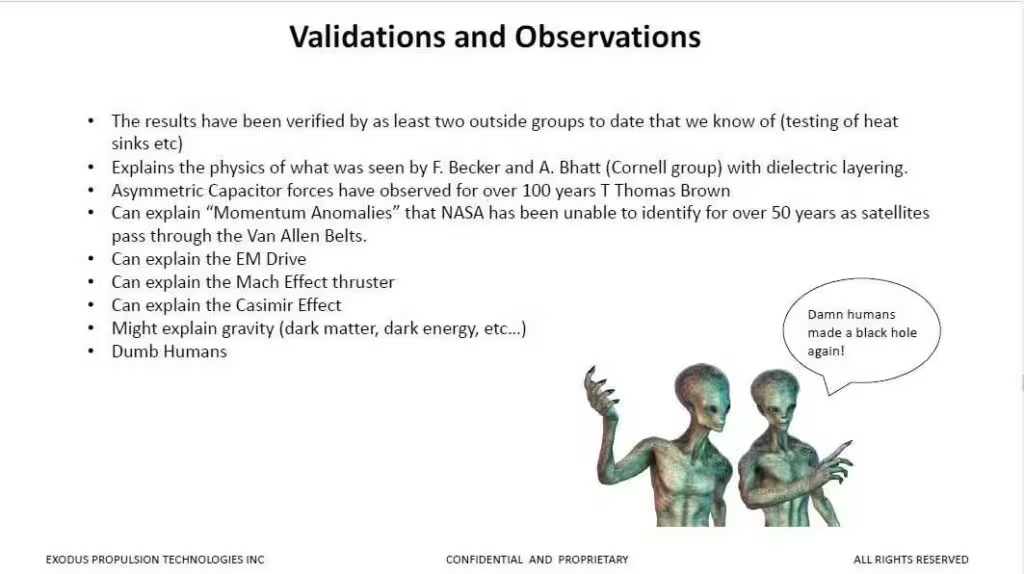
The pursuit of “reactionless” drives is not new. In 2001, the EmDrive captured global attention with claims that a radio-frequency resonant cavity could produce thrust, only to be largely debunked by later, more rigorous experiments that attributed the observed signals to thermal expansion and experimental noise. Yet, Dr. Charles Buhler, an electrostatics expert and former NASA researcher, asserts that his team has observed a measurable force that exceeds these earlier pitfalls.
A Reported Breakthrough in Electrostatic Propulsion
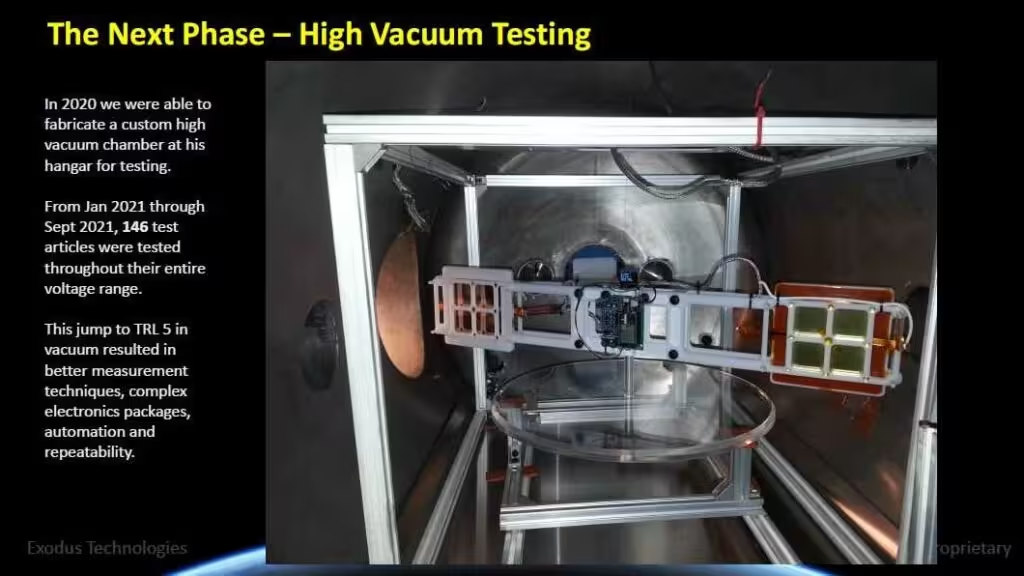
Buhler, who helped establish the Electrostatics and Surface Physics Laboratory at Kennedy Space Center, leads a private venture based in Titusville, Florida. His team claims that since 2021, their experiments with propellant-free devices have moved from producing negligible signals to generating enough force to effectively counter the pull of Earth’s gravity. In a series of 146 vacuum chamber tests conducted between January and September 2021, the researchers reported that their devices steadily increased in performance.
The experimental setup described by the team is deceptively straightforward. The devices consist of common materials—Teflon, copper tape, and foam—subjected to high-voltage electric fields. Buhler maintains that these materials, when charged, generate a sustainable force that allows for center-of-mass translation without the expulsion of any mass, a finding he characterizes as evidence of a “new force.”
Addressing the Challenges of Experimental Validation
The skepticism surrounding such claims is deeply rooted in the history of “impossible” drives. Previous experiments, such as those conducted at the Dresden University of Technology on the EmDrive, demonstrated how easily small, false signals can be generated by heating components or interaction with Earth’s magnetic field. To counter these concerns, the Exodus team has utilized vacuum chambers to rule out “ion wind”—the movement of air molecules—and has performed tests with the device shielded to eliminate external interference.
Despite these internal protocols, the scientific community maintains a high threshold for proof. A patent, such as the international patent application filed by Buhler and colleague Andrew Aurigema, serves as a record of a claim rather than a verification of physical law. The most critical missing piece remains independent verification.
The Road Ahead for Commercial and Academic Inquiry
As the project transitions from experimental research to commercial outreach, the pressure for transparency increases. During early 2026, the Exodus team participated in industry events, such as Deep Tech Week in New York, to engage with investors and members of the scientific community. However, as noted by the Alternative Propulsion Engineering Conference (APEC), the primary hurdle is the absence of outside laboratories reproducing these results using their own equipment and standardized uncertainty budgets.
Until a third party can independently confirm that the force is not a byproduct of experimental setup or measurement error, the discovery remains a provocative, albeit unverified, possibility in the field of advanced propulsion. For now, the “new force” claimed by the Exodus team awaits the scrutiny of the broader physics community.
This article has been fact checked for accuracy, with information verified against reputable sources. Learn more about us and our editorial process.
Last reviewed on .
Article history
- Latest version
Reference(s)
- “WO2020159603A2 - System and method for generating forces using asymmetrical electrostatic pressure - Google Patents.”, November 19, 2019 <https://patents.google.com/patent/WO2020159603A2/en>.
Cite this page:
- Posted by Farah Siddiqui