Scientists May Have Solved the Mystery of How Life’s Essential Sugar Survived on Early Earth
Scientists have finally discovered how vital sugars may have survived on early Earth, thanks to a surprising chemical reaction hidden within common rocks.
The molecular foundation of life as we know it faces a significant durability challenge. Ribose, the essential sugar that acts as the backbone for RNA, is notoriously unstable, prone to degrading into a useless, tar-like substance when exposed to the harsh conditions of a young planet. New research suggests that this fragility may have been overcome through a symbiotic relationship with boron, a metalloid capable of stabilizing the sugar in a self-reinforcing chemical cycle.
The implications of this discovery are profound, particularly for the RNA World Hypothesis, which posits that early biological molecules relied on RNA to store genetic information and catalyze reactions before the emergence of DNA. While carbonaceous asteroids like Bennu have demonstrated that organic compounds, including sugars, can be delivered to Earth via space rocks, the question of how these molecules persisted long enough to facilitate the transition toward life has remained a persistent mystery.
The Chemistry of Molecular Survival
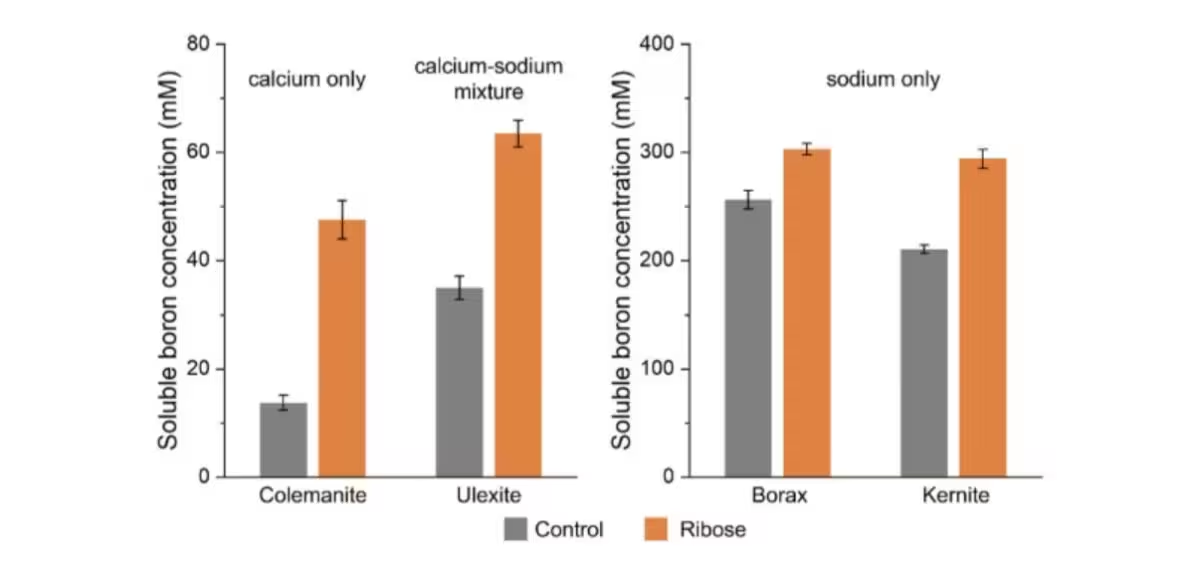
For decades, researchers have investigated the interaction between ribose and boron, but previous studies often relied on pure, laboratory-grade materials that may not have accurately simulated the complex geochemical environments of early Earth. A team from the University of New South Wales addressed this by examining how ribose interacts with common boron-bearing minerals such as kernite, colemanite, and ulexite. Their findings, published in Scientific Reports, reveal that these minerals typically lock boron away in insoluble forms, rendering it inaccessible to biological precursors.
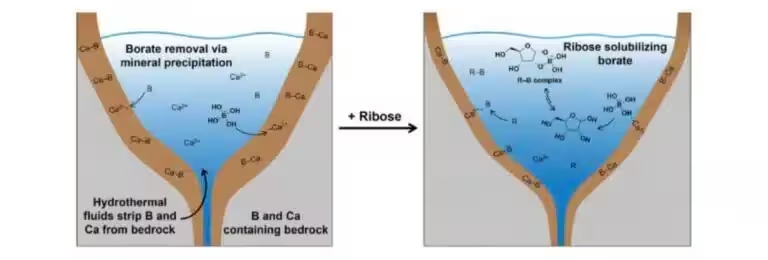
However, when ribose is introduced into this rocky environment, it creates a chemical interaction that effectively pulls boron out of its mineral prison. Testing samples from the Puga hydrothermal system in India—a geological site often used as an analog for early Earth—the researchers observed that the presence of ribose increased the solubility of boron by roughly 60 percent compared to water alone.
A Self-Sustaining Geochemical Loop
The data suggests a fascinating feedback loop: ribose assists in mobilizing boron from mineral deposits, and in turn, the mobilized boron forms complexes that protect the ribose from degrading. This mechanism appears highly specific; other sugars like glucose and sucrose provided some solubility benefits, but they were significantly less effective than ribose, likely due to the unique molecular geometry that allows ribose to form highly stable complexes with boron.
This cycle does not work in isolation, however. The researchers note that while boron protects ribose, excessive concentrations of the mineral can actually hinder the initial formation of the sugar. This is where other elements, specifically calcium, may play a vital regulatory role by keeping boron concentrations within a range that facilitates both the formation and the stabilization of ribose.
By shifting the focus from simplified lab models to complex, natural mineral samples, the team has underscored how the environmental conditions of early Earth may have been perfectly tuned to support the survival of these delicate precursors to life. The findings align with the perspective once championed by Carl Sagan, reinforcing the idea that the building blocks of biology are inextricably linked to the elemental history of our planet and the wider cosmos.
This article has been fact checked for accuracy, with information verified against reputable sources. Learn more about us and our editorial process.
Last reviewed on .
Article history
- Latest version
Reference(s)
- Steller, Luke. “The influence of ribose on borate mineral solubility - Scientific Reports.”, September 22, 2026 Nature, doi: 10.1038/s41598-026-70700-5. <https://www.nature.com/articles/s41598-026-70700-5>.
- Society, The. “Carl Sagan.”, April 12, 2012 The Planetary Society <https://www.planetary.org/profiles/carl-sagan>.
Cite this page:
- Posted by Bilal Abbasi