Scientists Found Giant Kelp Survival Relies On Substrate Size, But Grazers Dictate Recovery
Exclusion cages failed to stop agile snails and urchins, highlighting the need for policy changes to permit large-scale grazer removal.
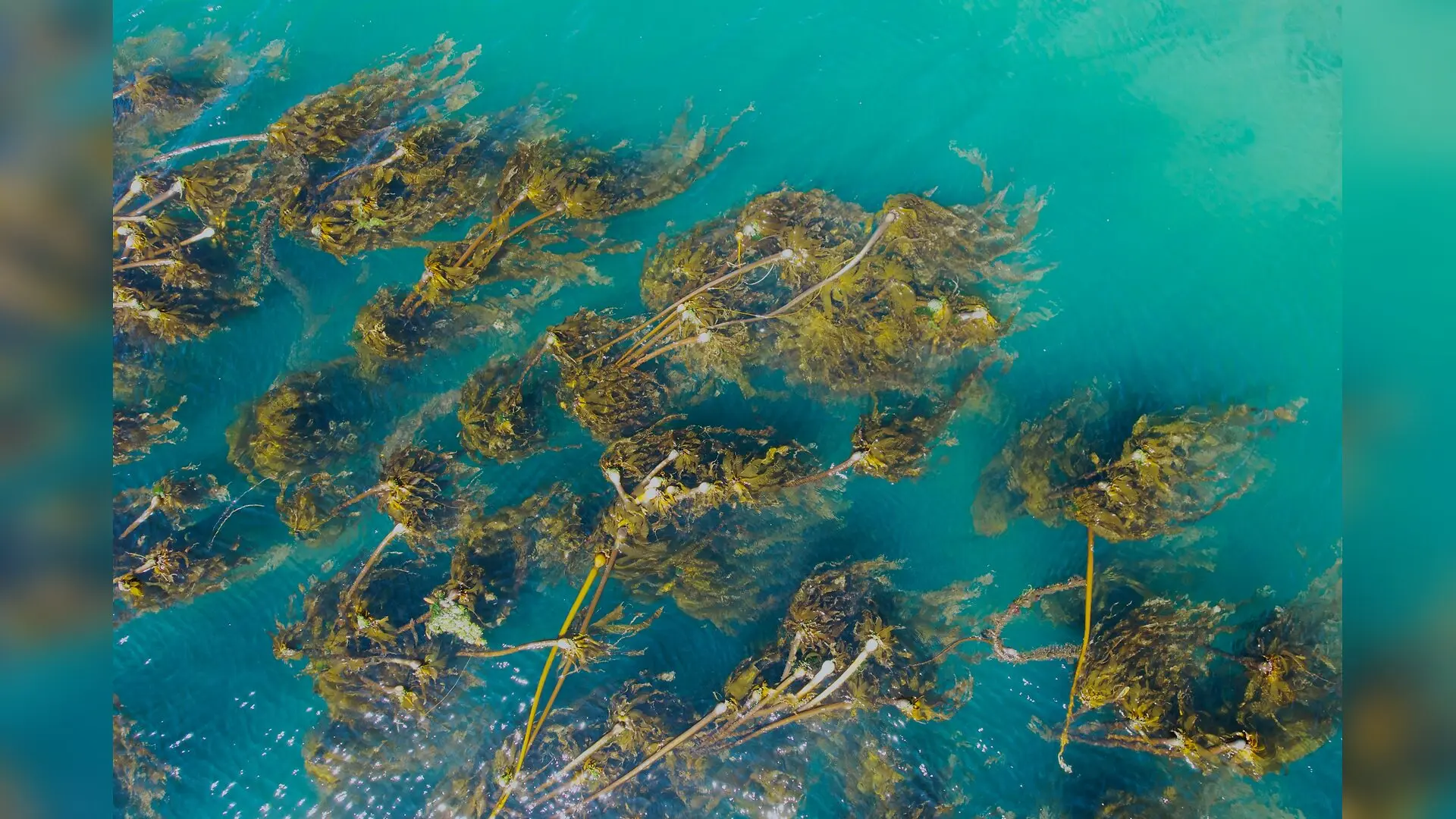
Marine biologists deployed juvenile giant kelp on seeded rocks across six restoration sites in Barkley Sound, British Columbia, to test whether physical barriers could protect the algae from herbivorous invertebrates. The findings reveal that while small exclosures slightly lowered local grazer counts, site-level densities of sea urchins and red turban snails remained the primary driver of kelp survival and growth.
Grazer Pressures Shape Kelp Survival
Giant kelp forests span roughly a third of the world coastlines in temperate regions, providing essential biogenic habitat for numerous marine species. However, these ecosystems face severe declines driven by marine heatwaves and localized surges in herbivorous invertebrates. Unchecked grazing by sea urchins and smaller mesograzers often creates stable urchin barrens where kelp struggles to re-establish naturally.
To investigate these dynamics, the researchers implemented a manipulative field experiment from March to August 2024 across Trevor Channel. They tested the effects of mesh exclusion cages and two different green gravel substrate sizes on the survival and net growth of outplanted juvenile sporophytes. The team also measured environmental variables including water temperature, current speed, dissolved oxygen, and light availability at each location.
Red urchins and red turban snails dominated the invertebrate communities across the study area, with site-level densities reaching up to 2.9 urchins and 5.5 snails per square meter. The authors report that the work is published in Marine biology, detailing how these grazers impact early-stage restoration efforts. Natural grazer densities varied considerably among the six locations, creating distinct ecological gradients for testing restoration outcomes.
Exclusion Cages Show Limited Benefit
Physical exclosures successfully reduced grazer counts inside the experimental plots, with open plots containing more than double the density of urchins and nearly six times the density of red turban snails compared to caged plots. Despite this reduction in local grazers, the cages yielded only a marginal improvement in kelp survival overall. Caged kelp survived about 1.07 times better than uncaged kelp, but the structures failed to secure sustained survival across the monitored sites.
The researchers observed that agile red turban snails frequently scaled the flexible lips of the mesh barriers to reach the juvenile kelp. Furthermore, at high-exposure locations, strong wave action and storm swells shifted the aluminum and PVC structures, causing damage and breakage. At calmer sites, biofouling accumulated on the mesh walls, which likely restricted water flow and light availability for the developing kelp.
The study highlights that exclusion infrastructure can introduce unintended artifacts, such as abrasion and shading, while failing to stop agile herbivores. The authors note that cages may only function effectively in environments with naturally low grazer pressure, rendering them impractical for large-scale restoration in heavily grazed barrens.
Substrate Stability Improves Early Establishment
Substrate size played a critical role in early post-outplanting survival, with kelp on larger six centimeter rocks surviving more than eight times better than kelp on smaller two centimeter gravel. Larger gravel provided greater mechanical stability, which helped the juvenile sporophytes avoid dislodgement from rolling or floating away in areas with higher current speeds.
Despite the benefits of larger substrate, overall kelp survival declined sharply over the course of the five-month experiment. By June, very few individuals remained across five of the sites, and by August, only nine kelp individuals survived at a single location where natural grazer densities were near zero. This high mortality even in the absence of herbivores indicates that the limitations of the green gravel technique and environmental stress also constrain restoration success.
The authors suggest that future outplanting initiatives for buoyant kelp species should prioritize stable, larger substrates and select low-exposure environments. At the same time, the results emphasize that physical outplanting alone cannot overcome heavy grazing pressure without active population management of the herbivores.
Policy Shifts Needed for Restoration Success
Regulatory frameworks in British Columbia currently do not permit large-scale sea urchin removal or culling for habitat restoration, forcing managers to rely on suboptimal interventions like exclusion devices. The experimental results demonstrate that site-level grazer density strongly limits kelp recovery, meaning that extensive grazer reduction will be necessary before outplanted kelp can persist.
The authors conclude that conservation strategies should pivot toward policy changes that allow authorized large-scale grazer removal, alongside community-based harvest practices and the recovery of natural predators like sea otters and sunflower stars. Without addressing the underlying overgrazing, physical restoration methods will likely continue to face severe biological and logistical bottlenecks.
The research was published in Marine biology on November 26, 2026.
This article has been fact checked for accuracy, with information verified against reputable sources. Learn more about us and our editorial process.
Last reviewed on .
Article history
- Latest version
Cite this page:
- Posted by Kamran Akhtar