Intertidal Corals Survive 36°C Heatwaves Thanks to Generalist Microbes That Buffer Thermal Stress
Metagenomic sequencing reveals that variable intertidal habitats harbor coral microbiomes with high functional redundancy and modular networks.
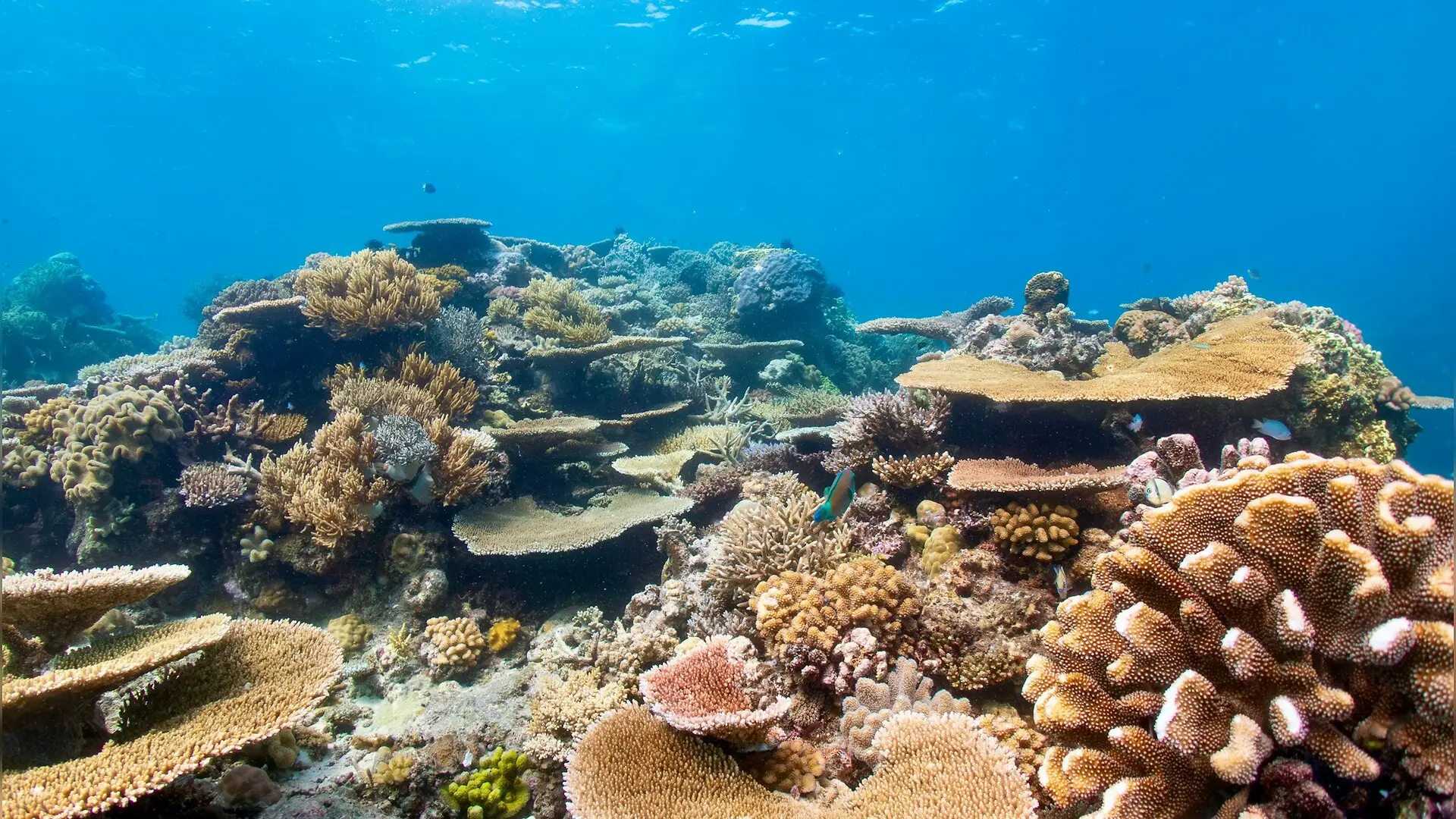
Corals living in the dynamic intertidal zone at Luhuitou Reef in Sanya, China, withstand 36°C heat stress by hosting specialized microbial communities that retain functional stability while subtidal corals bleach extensively. Anthropogenic global warming threatens marine ecosystems by triggering frequent and severe marine heatwaves. While much attention focuses on the coral animal and its symbiotic microalgae, the surrounding microscopic partners act as a vital second genome. Researchers investigated how these bacterial communities adapt to extreme environmental variability.
To understand this microscopic resilience, the team examined the reef-building coral species Porites lutea across distinct tidal habitats. The intertidal zone exposes organisms to severe diurnal temperature swings, intense sunlight, and regular air exposure. In contrast, the subtidal zone experiences a much more stable thermal environment. The study is published in Science Advances, detailing how habitat-driven selective pressures shape the ecological niches of coral-associated bacteria.
How Did Intertidal Corals Survive 33°C Heat Stress Without Bleaching?
During a 7-day controlled heat stress experiment at 33°C, Porites lutea fragments collected from the intertidal zone showed no visible bleaching symptoms. Their photosynthetic efficiency, measured as the maximum quantum yield of photosystem II or Fv/Fm, dropped by a median of only 7.25 percent. Conversely, subtidal coral fragments suffered widespread visual bleaching and experienced a sharp 67.6 percent decline in photosynthetic efficiency.
Environmental monitoring revealed that intertidal temperatures fluctuated between 20° and 36°C over 9 months, producing an average daily temperature variation of 2.52°C. Subtidal temperatures remained far more stable, ranging between 22° and 32°C with a daily variation of just 0.97°C. This chronic variability prepares intertidal corals and their associated microbes to better withstand acute thermal shocks.
Why Do Intertidal Corals Host More Generalist Bacteria?
Deep metagenomic sequencing of 81 samples generated over 2,000,000 predicted open reading frames, revealing clear structural differences between the two microbial communities. Intertidal corals hosted significantly higher bacterial alpha diversity than their subtidal counterparts. Furthermore, bacterial taxa in the intertidal zone exhibited broader standardized Levins’ niche breadth indices, indicating a higher prevalence of generalist microbes.
Niche theory suggests that fluctuating environments favor generalists that can exploit diverse resources, whereas stable environments favor specialists. The intertidal bacterial community also displayed a highly modular co-occurrence network with 144 nodes and 218 edges. This modular structure likely restricts the spread of external disturbances across the microbial network.
What Is Functional Redundancy and How Does It Protect Corals?
Despite having broader taxonomic niche breadths, intertidal microbial communities showed concentrated functional profiles with high functional redundancy. The authors, led by J. Li and H. Huang from the Chinese Academy of Sciences, quantified the functional redundancy index to measure how many distinct bacterial groups contribute to specific metabolic pathways. Intertidal microbiomes displayed significantly higher whole-community functional redundancy than subtidal communities.
Nine stress-resistance pathways showed elevated redundancy in intertidal bacteria, including antioxidant defense, DNA repair, and chaperone proteins. This functional buffering means that if environmental stress suppresses certain bacterial taxa, other microbes within the same functional guild compensate to maintain metabolic stability. Linear regression confirmed that whole-community functional redundancy correlated positively with the richness of generalist bacterial genera.
What Are the Limitations of These Microbiome Findings?
While the association between generalist-rich microbiomes and enhanced coral thermotolerance is strong, the authors note that these observations do not definitively prove causation. The observed microbiome differences could also reflect distinct host genetic backgrounds, separate algal symbiont compositions, or unmeasured microclimatic variables like hydrodynamics and light intensity. Establishing a direct causal link will require future experimental manipulation, such as targeted microbiome transplantation.
Additionally, the current study relied primarily on an open reading frame-centric approach rather than genome-resolved metagenomics. Future research should aim to generate high-quality metagenome-assembled genomes to validate the precise functional roles of key generalist taxa. Understanding these natural microbial reservoirs could eventually inform the design of probiotic consortia to aid coral reef restoration in a warming ocean.
The research was published in Science advances on November 27, 2026.
This article has been fact checked for accuracy, with information verified against reputable sources. Learn more about us and our editorial process.
Last reviewed on .
Article history
- Latest version
Cite this page:
- Posted by Divya Iyer