Webb Telescope Reveals Violent Planet-Shattering Crashes Around Distant Stars
The James Webb Space Telescope has captured rare, front-row views of the destructive forces shaping rocky planets within 21 distant, dusty star systems.
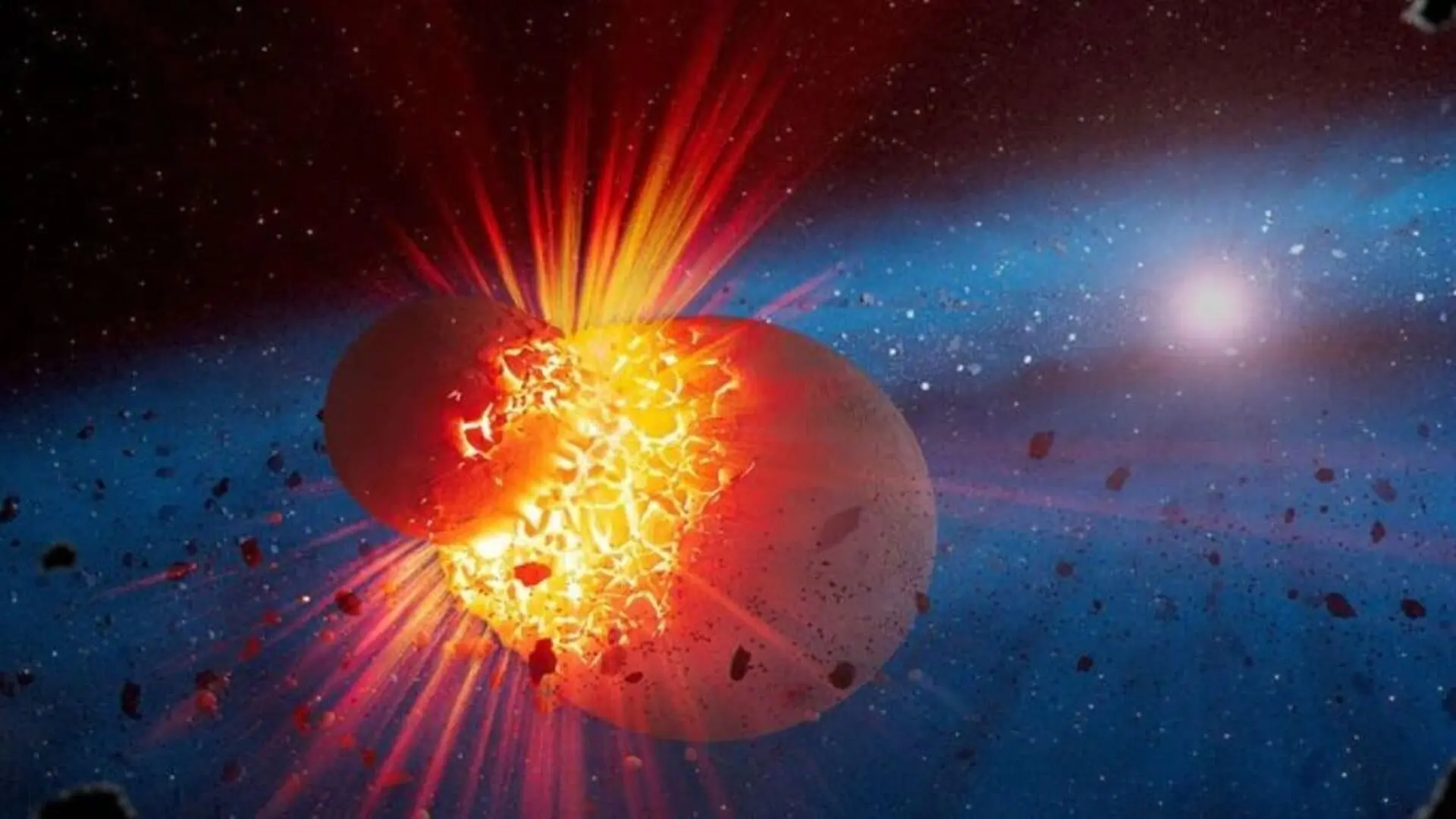
NASA’s James Webb Space Telescope is providing astronomers with an unprecedented look at the violent celestial collisions that sculpt young planetary systems. By analyzing a collection of 21 rare extreme debris disks, researchers have discovered that the mineral composition of the surrounding dust acts as a diagnostic tool, revealing whether the fragments originated from massive, Mars-sized planetary impacts or smaller, Moon-sized collisions.
Planetary formation is a notoriously chaotic process. While young stars initially emerge from gas-rich protoplanetary disks, these environments eventually transition into debris disks characterized by dust and rocky fragments. Extreme debris disks are a distinct subset of these systems, marked by an unusually high concentration of warm dust situated in the same proximity to their host stars as the rocky planets in our own solar system.
Although the planetary embryos involved in these crashes are too distant and small to observe directly, the resulting debris provides a forensic record of these cataclysmic events, some of which may mirror the collision believed to have birthed Earth’s Moon.
A Rare Window into Planetary Evolution
These extreme debris disks represent a fleeting stage in cosmic development. Estimates suggest that only about 1% of young stars exhibit these visible signatures, a figure that remains lower than what many theoretical models predict. To investigate this phenomenon, the research team compiled data from 21 systems. The study integrated legacy observations from the retired Spitzer Space Telescope with 16 systems analyzed by Webb, 12 of which had never been studied before.
“This is the first time we have gathered enough systems to truly understand this subclass that we call extreme debris disks,” said Kate Su of the Space Science Institute in Boulder, Colorado, who led the study.
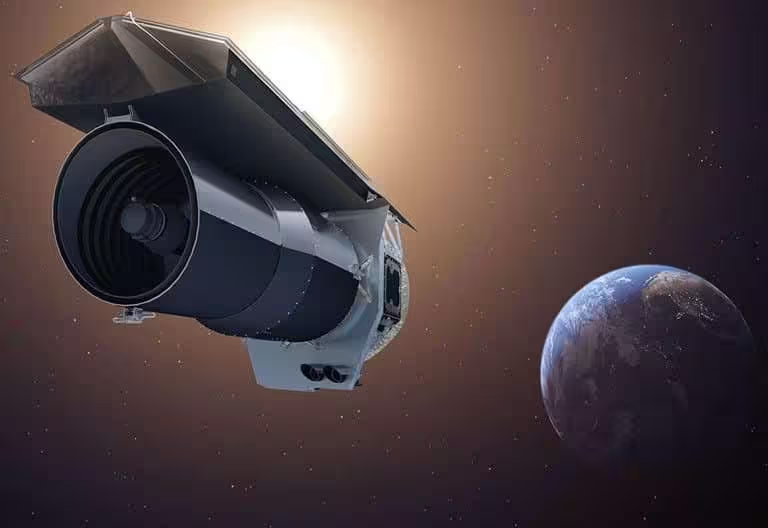
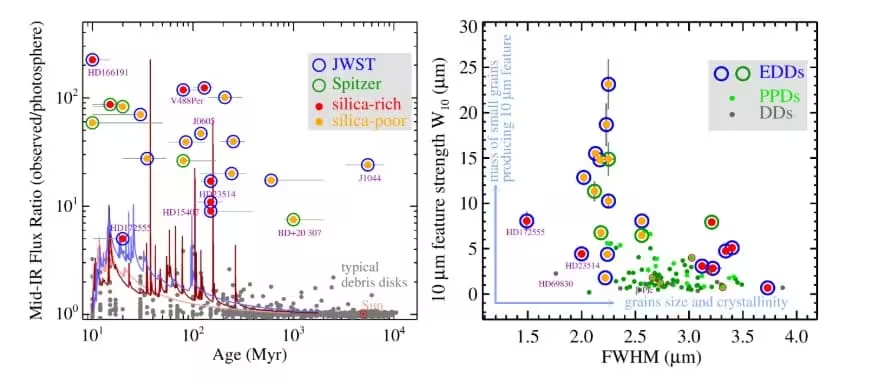
By utilizing mid-infrared data from both telescopes, researchers identified three defining characteristics common to these systems: exceptionally small dust grains, significant quantities of warm dust, and erratic fluctuations in brightness. According to the findings, while these systems were previously known to be anomalous, the current data offers the first clear look at how these differences influence the broader narrative of planet formation.
Interpreting the Dust Composition
The research team categorized the disks into two distinct profiles: silica-rich and silica-poor. Approximately one-third of the systems fall into the silica-rich category. These disks are associated with high-energy impacts involving Mars-sized bodies, where the intensity of the collision is sufficient to vaporize significant volumes of rock, resulting in a residue similar to volcanic glass like obsidian.
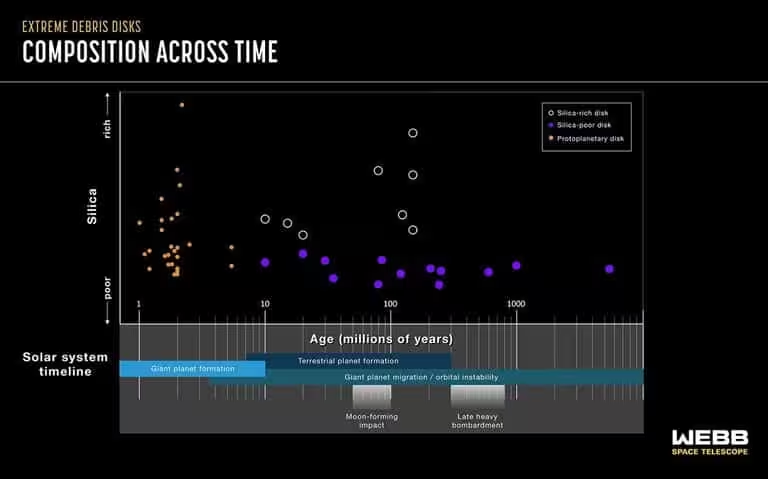
The remaining two-thirds of the sample consist of silica-poor disks. These indicate lower-energy events, such as grazing collisions between Moon-sized objects. These disks often contain minerals like forsterite, which is chemically similar to the green sand found on Hawaiian beaches. For scientists, this mineralogical distinction is crucial because it offers a rare, indirect window into the life cycle of planetary embryos.
“We have no other way to study these planetary embryos directly because they are too small,” said Agnes Kospal of Konkoly Observatory, a co-author of the study. Webb’s mid-infrared spectra made it possible to identify what the dust was made of.
Contextualizing with Our Solar System
Age appears to be a critical factor in determining disk composition. Silica-rich disks were exclusively observed around stars younger than 300 million years, a timeframe that aligns with the era when rocky planets in our own system were actively taking shape. Earth and the Moon are believed to have formed roughly 100 million years after the birth of the Sun, with the Moon likely resulting from a collision between the early Earth and a Mars-sized proto-planet dubbed Theia.
Conversely, silica-poor disks show no such age restriction and exhibit more significant infrared brightness variations, potentially indicating ongoing, dynamic orbital changes. Researchers speculate that these systems might even reflect processes similar to the Late Heavy Bombardment, where the migration of giant planets destabilized smaller bodies, leading to intense collision cycles. While the current findings are compelling, the team acknowledges that larger samples are necessary to confirm these theories.
“We only have three disks in our sample that fit that age criterion, so it’ll be nice to observe more of these systems to confirm our hypothesis,” said co-author Attila Moor.
This article has been fact checked for accuracy, with information verified against reputable sources. Learn more about us and our editorial process.
Last reviewed on .
Article history
- Latest version
Reference(s)
- Cermak, Alicia. “Spitzer Space Telescope - NASA Science.”, April 20, 2019 NASA <https://science.nasa.gov/mission/spitzer/>.
- “SSI - Kate Su.” <https://www.spacescience.org/bio.php?emp=KSU>.
- Su, Kate Y. L.., et al. “Extreme Debris Disks: Insights into Violent Collisions in Planet Formation and Destruction.” The Astrophysical Journal, vol. 1010, no. 1, October 1, 2026, pp. 1 American Astronomical Society, doi: 10.3847/1538-4357/ae88fe. <https://dx.doi.org/10.3847/1538-4357/ae88fe>.
- <https://www.researchgate.net/profile/Agnes-Kospal/5>.
- Vogel, Tracy. “What is the Late Heavy Bombardment? - NASA Science.”, December 19, 2024 NASA <https://science.nasa.gov/moon/lunar-craters/what-is-the-late-heavy-bombardment/>.
- <https://www.researchgate.net/scientific-contributions/Attila-Moor-2140296551>.
Cite this page:
- Posted by Aisha Ahmed