Mathematical Model Reveals How Cell Division Reshapes Waddington Landscapes
Ecology

Mathematical Model Reveals How Cell Division Reshapes Waddington Landscapes

A new unified framework shows that tissue proliferation acts as an active driver of cell fate rather than a passive scaling factor.
By Omar Mirza
Published:
Email this Article
Mathematical Model Reveals How Cell Division Reshapes Waddington Landscapes
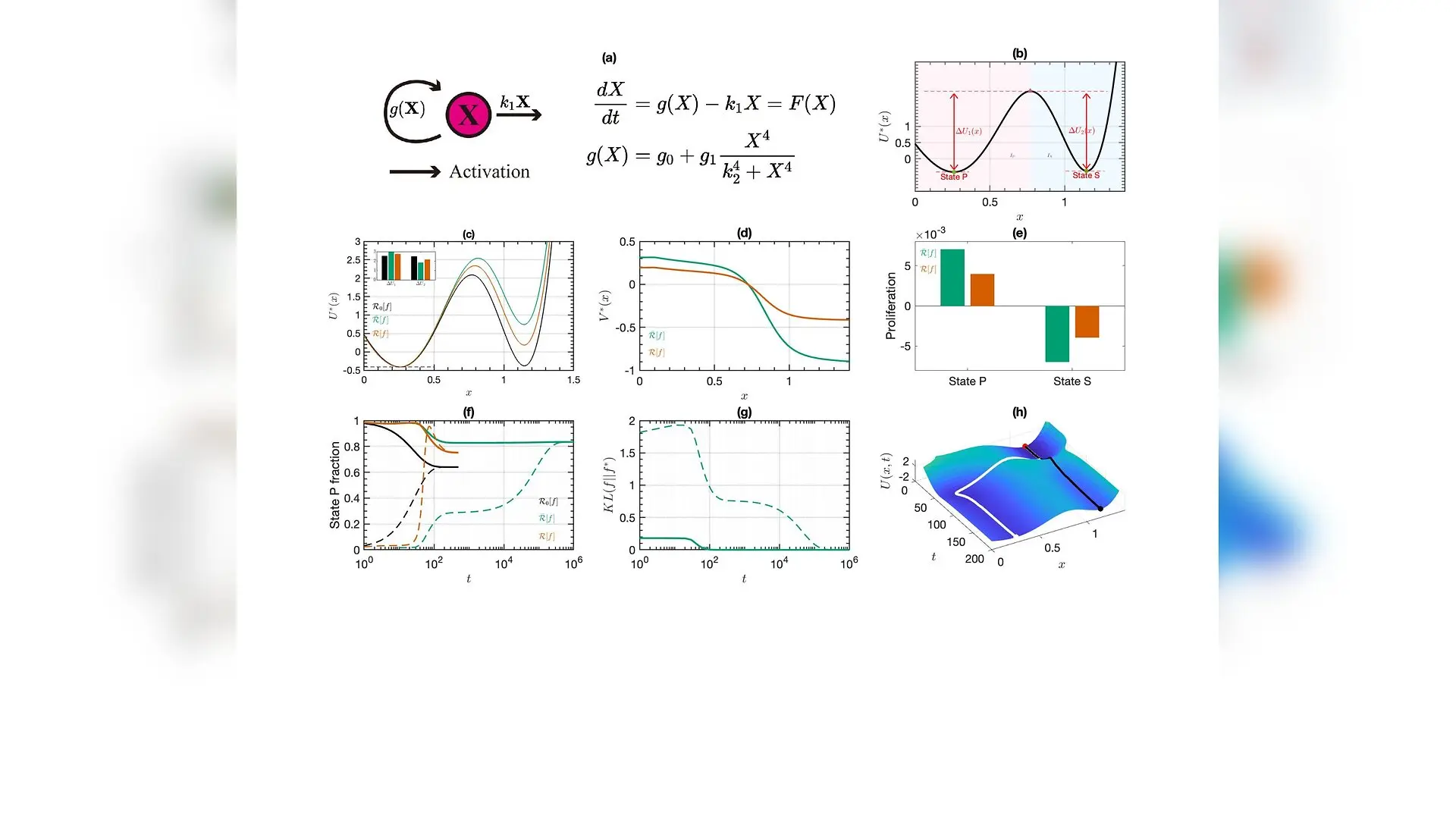
Cell-fate decisions and the dynamic Waddington landscape in a single-gene circuit. (a) Schematic of the single-gene positive-feedback circuit. (b) Reference landscape U∗​(x)U^{\ast}(x) generated by the intrinsic GRN dynamics in the absence of population regulation (ℛ0​[f]=0\mathcal{R}_{0}[f]=0). The two local minima correspond to the inherent epigenetic attractors. (c) Steady-state Waddington landscapes U∗​(x)U^{\ast}(x) under three distinct population renewal operators. The left minima are vertically aligned to highlight topological deviations; the inset compares the reshaped transition barrier heights (Δ​U\Delta U). (d) Profiles of the equilibrium selective potential V∗​(x)V^{\ast}(x). (e) Net population regulation within each attractor basin, computed as the integral of ℛ⁡[f]\mathcal{R}[f] over the respective domains. The contrasting source-sink dynamics functionally identify State S as stem-like and State P as progenitor-like. (f) Temporal evolution of the State P fraction starting Yuling Xue et al. / arXiv

A new mathematical model reveals that cell division actively shapes the developmental landscape of tissues, challenging the long-held assumption that cell fate is governed solely by internal genetic switches. Researchers Yuling Xue and Jinzhi Lei developed a framework connecting microscopic gene regulation with macroscopic tissue dynamics, published in the arXiv preprint server on November 14, 2026. Their work demonstrates how proliferation actively remodels the topological terrain that guides how cells differentiate and maintain their identities.

For decades, developmental biology has relied on Conrad Waddington’s classic 1940s metaphor of a ball rolling down branching valleys to represent how uncommitted cells develop into specialized tissue types. While modern biophysicists have successfully mapped these valleys using stochastic gene regulatory networks, these traditional models typically treat cells in isolation. They assume a static equilibrium where cell populations do not grow, shrink, or interact through macroscopic fluxes.

How Cell Proliferation Reconfigures Valley Topography

To overcome this limitation, the authors designed a unified framework that couples microscopic gene dynamics with population renewal. By tracking the evolving epigenetic probability density, which measures the likelihood of finding cells in specific molecular states, they defined a dynamic Waddington landscape. Rather than viewing proliferation as a mere scaling factor that changes tissue size, the team found that cell division acts as a non-equilibrium driving force that alters transition barriers and reshapes attractor stability.
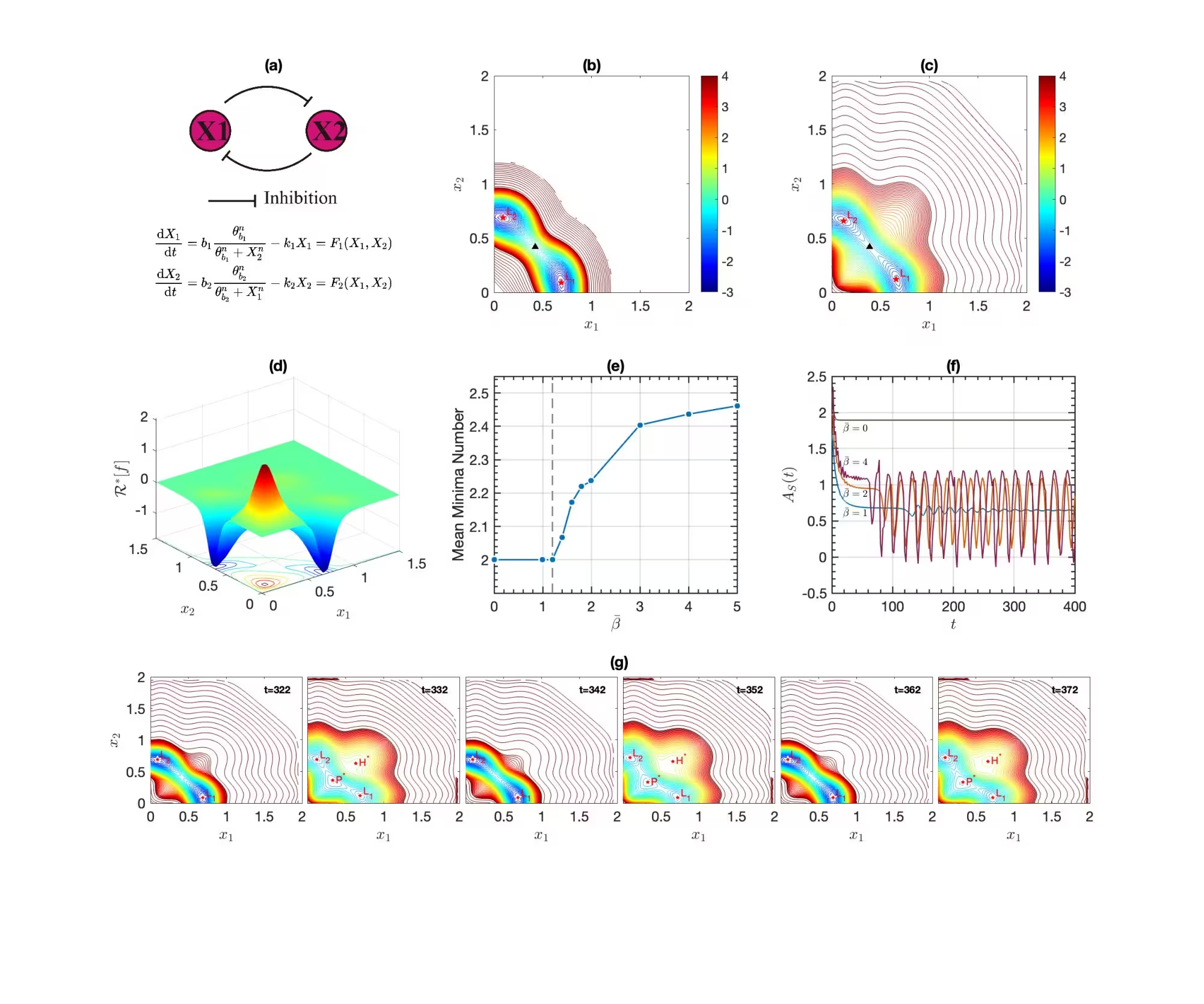
Figure 3: Proliferation-induced changes in landscape topology through the emergence of additional attractors in a binary cell-fate circuit. (a) Schematic of the two-gene mutual-inhibition circuit without self-activation. (b) Steady-state landscape U∗​(𝐱)U^{\ast}(\mathbf{x}) in the absence of population renewal (β¯=0\bar{\beta}=0). Two terminal attractors (L1L_{1} and L2L_{2}, red stars) are separated by a central saddle (black triangle). (c) The stationary landscape at a moderately low proliferation rate (β¯=1\bar{\beta}=1). (d) Steady-state spatial distribution of the non-equilibrium population renewal operator ℛ∗​[f]\mathcal{R}^{\ast}[f] for β¯=1\bar{\beta}=1. Negative valleys at the terminal attractors indicate a continuous probability efflux (population depletion), while the positive region near the origin (associated with low gene expression levels) corresponds to a substantial probability influx. This localized accumulation of probability mass provides the kinetic basis for the emergence o
Proliferation-induced changes in landscape topology through the emergence of additional attractors in a binary cell-fate circuit. (a) Schematic of the two-gene mutual-inhibition circuit without self-activation. (b) Steady-state landscape U∗​(𝐱)U^{\ast}(\mathbf{x}) in the absence of population renewal (β¯=0\bar{\beta}=0). Two terminal attractors (L1L_{1} and L2L_{2}, red stars) are separated by a central saddle (black triangle). (c) The stationary landscape at a moderately low proliferation rate (β¯=1\bar{\beta}=1). (d) Steady-state spatial distribution of the non-equilibrium population renewal operator ℛ∗​[f]\mathcal{R}^{\ast}[f] for β¯=1\bar{\beta}=1. Negative valleys at the terminal attractors indicate a continuous probability efflux (population depletion), while the positive region near the origin (associated with low gene expression levels) corresponds to a substantial probability influx. This localized accumulation of probability mass provides the kinetic basis for the emergence o Credit: Yuling Xue et al. / arXiv

When analyzing single-gene and dual-gene regulatory circuits, the researchers observed that population renewal creates an asymmetric source-sink dynamic. Slowly cycling stem-like cells act as a kinetic sink that preserves lineage origins, while rapidly proliferating progenitor compartments function as kinetic sources. This ongoing circulation of probability mass maintains tissue homeostasis through continuous cellular turnover.

The Discovery of Rhythmic Breathing Landscapes

Under hyper-proliferative conditions exceeding a critical threshold, the mathematical model predicts a dramatic shift in tissue behavior. Instead of settling into a fixed configuration, the Waddington landscape undergoes sustained limit-cycle oscillations. This rhythmic topological breathing causes transient intermediate attractors to repeatedly emerge and disappear.

These temporary basins trap cells in transient progenitor-like states before releasing them toward terminal fates. This dynamic restructuring offers a theoretical explanation for episodic windows of cellular plasticity observed during tissue regeneration in mammalian intestines and airways, where differentiated cells temporarily regain plasticity without altering their underlying DNA.
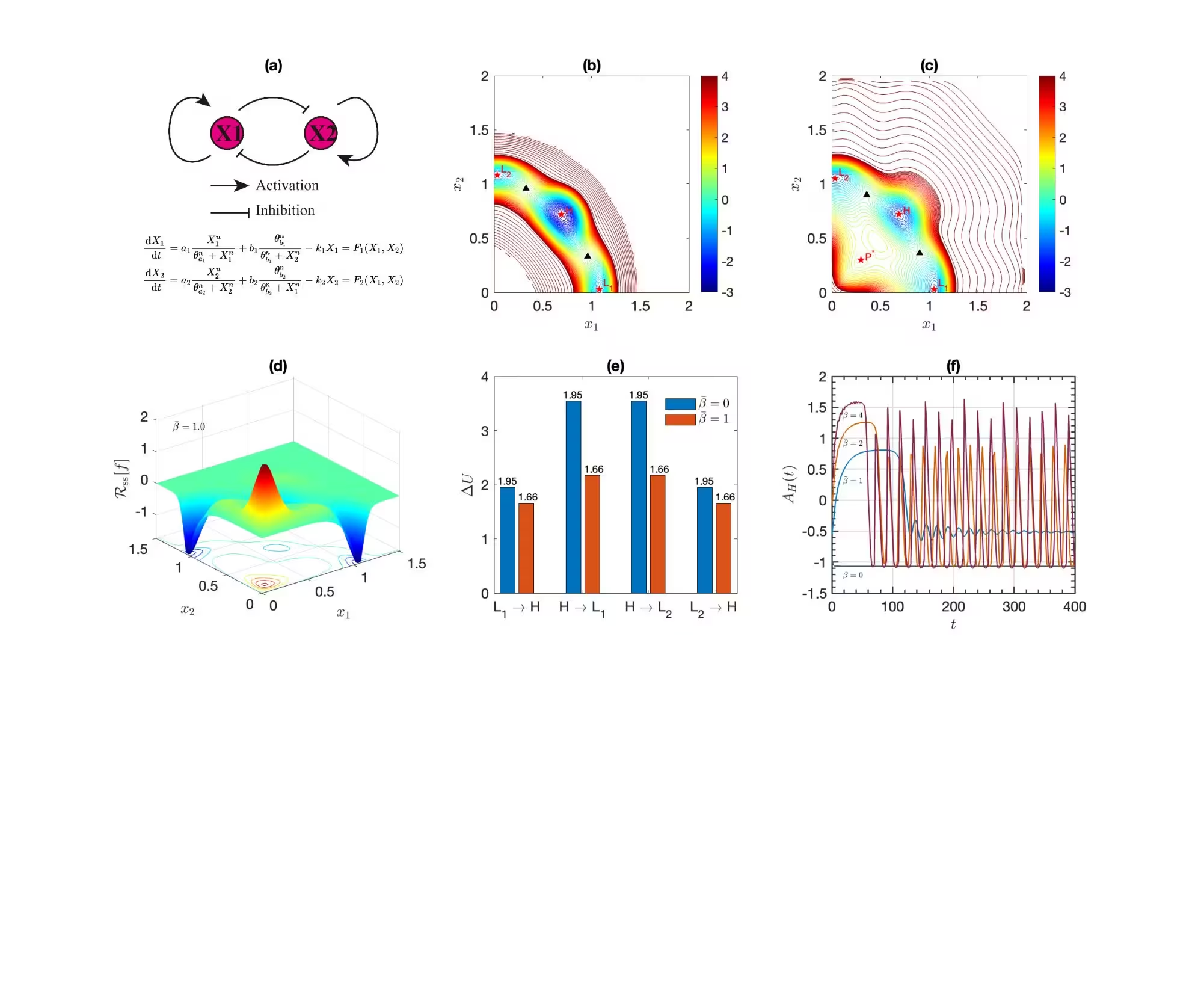
Figure 4: Proliferation-driven emergence of a tetrastable landscape and rhythmic topological breathing in a gene regulatory network with intrinsic memory. (a) Schematic of the mutual-inhibition circuit with self-activation. (b) Steady-state landscape U∗​(𝐱)U^{\ast}(\mathbf{x}) in the absence of population renewal (β¯=0\bar{\beta}=0). The intrinsic dynamics exhibit a tristable topology consisting of two terminal lineage attractors (L1L_{1} and L2L_{2}) and one intrinsic progenitor attractor (HH). (c) Steady-state landscape under moderate population renewal (β¯=1\bar{\beta}=1). A proliferation-induced attractor (P∗P^{\ast}) emerges in the low-expression region while the intrinsic progenitor attractor HH is preserved, producing a tetrastable landscape. (d) Spatial distribution of the steady-state population renewal operator ℛ∗​[f]\mathcal{R}^{\ast}[f] at β¯=1\bar{\beta}=1, showing localized probability influx that stabilizes the proliferation-induced attractor. (e) Comparison of landscape transitio
Proliferation-driven emergence of a tetrastable landscape and rhythmic topological breathing in a gene regulatory network with intrinsic memory. (a) Schematic of the mutual-inhibition circuit with self-activation. (b) Steady-state landscape U∗​(𝐱)U^{\ast}(\mathbf{x}) in the absence of population renewal (β¯=0\bar{\beta}=0). The intrinsic dynamics exhibit a tristable topology consisting of two terminal lineage attractors (L1L_{1} and L2L_{2}) and one intrinsic progenitor attractor (HH). (c) Steady-state landscape under moderate population renewal (β¯=1\bar{\beta}=1). A proliferation-induced attractor (P∗P^{\ast}) emerges in the low-expression region while the intrinsic progenitor attractor HH is preserved, producing a tetrastable landscape. (d) Spatial distribution of the steady-state population renewal operator ℛ∗​[f]\mathcal{R}^{\ast}[f] at β¯=1\bar{\beta}=1, showing localized probability influx that stabilizes the proliferation-induced attractor. (e) Comparison of landscape transitio Credit: Yuling Xue et al. / arXiv

Balancing Memory and Renewal in Tissue Homeostasis

The analysis further demonstrates that intrinsic gene regulatory memory, such as self-activation circuits, plays a crucial role in constraining proliferation-induced remodeling. While population renewal continuously alters landscape accessibility, autoregulatory feedback preserves the core developmental architecture. This interplay explains how resilient stem-cell niches maintain their stability during cyclic hematopoiesis and periodic hair follicle regeneration.

While the study successfully establishes rigorous mathematical proof for global well-posedness and probability conservation in these complex integro-differential systems, the authors note that proving uniqueness for general state-dependent cases remains an open challenge. Future work will focus on integrating these dynamic landscape equations with time-resolved single-cell transcriptomic measurements and RNA velocity data to map real developmental trajectories.

The study was posted to the arXiv preprint server on November 14, 2026.

Fact Checked

This article has been fact checked for accuracy, with information verified against reputable sources. Learn more about us and our editorial process.

Last reviewed on .

Article history

  • Latest version

Reference(s)

  1. Xue, Yuling. “A unified cross-scale framework for the dynamic Waddington landscape.” arXiv.org <http://arxiv.org/abs/2611.19257v1>.

Cite this page:

Mirza, Omar. “Mathematical Model Reveals How Cell Division Reshapes Waddington Landscapes.” BioScience. BioScience ISSN 2521-5760, 17 November 2026. <https://www.bioscience.com.pk/en/subject/ecology/a-unified-cross-scale-framework-for-the-dynamic-waddington-landscape>. Mirza, O. (2026, November 17). “Mathematical Model Reveals How Cell Division Reshapes Waddington Landscapes.” BioScience. ISSN 2521-5760. Retrieved November 17, 2026 from https://www.bioscience.com.pk/en/subject/ecology/a-unified-cross-scale-framework-for-the-dynamic-waddington-landscape Mirza, Omar. “Mathematical Model Reveals How Cell Division Reshapes Waddington Landscapes.” BioScience. ISSN 2521-5760. https://www.bioscience.com.pk/en/subject/ecology/a-unified-cross-scale-framework-for-the-dynamic-waddington-landscape (accessed November 17, 2026).
End of the article