A Unique Arctic Ecosystem Has Vanished Forever After Massive Ice Shelf Collapse
After thousands of years of isolation, a remote Arctic lake’s icy barrier has finally failed. New research reveals the dramatic impact of this event.
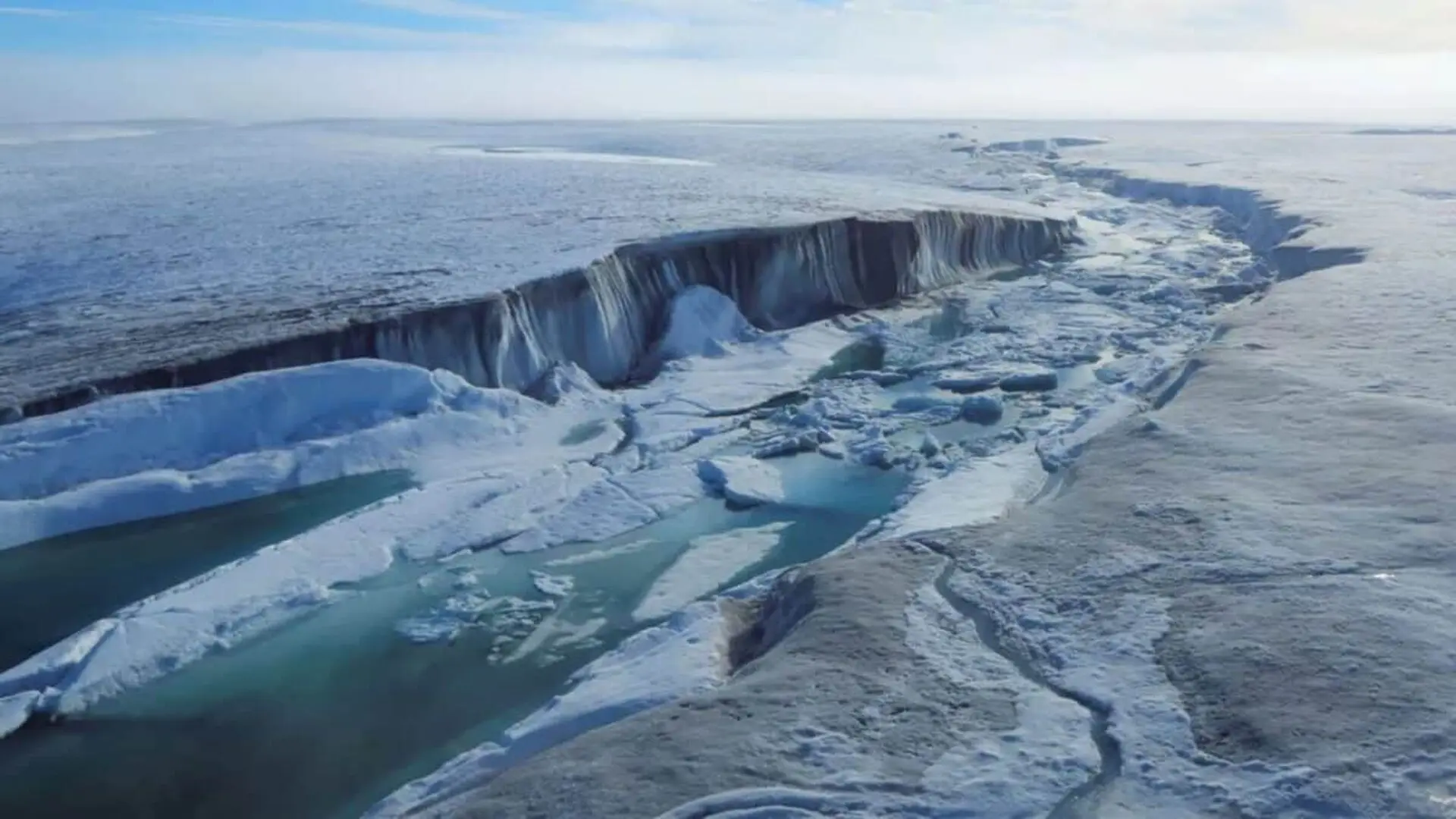
A distinctive aquatic feature in the Canadian Arctic, which had persisted for millennia, has vanished. Scientific analysis confirms that the 2020 collapse of the Milne Ice Shelf resulted in the total drainage of Canada’s final epishelf lake, effectively erasing a rare, stratified ecosystem that thrived at the interface of freshwater and marine environments.
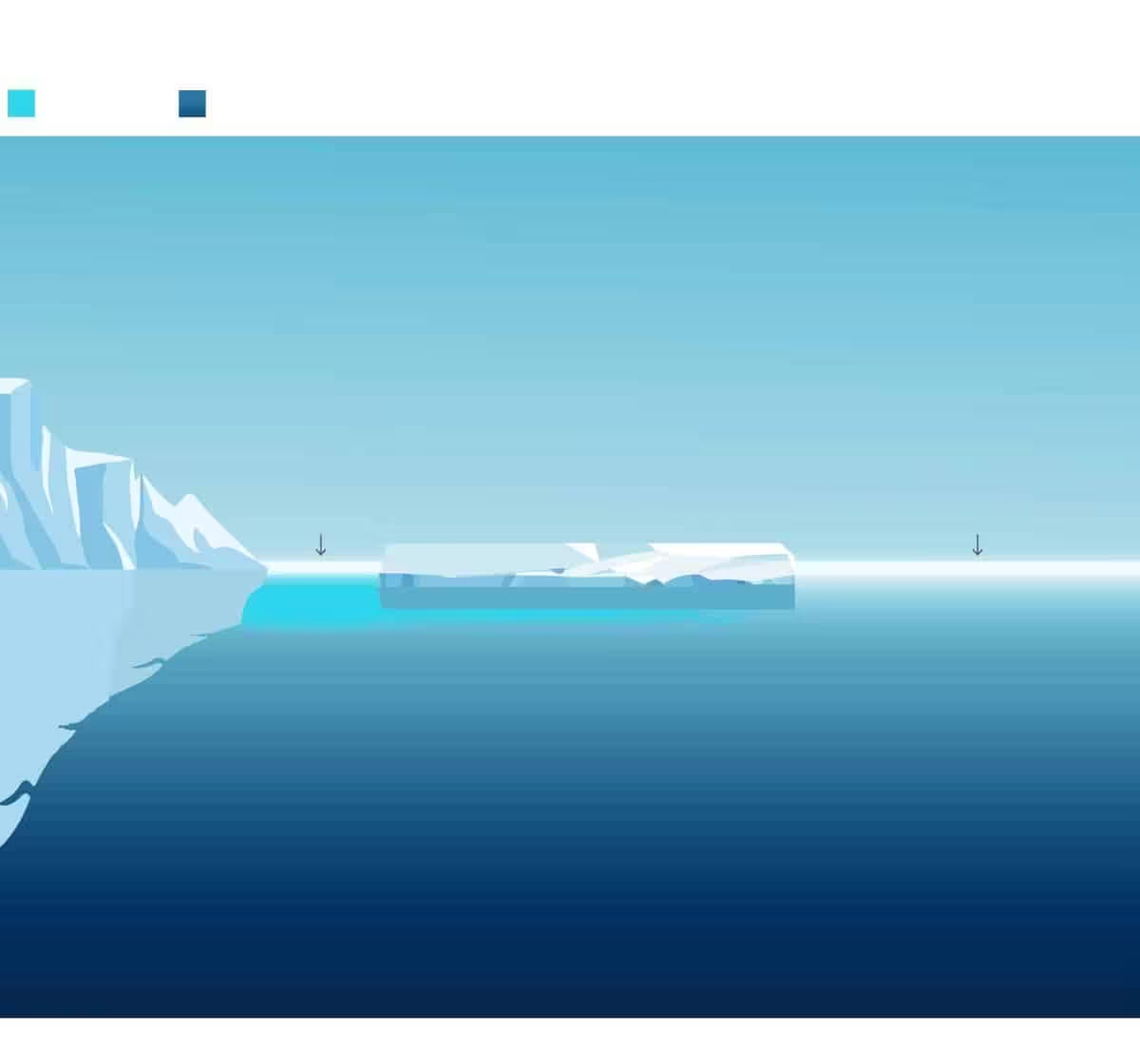
Located within the rugged terrain of northern Ellesmere Island in Nunavut, the Milne Fiord epishelf lake functioned as a natural anomaly. It was sustained by the Milne Ice Shelf, which served as a massive retaining wall, isolating a layer of buoyant freshwater from the denser, underlying seawater. The loss of this basin signifies more than the departure of a water body; it serves as a stark indicator of how rapidly the Arctic landscape is being transformed. The region, known in Inuktitut as Tuvaijuittuq, or “the place where ice never melts,” is increasingly vulnerable to the realities of a changing climate.
While northern Ellesmere Island remains a critical habitat for ice-dependent species, including polar bears, ringed seals, and Atlantic walruses, the disintegration of the ice shelf underscores the fragility of even the most remote northern environments.
Structural Failure Leads to Catastrophic Drainage
The transition began in July 2020 when a significant fracture caused the Milne Ice Shelf to fragment. According to findings published in Scientific Reports by a multi-institutional team from the University of British Columbia, the University of Alberta, Université Laval, and Carleton University, the lake began to empty almost immediately following the structural failure. By the autumn of 2020, the vast majority of the lake, along with the unique biological community it hosted, had ceased to exist. Researchers reconstructed this collapse by synthesizing long-term satellite imagery with in-situ oceanographic data collected before and after the event.
“The ice shelf and lake had been thinning for decades, but the 2020 breakup was the last straw. The lake drained within months,” said Jérémie Bonneau, the study’s lead author.
Monitoring an Ecosystem’s Quiet Demise
The mechanism behind an epishelf lake is defined by its stratification; the ice shelf provides the physical containment necessary for freshwater to float atop the heavier saltwater. Once this seal was breached, the distinct layers collapsed. Post-2020 monitoring revealed that by July 2022, the freshwater had been entirely replaced by saline water from the surrounding ocean.
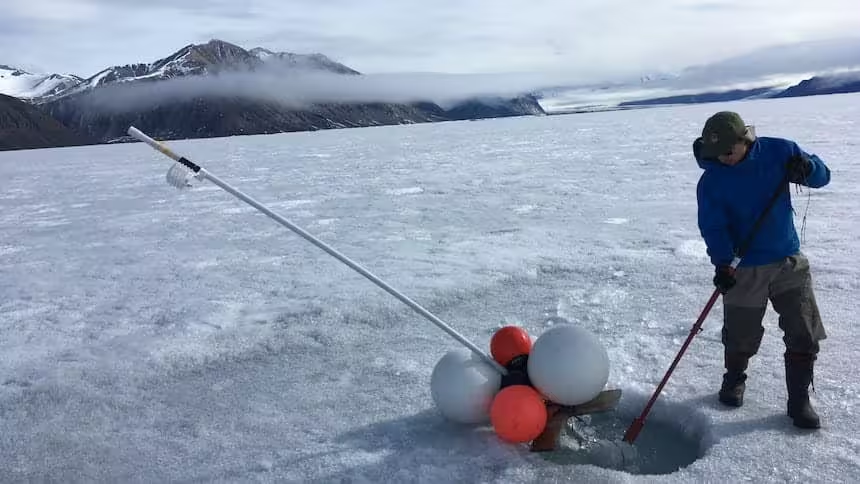
Due to travel restrictions imposed during the pandemic, researchers were unable to reach the site in 2020. However, sensors previously deployed to measure temperature, depth, and salinity remained active. When the team finally recovered the instruments two years later, they possessed an uninterrupted record of the ecological transition.
“We saw the [Milne Ice Shelf] breakup on satellite images, and two years later we got the data,” said Bernard Laval, one of the study’s co-authors. “The instruments were there, observing. We just couldn’t reach them.”
An Irreversible Loss for the Arctic
The research mission, which involved traversing remote northern reaches via Twin Otter aircraft, captured the definitive end of a stable, long-standing natural system. Scientists emphasize that this loss is permanent on any human timescale. The restoration of such a lake would require the complete reformation of the ice shelf, a scenario deemed impossible under current environmental trajectories.
“These systems took thousands of years to form and were lost in months,” Bonneau said. “On any human timescale, they are not coming back.”
This article has been fact checked for accuracy, with information verified against reputable sources. Learn more about us and our editorial process.
Last reviewed on .
Article history
- Latest version
Reference(s)
- Mueller, Derek. “Milne Ice Shelf.”, July 17, 2017 Water and Ice Research Laboratory <https://wirl.carleton.ca/research/ice/ice-shelves/milne-ice-shelf/>.
- Bonneau, J.. “Regime shift in high arctic fjord signals the vulnerability of the Arctic’s Last Ice Area - Scientific Reports.”, August 27, 2026 Nature, doi: 10.1038/s41598-026-68201-6. <https://www.nature.com/articles/s41598-026-68201-6>.
- “Jérémie Bonneau | Laboratoire DEEP.” <https://deep.insa-lyon.fr/fr/page/jeremie-bonneau>.
- “Browser Verification | UBC Cybersecurity.” <https://civil.ubc.ca/bernard-laval/>.
Cite this page:
- Posted by Linda Wilson