New Urban Wildlife Survey Reveals Thousands of Free-Roaming Dogs and a Surprising Capacity for Growth
Researchers in Iran estimate a city population of over 7,400 stray dogs and model how different management scenarios shape long-term survival.
A new demographic survey conducted in the Iranian city of Karaj reveals an estimated population of 7,459 free-roaming dogs, alongside an environmental carrying capacity that could theoretically support nearly ten times that number. The study, published in PLOS One by Amin Hekmat and colleagues, sheds light on the complex interplay between urban wildlife dynamics, human compassion, and municipal challenges.
How Many Dogs Roam the Streets of Karaj and Why Their Numbers Matter
Free-roaming dogs (Canis familiaris) represent a unique urban wildlife challenge because their survival is heavily subsidized by human activity. To map out the population structure, researchers conducted six systematic surveys across 35 randomly selected blocks between May and August 2024. Using a modified block-survey method established by the World Society for the Protection of Animals, the team recorded vital demographic data, including age classes, sex ratios, visible health conditions, and ear-tag information.
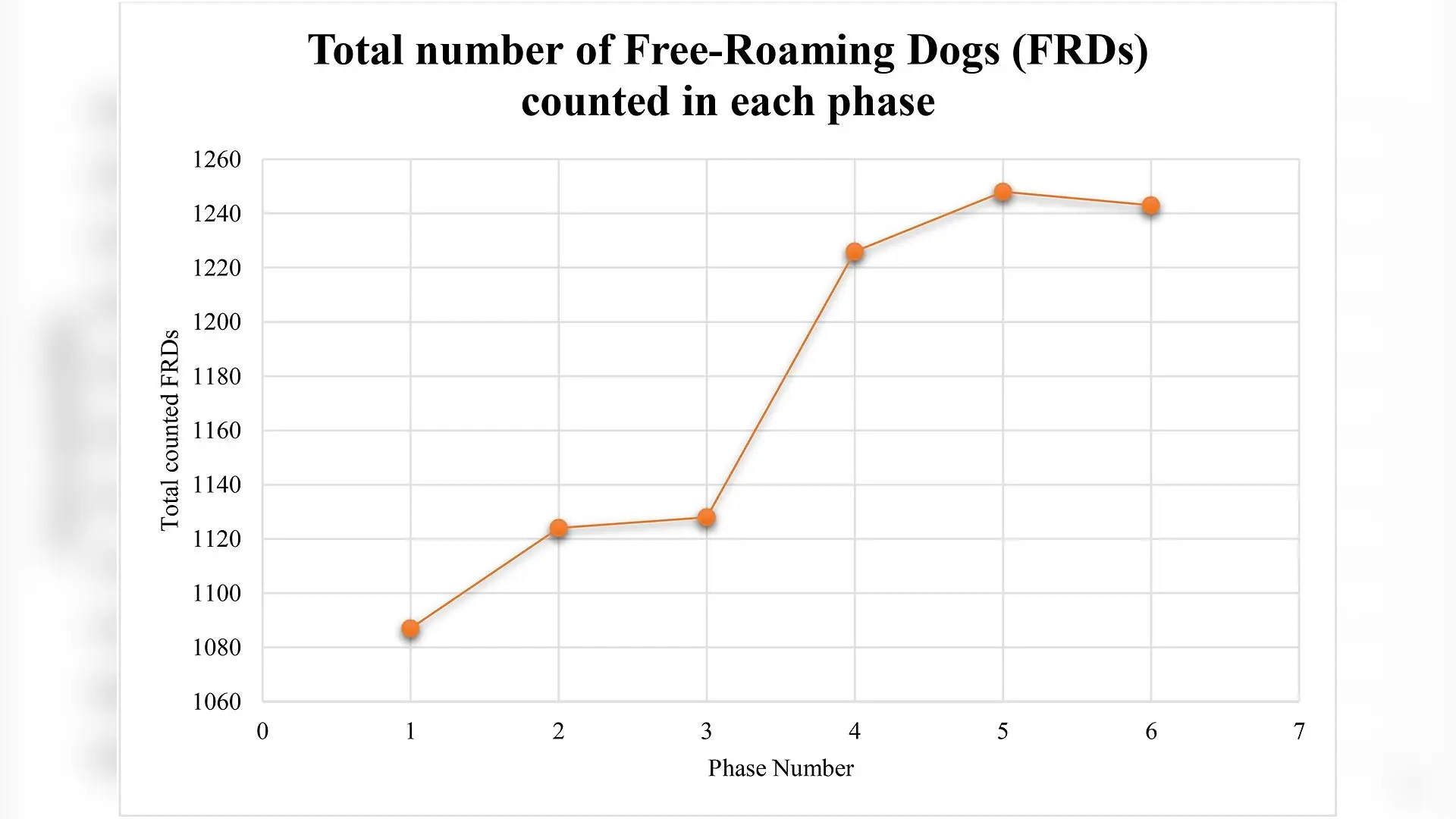
The surveys revealed an average count of 1,113 dogs during daytime hours and 1,239 dogs at night. This nocturnal shift points to a clear behavioral adaptation where dogs actively avoid areas with high daytime human activity, seeking out secluded resting spots. Among the observed population, males accounted for 63 percent and females represented 37 percent. Young adults dominated the demographic profile at 70.5 percent, followed by juveniles at 21 percent, older adults at 5 percent, and puppies at just 3.5 percent.
The Hidden Impact of Human Feeding and Environmental Carrying Capacity
One of the most striking findings of the assessment is the immense scale of human support across the city. Researchers discovered direct or indirect signs of feeding, artificial watering, or caregiving in 94 percent of the surveyed blocks (33 out of 35). Furthermore, 31 blocks featured actual or potential shelters such as human-built dog kennels, abandoned buildings, unfinished construction sites, and drainage channels.
By factoring in these high levels of anthropogenic support alongside spatial and ecological variables, the team calculated an environmental carrying capacity of 68,895 dogs. While well-intentioned supplemental feeding helps individual animals survive, it artificially inflates the carrying capacity far beyond natural limits. This dynamic creates a paradox where local caregiving reduces immediate mortality but escalates long-term population pressures, increasing the potential for human-dog conflicts, traffic accidents, and disease transmission.
What Long-Term Population Projections Tell Us About Sterilization Strategies
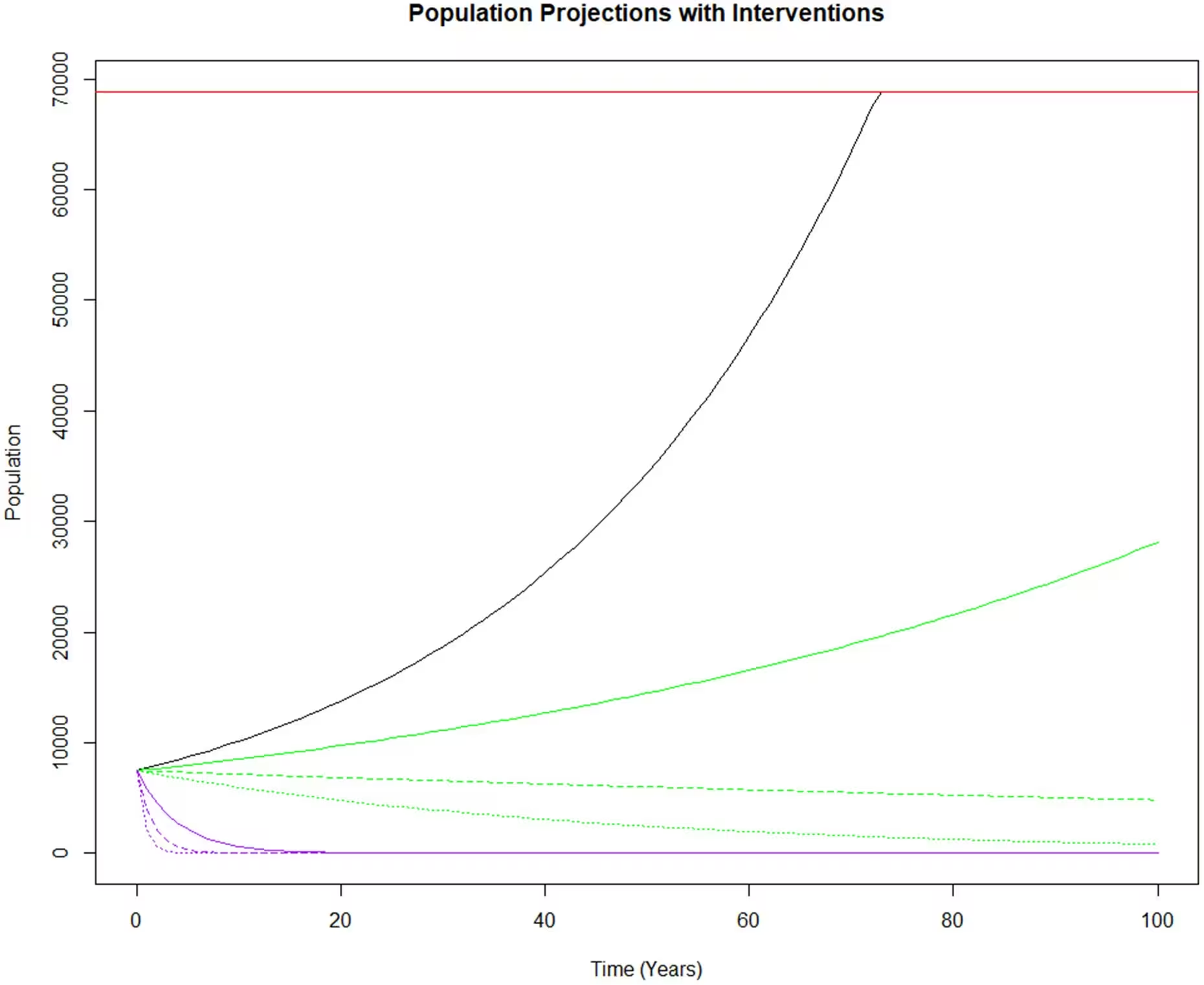
To understand where the population is heading, the authors incorporated calculated vital rates, including an average birth rate of 7.08 percent, a death rate of 3.98 percent, a growth rate of 1.28 percent, and a survival rate of 96.02 percent, into an age-structured mathematical model known as a Leslie matrix. Their projections indicate that without effective intervention, the stray dog population will steadily climb toward the city carrying capacity over the coming decades.
When modeling various management scenarios over 50- and 100-year periods, the team found that low-intensity measures fall short. A sterilization rate of 25 percent only slows population growth without shrinking the total number of animals. In contrast, a 50 percent sterilization rate initiates a moderate decline, while a 75 percent sterilization coverage successfully drives a sustained downward trend, reducing the population significantly over time.
Although mathematical models show that euthanasia can eliminate populations rapidly, the researchers caution against relying on it as a primary tool. Euthanasia frequently triggers demographic rejuvenation by disproportionately removing slower, older adults while leaving hidden puppies and juveniles behind, and it remains a deeply controversial practice fraught with ethical concerns. Ultimately, the authors emphasize that sustainable population management requires combining high-intensity sterilization programs with improved waste management, public education, and responsible pet ownership campaigns tailored to local social conditions.
The research was published in PLOS One on November 13, 2026.
This article has been fact checked for accuracy, with information verified against reputable sources. Learn more about us and our editorial process.
Last reviewed on .
Article history
- Latest version
Reference(s)
- Hekmat, Amin., et al. “First assessment of population size, population dynamics, and carrying capacity of free-roaming dogs in Karaj, Iran.” PLOS One, vol. 21, no. 11, November 13, 2026, pp. e0358766 Public Library of Science (PLoS), doi: 10.1371/journal.pone.0358766. <https://doi.org/10.1371/journal.pone.0358766>.
Cite this page:
- Posted by Linda Wilson