Hidden Mathematical Symmetries Explain How Complex Networks Organize
Researchers reveal that a hyperdimensional geometric group governs the global dynamics and local rules of complex binary networks.
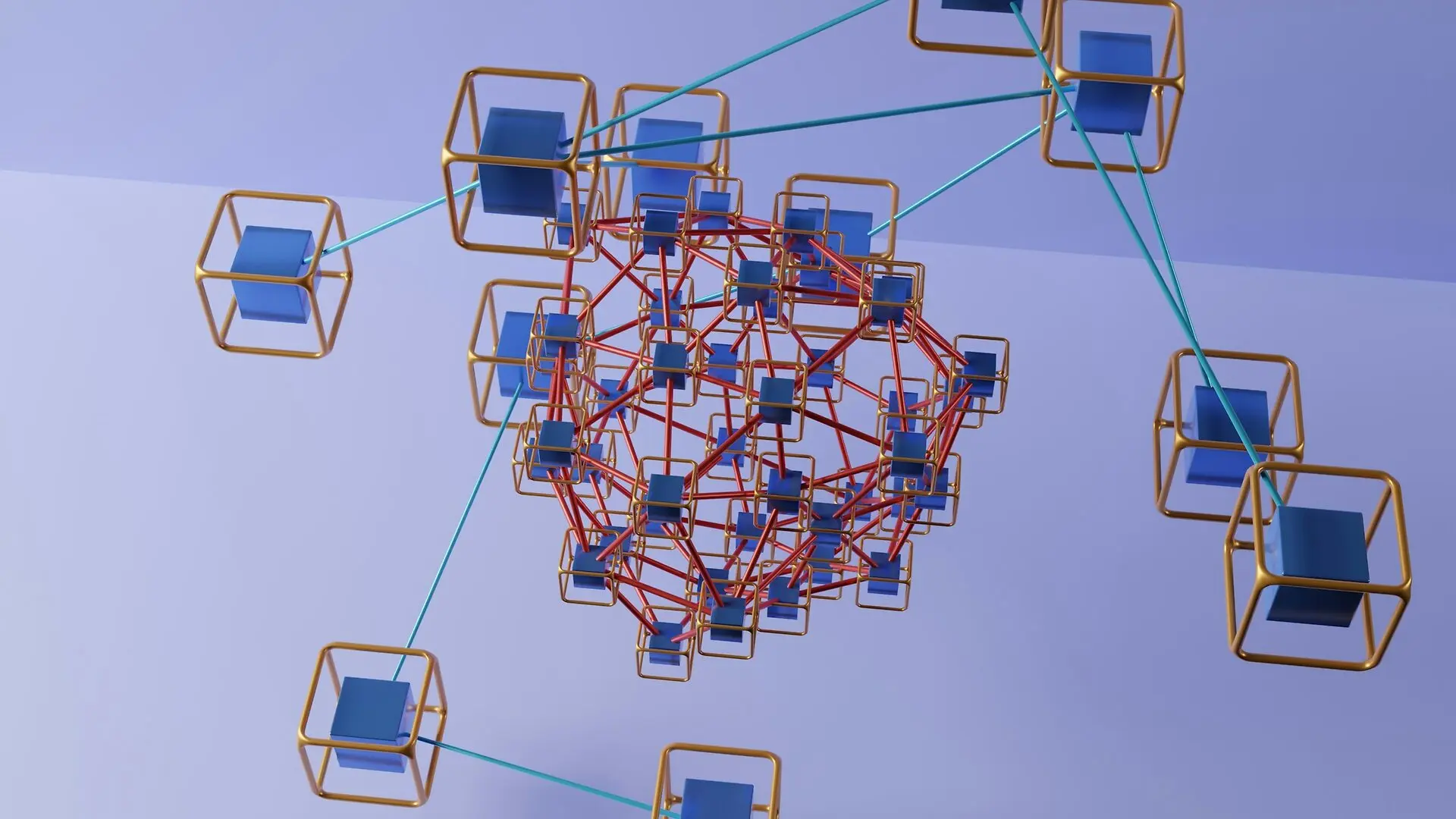
Complex networks made of interacting binary elements reveal a deep structural order driven by hidden mathematical symmetries that dictate how information flows through living and artificial systems. Researchers Yi-Kai Mo and Kevin E. Bassler from the University of Houston report that the global dynamics of these networks are governed by a symmetry group known as the $N$-dimensional hyperoctahedral group. The study is available on the arXiv preprint server.
Boolean networks consist of nodes that update their binary states based on logical rules applied to their inputs. Although scientists have long used these systems to model gene regulation, cellular signaling, and neural processing, the origins of certain statistical patterns in their evolution remained unclear. Previous studies showed that the logical rules governing nodes in evolved networks tend to cluster into specific equivalence classes, but the dynamical reason behind this organization was missing.
Unveiling the Hidden Geometry of Network Dynamics
To understand why certain logical functions appear more frequently than others, the authors analyzed how network states transition over time using a matrix formulation. Every possible state of an $N$-node network can be mapped as a vertex on a hyperdimensional cube. The team demonstrated that two specific operations always preserve network dynamics without altering the underlying interaction topology. These operations are node-flips, which invert the binary state of individual nodes, and node-label permutations, which rename the nodes.
Together, these transformations generate the hyperoctahedral group, a mathematical structure that describes the symmetries of a hypercube in $N$ dimensions. The authors established that this group serves as the complete dynamical symmetry group for random-topology ensembles where no two nodes share identical input sets. This geometric framework explains how network states transform into isomorphic copies while preserving attractor cycles and basin sizes.
The Role of Input Gauge Freedom and Local Rules
Beyond global state symmetries, the investigation identified a hidden gauge freedom involving input-label permutations. Because the order in which a node receives inputs from its neighbors is arbitrary, rearranging those input connections while adjusting the corresponding logical function leaves the overall network dynamics completely unchanged. This gauge freedom acts as an internal coordinate transformation rather than a symmetry of the state space.
When combined with global hyperoctahedral symmetries, this gauge freedom directly produces the Zyklenzeiger symmetry group observed in local Boolean functions. This local symmetry preserves canalization, a biological property where certain inputs control a gene or cellular switch regardless of the state of other inputs. The findings explain why evolutionary processes favor canalizing functions, resolving a longstanding puzzle regarding the frequency distribution of logical rules in evolved networks.
Implications for Network Reduction and Future Modeling
The identification of these universal symmetries offers practical tools for analyzing complex systems. By grouping network configurations into symmetry orbits using Burnside’s lemma, researchers can drastically reduce the computational complexity of studying large ensembles. Instead of analyzing every possible network configuration, scientists can examine a single representative network per orbit.
While the current mathematical framework applies primarily to synchronous networks where all nodes update simultaneously, the authors note that the underlying matrix formulation extends naturally to asynchronous and stochastic updating schemes. These insights pave the way for deeper explorations into how symmetry and symmetry breaking shape biological self-organization and information processing.
The study was posted to the arXiv preprint server on November 14, 2026.
This article has been fact checked for accuracy, with information verified against reputable sources. Learn more about us and our editorial process.
Last reviewed on .
Article history
- Latest version
Reference(s)
- Mo, Yi-Kai. “State-space symmetry in Boolean network ensembles.” arXiv.org <http://arxiv.org/abs/2611.19639v1>.
Cite this page:
- Posted by Hassan Raza