Hidden Math Choices Can Create Fake Alzheimer’s Brain Differences
A new EEG study reveals how routine analytical decisions in brain network research can produce misleading markers of neurodegeneration.

When analyzing brain scans of people with Alzheimer’s disease, scientists often look at the rich club, a tightly interconnected group of neural regions that act as major communication hubs for the entire organ. New research reveals that whether these brain networks appear abnormal can depend entirely on behind-the-scenes math choices rather than actual biology.
Brain network connectivity is frequently evaluated using a metric called the weighted rich-club coefficient, which measures whether the brain’s most strongly connected nodes link to each other more often than expected by chance. However, this coefficient is not measured in a vacuum, as it requires comparing real brain networks against randomized surrogate models to establish a baseline. Investigators Kai-Wayne Liu, Ryan Tian En Pang, and Pholpat Durongbhan explored how hidden methodological choices alter these comparisons.
The study, published in the Journal of Neuroscience Methods, examined resting-state electroencephalography, or EEG, recordings from 20 participants diagnosed with Alzheimer’s disease and 20 healthy control subjects. Electroencephalography is a technique that measures electrical activity in the brain using small sensors placed on the scalp. The authors tested four different analytical pathways by combining two different randomization methods with two different ways of selecting brain hubs.
How Minor Pipeline Tweaks Create Phantom Brain Abnormalities
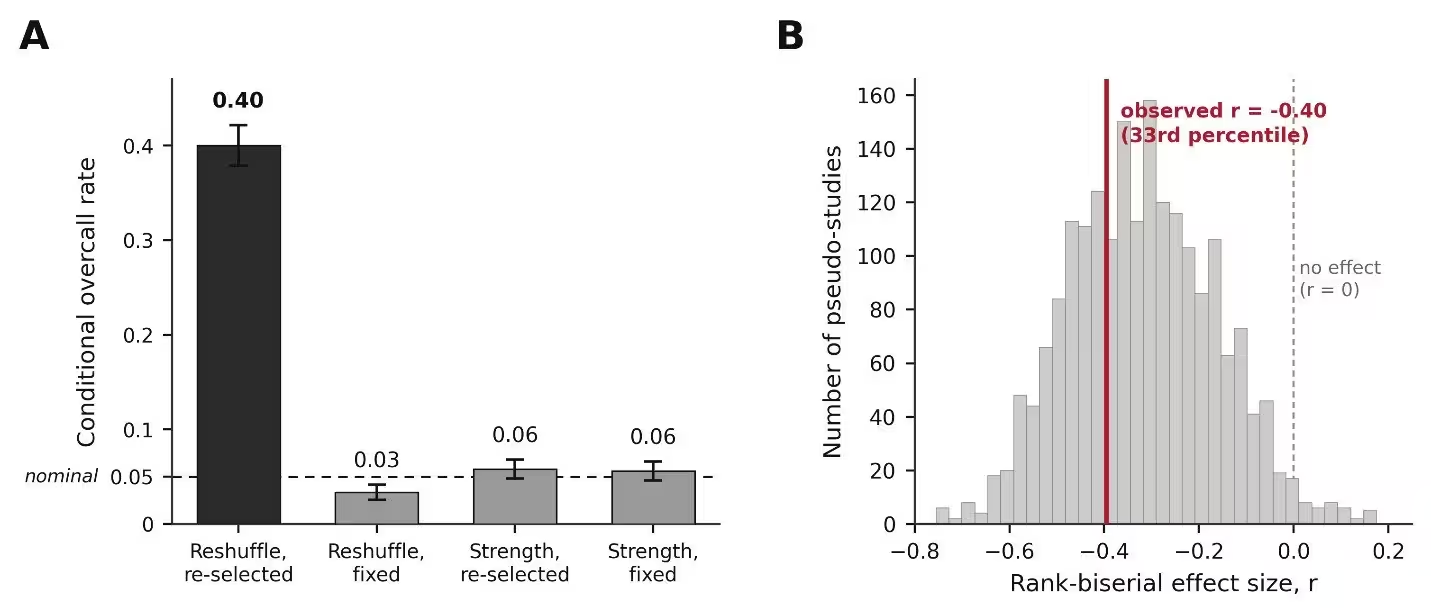
When the team applied their four different analysis pipelines to the exact same Alzheimer’s disease dataset, the results diverged dramatically. An apparent group difference in rich-club organization appeared under only one specific combination, which paired a global weight reshuffle with re-identifying hubs in every randomized surrogate network. Under the other three pipelines, no difference between the Alzheimer’s group and healthy controls was detected.
To understand why this happened, the authors ran a calibration study using artificial data constructed to contain no actual preferential hub coupling. They discovered that the pipeline producing the apparent disease marker falsely reported a group difference in 40 percent of pseudo-studies where no extra core structure existed. The other three pipelines maintained a false-positive rate close to the expected 5 percent nominal level.

Distinguishing True Structural Shifts From Mathematical Artifacts
Further decomposition of the EEG data showed that the Alzheimer’s group possessed higher overall connectivity and stronger hubs overall, rather than a specialized rewiring of the rich club itself. When a null model accounted for individual nodal strength instead of wiping it out entirely, the apparent disease effect vanished. This indicates that standard weight-reshuffle models can mistake overall node strength for genuine preferential coupling among core brain regions.
The authors emphasize that their findings do not invalidate previous network studies, but they do highlight a vital lesson for neuroimaging research. Because analytical pipelines can drive apparent findings, transparency regarding null models and hub selection rules is essential for clinical interpretation.
The study was posted to the arXiv preprint server on November 15, 2026.
This article has been fact checked for accuracy, with information verified against reputable sources. Learn more about us and our editorial process.
Last reviewed on .
Article history
- Latest version
Reference(s)
- Liu, Kai-Wayne., et al. “Analysis choices can produce apparent rich-club differences: an Alzheimer's disease EEG case study.” Journal of Neuroscience Methods, vol. 438, February 1, 2027, pp. 110927 Elsevier BV, doi: 10.1016/j.jneumeth.2026.110927. <https://doi.org/10.1016/j.jneumeth.2026.110927>.
Cite this page:
- Posted by Priya Sharma