Dying Giant Star Surprises Astronomers With Brief Blast of Gas Interaction
Observations of a newborn supernova just 16.8 hours after explosion reveal a surprisingly short window of interaction with material surrounding the dying red supergiant.
A dying giant star designated as Type II supernova SN 2024phv exploded just 16.8 hours before astronomers first caught its faint optical glow, revealing an unusually brief flash of interaction with material surrounding the star. Telescopes tracked the newborn stellar explosion as it brightened rapidly by 2 magnitudes over the course of its first day of observation, jumping from an absolute magnitude of negative 14.
How Fast Did the Newborn Supernova Brighten After Its Initial Blast?
The stellar blast occurred within the spiral galaxy NGC 3936, located roughly 19.2 megaparsecs away from Earth, or approximately 62.6 million light-years. Automated survey instruments monitored the patch of sky daily, establishing a strict upper limit that nothing was visible there less than two days prior to the initial detection. Following the discovery, an international team of astronomers coordinated rapid photometric and spectroscopic follow-up observations using multiple ground-based facilities, including the Gemini South telescope and Las Cumbres Observatory network, as detailed in a study published in arXiv.
Early spectra gathered 1.7 and 2.6 days after the explosion revealed weak, narrow emission lines of hydrogen and helium superimposed on a bright blue continuum. These narrow signatures indicate that the outward-moving debris of the collapsed core ran into surrounding gas immediately after the shock wave broke through the stellar surface. However, those narrow spectral features vanished completely by day 4.6, replaced by broad P Cygni profiles typical of expanding supernova ejecta, pointing to a surprisingly short window of circumstellar interaction.
What Did the Shock-Cooling Models Reveal About the Star’s Radius?
To understand the physical dimensions of the progenitor star before it met its violent end, the authors applied theoretical shock-cooling models to the multi-band light curve data. The best-fit model yielded a progenitor radius of 390 solar radii, with a margin of uncertainty of 90 solar radii. This size aligns with expectations for a medium-sized red supergiant star, which represents the typical final evolutionary phase for massive stars with initial main-sequence masses between 8 and 30 times the mass of the Sun.
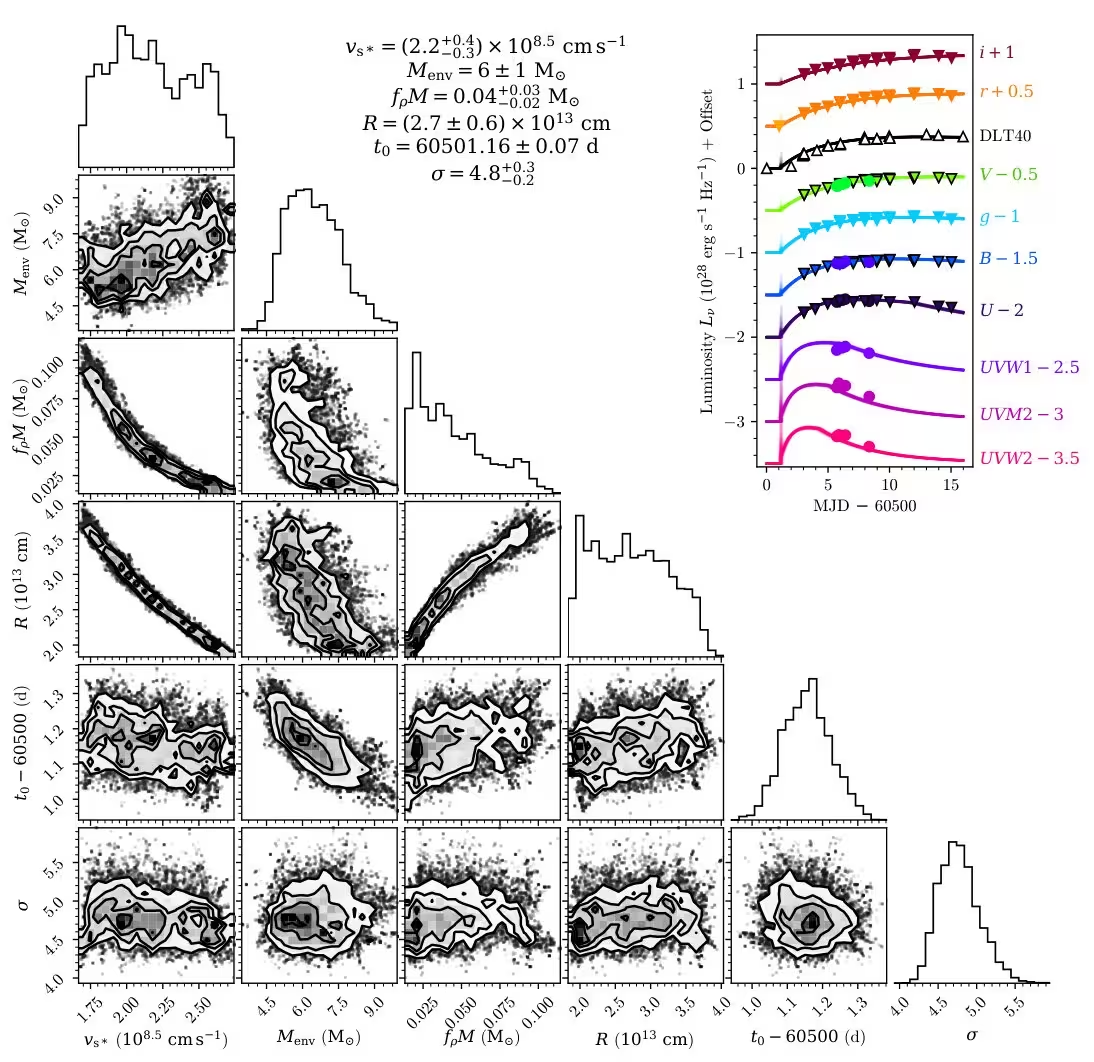
Despite providing a reasonable fit for the light curve after the second day, the standard shock-cooling model overpredicted the brightness of the very first discovery observation by a factor of roughly four. The authors note that the model cannot fully account for the initial steep rise fueled by the early gas collision. Nevertheless, the derived explosion time of MJD 60501.30 matched closely with independent estimates derived from expanding fireball calculations.
Why Does This Explosion Point to a Diversity in Stellar Mass Loss?
Comparing SN 2024phv with other very early supernova discoveries highlights a wide spectrum of behavior among dying red supergiants. While some well-studied supernovae display prominent, long-lasting narrow emission lines and dramatic early color shifts, SN 2024phv showed much weaker lines and lacked the initial blueward color evolution seen in events like SN 2023ixf and SN 2024ggi. Radiation hydrodynamical models of exploding red supergiants suggest that the progenitor of SN 2024phv maintained a dense envelope or closely confined circumstellar gas with densities reaching roughly $10^{-12}$ grams per cubic centimeter within a few stellar radii, followed by a sharp drop-off in density.
This steep density gradient implies that the star experienced a surge in mass loss or a mild eruption shortly before its core collapse, though archival surveys found no precursor brightening during the 3,000 days prior to the blast. Late-phase photometry gathered after the supernova emerged from solar conjunction allowed the team to measure the radioactive decay of nickel-56 trapped within the expanding debris. The analysis yielded a nickel mass of 0.0232 solar masses, placing it slightly below average for Type II supernovae but well within the normal observed distribution. As wide-field astronomical surveys continue scanning the sky with rapid cadences, catching more events in their first hours will help astronomers map the erratic final years of massive stars across the universe.
The study was posted to the arXiv preprint server on November 14, 2026.
This article has been fact checked for accuracy, with information verified against reputable sources. Learn more about us and our editorial process.
Last reviewed on .
Article history
- Latest version
Reference(s)
- Aldea, Lucas. “Early Spectroscopy of the Type II SN 2024phv Suggests Short-Lived Circumstellar Interaction.” arXiv.org <http://arxiv.org/abs/2611.19031v1>.
Cite this page:
- Posted by Karan Das