Hidden Binary Stars Unmasked Orbiting Nearby Red Dwarfs in Local Space
Astronomers resolve eleven hidden stellar pairs using space catalog data and high-resolution ground telescope imaging.
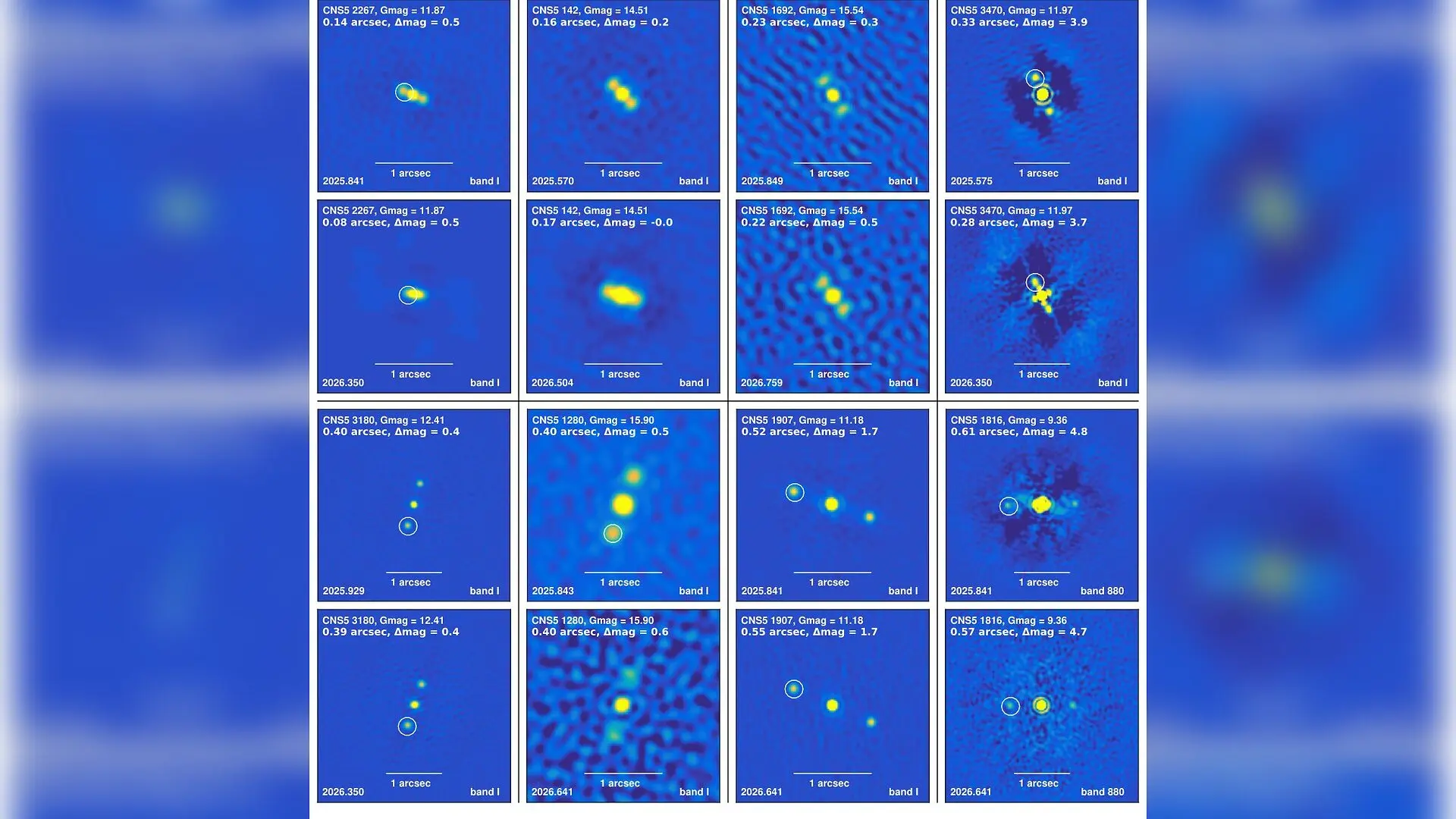
Astronomers peering into the solar neighborhood have successfully unmasked eleven previously hidden stellar companions orbiting nearby red dwarfs, solving a long-standing puzzle about missing stellar systems. The research team focused on nearby stars within 20 parsecs (about 65 light-years) of Earth whose true nature had eluded detection.
By harnessing data from the European Space Agency’s Gaia space observatory alongside high-resolution ground-based telescope images available on the arXiv preprint server, the astronomers systematically hunted for binary systems hiding in plain sight. Their observations reveal that many nearby red dwarfs, officially known as M-type dwarfs, are actually twins or multiple star systems rather than solitary suns.
How a Hidden Data Flag Exposed Secret Star Pairs
Finding close-knit star pairs is notoriously difficult because their light blends together into what looks like a single point of light in standard sky surveys. To overcome this hurdle, the authors turned to a specific metric in the Gaia data catalog known as the multipeak fraction. This parameter measures the percentage of times the spacecraft’s image processing algorithm detected a double peak in a star’s light profile.
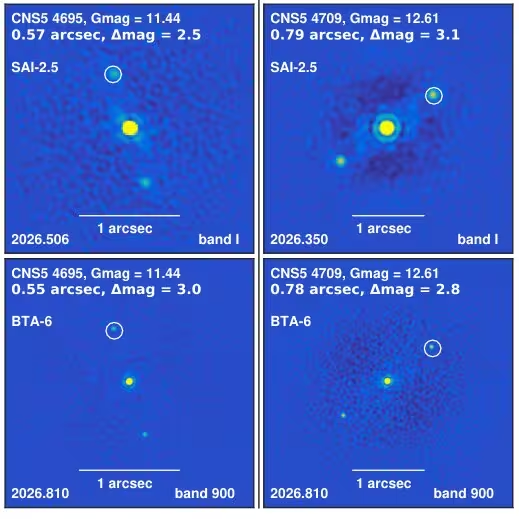
When the team selected 18 promising targets with a multipeak fraction above 5 percent, they put these candidates to the test using speckle interferometry. This imaging technique captures thousands of extremely short exposure frames to freeze atmospheric blurring, allowing astronomers to peer through turbulence and separate light sources separated by mere fractions of an arcsecond. Using a 2.5-meter telescope at the Caucasian Mountain Observatory and archival observations from larger facilities, the researchers successfully resolved eleven of the candidate systems.
Weighing Stellar Companions and Their Separation Distances
The newly resolved binary components sit at angular separations ranging from 0.08 to 0.8 arcseconds, translating to physical projected distances between 2 and 16 astronomical units (where one astronomical unit is the average distance from Earth to the Sun). By combining their measured brightness differences with theoretical stellar evolution models, the authors calculated that the companion masses fall between 0.09 and 0.23 times the mass of the Sun.
These low-mass companions fit squarely into the red dwarf category, which makes up roughly three-quarters of the entire stellar population in our local cosmic neighborhood. Understanding the true frequency of multi-star systems among these small stars is crucial for astronomers cataloging exoplanets, as the gravitational pull of a hidden stellar companion can profoundly influence planetary orbits and habitability.
An Unexpected Observational Bias in Local Space
Interestingly, not every candidate target yielded a companion. Six sources that displayed a moderately elevated multipeak fraction between 6 and 8 percent stubbornly remained single points of light in high-resolution images. The authors suggest this points to an observational bias affecting nearby stars in the Gaia catalog, where certain crowding effects or astrometric quirks can mimic the signature of a binary system.
Despite these false positives, the confirmed discoveries significantly improve the completeness of local stellar censuses. Several of the newly resolved systems also emerge as prime targets for future characterization by space telescopes searching for alien worlds, bridging a critical gap in our understanding of the solar neighborhood.
The study was posted to the arXiv preprint server on November 14, 2026.
This article has been fact checked for accuracy, with information verified against reputable sources. Learn more about us and our editorial process.
Last reviewed on .
Article history
- Latest version
Reference(s)
- Chulkov, Dmitry. “Nearby M&M Binaries Uncovered with the Gaia Multipeak Fraction and Speckle Interferometry.” arXiv.org <http://arxiv.org/abs/2611.19048v1>.
Cite this page:
- Posted by Aisha Ahmed