Hidden Planet Found Orbiting a Failed Star in Rare Triple System
A re-analyzed 2018 cosmic lensing event points to a crowded system containing an M dwarf, a brown dwarf, and a Saturn-mass world.
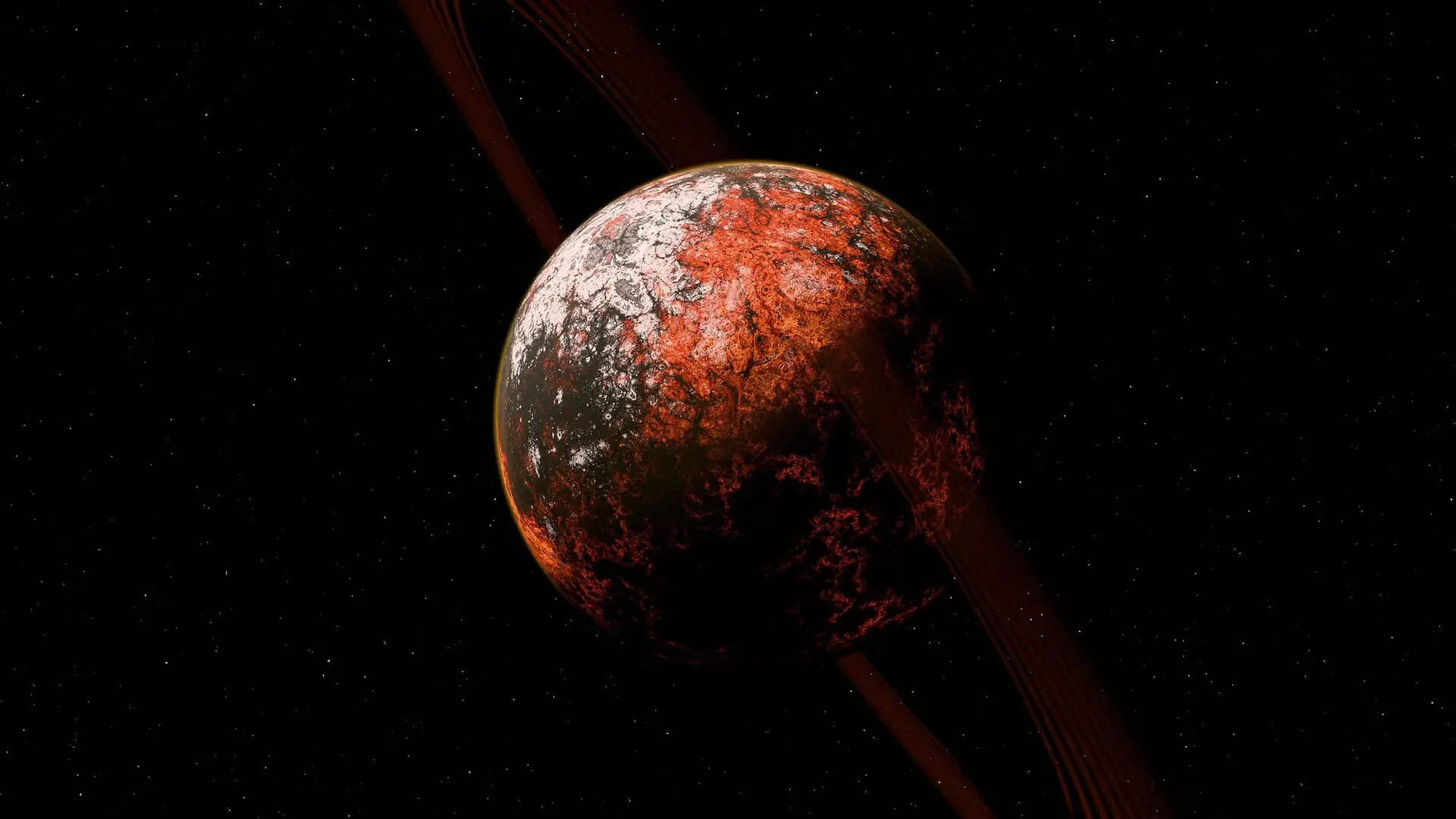
Astronomers poring over archival data from a 2018 cosmic magnifying event have spotted hints of a rare planetary system featuring a star, a failed star, and a Saturn-sized world locked in a complex gravitational dance. The discovery relies on a phenomenon called gravitational microlensing, where the gravity of a foreground star system bends and magnifies the light of a more distant background star.
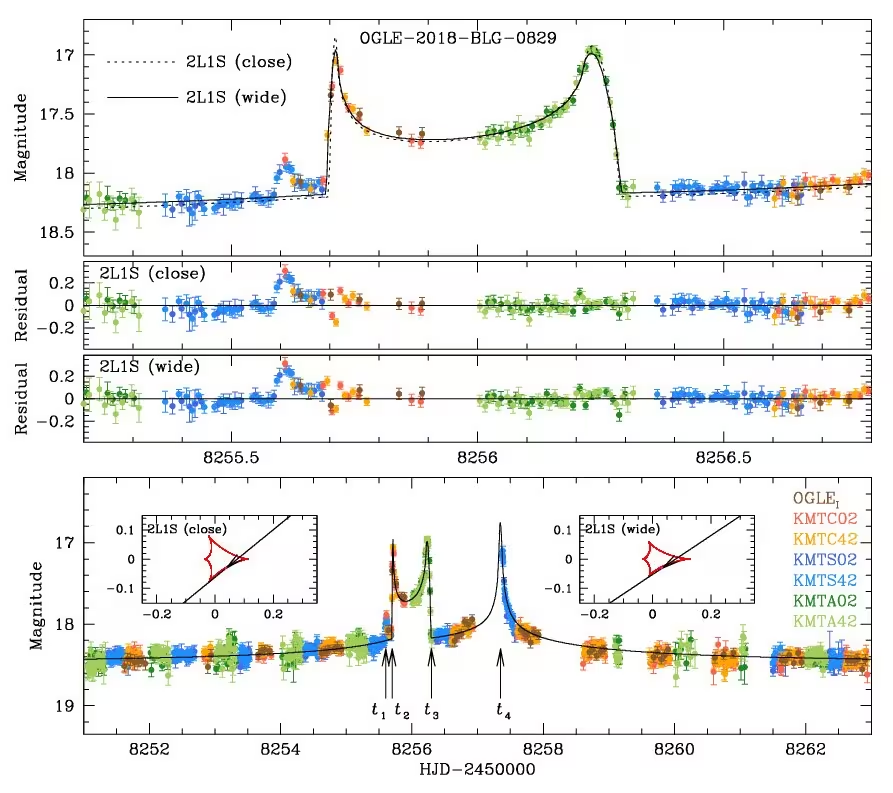
The lensing event, designated OGLE-2018-BLG-0829, was originally tracked by the Optical Gravitational Lensing Experiment, which uses a 1.3-meter telescope at Las Campanas Observatory in Chile. While the primary data clearly showed the sharp, dramatic spikes typical of a binary lens system, a subtle bump in the light curve remained unexplained. An international team of researchers re-analyzed the observations using high-precision data processing techniques from the Korea Microlensing Telescope Network and published their findings available on the arXiv preprint server.
What Caused the Mysterious Tiny Bump in the Light Curve?
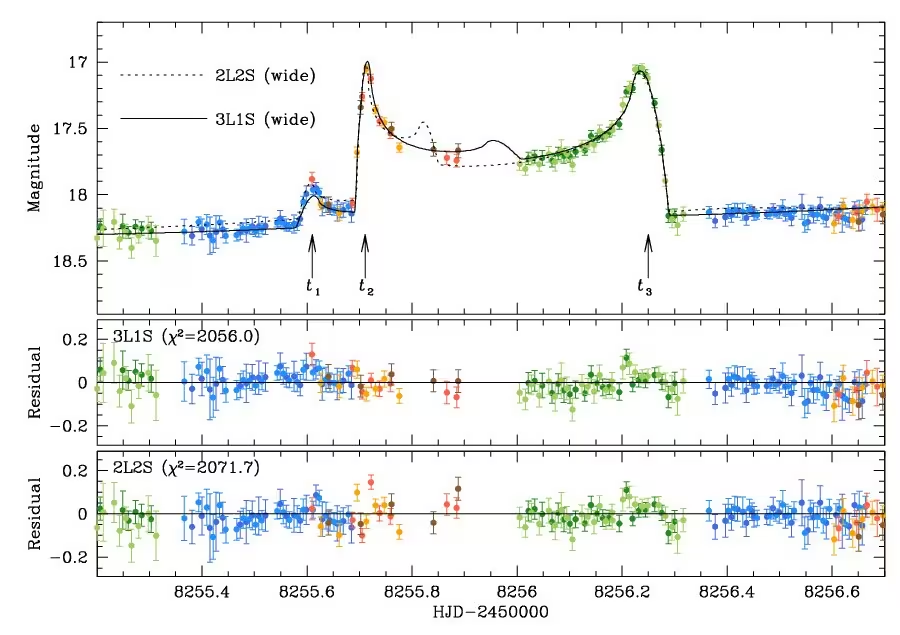
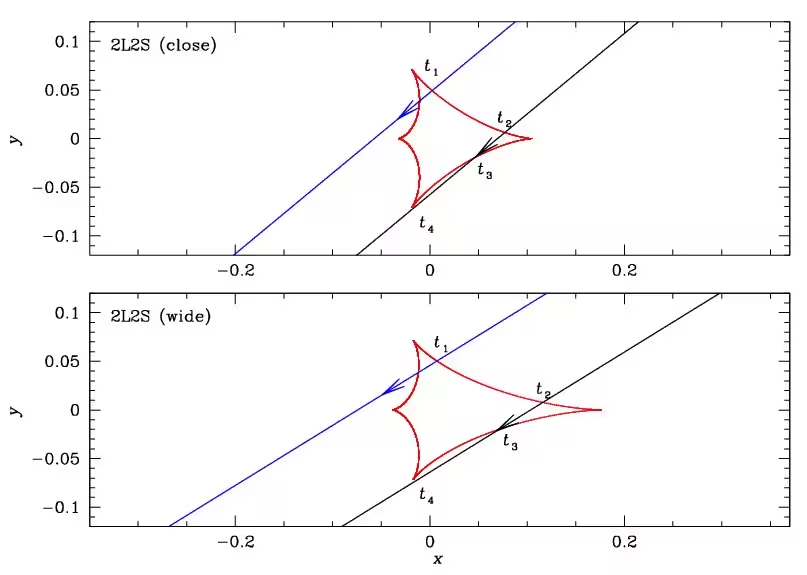
When the team tested standard models featuring a single pair of massive objects, the math could not account for the faint, short-term anomaly occurring just before the main brightening events. To solve the puzzle, the researchers tested two advanced scenarios, including a complex setup with two lenses and two separate background light sources, as well as a configuration involving three lenses and a single background star.
Statistical analysis strongly favored the triple-lens model, beating the alternative explanation by a significant margin. In this preferred scenario, the foreground lens consists of a low-mass star known as an M dwarf, a heavy substellar companion known as a brown dwarf, and an orbiting planet roughly the mass of Saturn. Brown dwarfs are objects that sit in the mass gap between giant planets and true hydrogen-burning stars, often called failed stars because they never gathered enough mass to ignite nuclear fusion in their cores.
How the Triple-Lens Configuration Creates Extreme Orbits
According to the best-fit calculations, the primary M dwarf has a mass of approximately 0.193 solar masses, while its brown dwarf companion weighs in at about 0.068 solar masses. The Saturn-mass planet, estimated at roughly 0.337 Jupiter masses, orbits the system alongside them. In physical terms, the brown dwarf candidate sits at a projected distance of about 3.6 astronomical units from the primary star, while the planet orbits much closer at roughly 1.6 astronomical units. One astronomical unit is the average distance from Earth to the Sun.
This tight configuration creates an extraordinarily compact system where the ratio of the two companions’ separations is only about 2.3. Ordinarily, long-term orbital stability in such crowded environments requires planets to maintain much wider berths relative to binary stellar companions. However, the researchers emphasize that these projected separations do not tell the whole story, as true orbital paths depend heavily on unknown inclination angles, phases, and eccentricities that require future dynamical modeling to confirm.
What This Rare Triple System Means for Planetary Science
If fully verified through follow-up observations, OGLE-2018-BLG-0829L would represent only the third star, brown dwarf, and planet system ever discovered via gravitational microlensing. The previous two systems, designated KMT-2020-BLG-0414Lb and KMT-2024-BLG-0404L, revealed planets orbiting alongside brown-dwarf companions in vastly different mass tiers, spanning nearly three orders of magnitude from Earth-mass worlds up to Uranus-mass planets.
Finding more of these complex systems helps astronomers understand whether planets can form and survive the intense gravitational disruptions, tidal forces, and accelerated disk dispersal caused by substellar companions during their earliest evolutionary stages. Because gravitational microlensing is uniquely sensitive to planets orbiting faint, low-mass hosts far beyond their snow lines, it remains one of the few tools capable of uncovering worlds hidden inside crowded multiple-star architectures.
Why Future Telescopes Must Resolve the System Directly
Despite the strong statistical backing for the triple-lens interpretation, the authors caution that the findings remain tentative. The current mathematical modeling did not incorporate complicating factors such as orbital motion between the lens components or microlens parallax, which accounts for the Earth’s changing perspective as it orbits the Sun. Furthermore, because neither the precise lens flux nor the microlensing parallax was directly measured, the individual mass estimates carry wide uncertainty ranges.
Fortunately, the relative proper motion between the foreground lens and the background source is exceptionally swift, measured at roughly 16.5 mas per year. This rapid relative motion means that roughly eight years after the event, the lens and source will have drifted far enough apart to be directly resolved using advanced adaptive-optics facilities such as the Keck Observatory. Direct imaging would allow astronomers to measure the luminous flux of the lens directly, putting the proposed star, brown dwarf, and planet architecture to a definitive test.
The study was posted to the arXiv preprint server on November 14, 2026.
This article has been fact checked for accuracy, with information verified against reputable sources. Learn more about us and our editorial process.
Last reviewed on .
Article history
- Latest version
Reference(s)
- Han, Cheongho. “OGLE-2018-BLG-0829L: A Microlensing System with a Planet Orbiting a Star Possessing a Brown-Dwarf Companion.” arXiv.org <http://arxiv.org/abs/2611.19134v1>.
Cite this page:
- Posted by John Williams