Astronomers Model Protonated Fullerene to Unlock Secrets of Deep Space Chemistry
By modeling the rotational spectrum of the protonated buckyball, researchers have identified a new way to hunt for these carbon giants in the coldest corners of the galaxy.
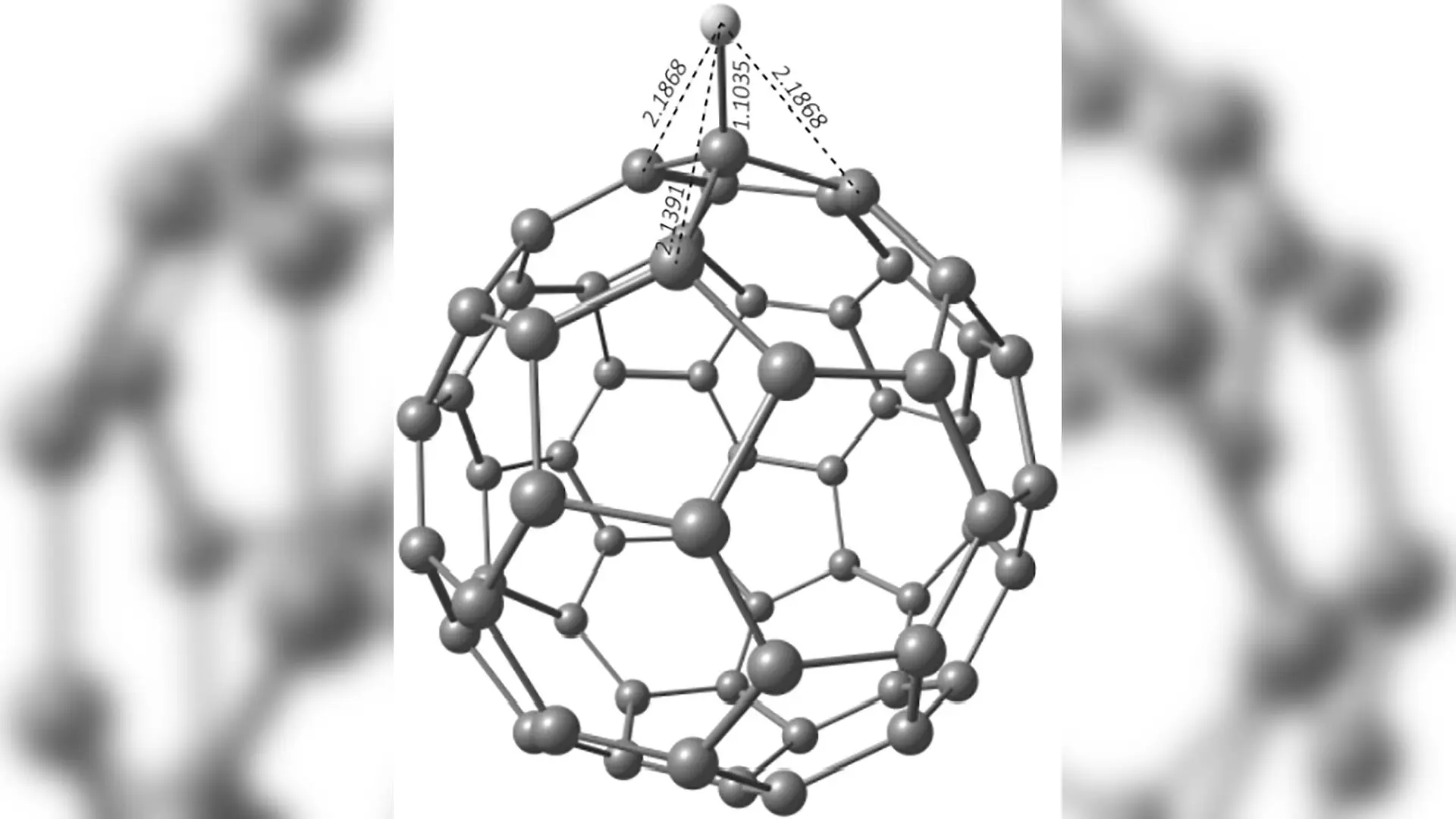
The quest to map the chemical complexity of the interstellar medium has reached a new milestone with the computational modeling of protonated C60, a molecule that could serve as a cosmic beacon for the elusive fullerene family. While the discovery of C60 in 1985 sparked a revolution in materials science, its detection in the harsh, cold reaches of space has remained a significant challenge for astronomers. Because standard fullerenes lack the necessary electrical asymmetry to produce rotational signals, they remain silent to the radio telescopes that typically probe the deepest, darkest regions of our galaxy.
A New Target in the Dark
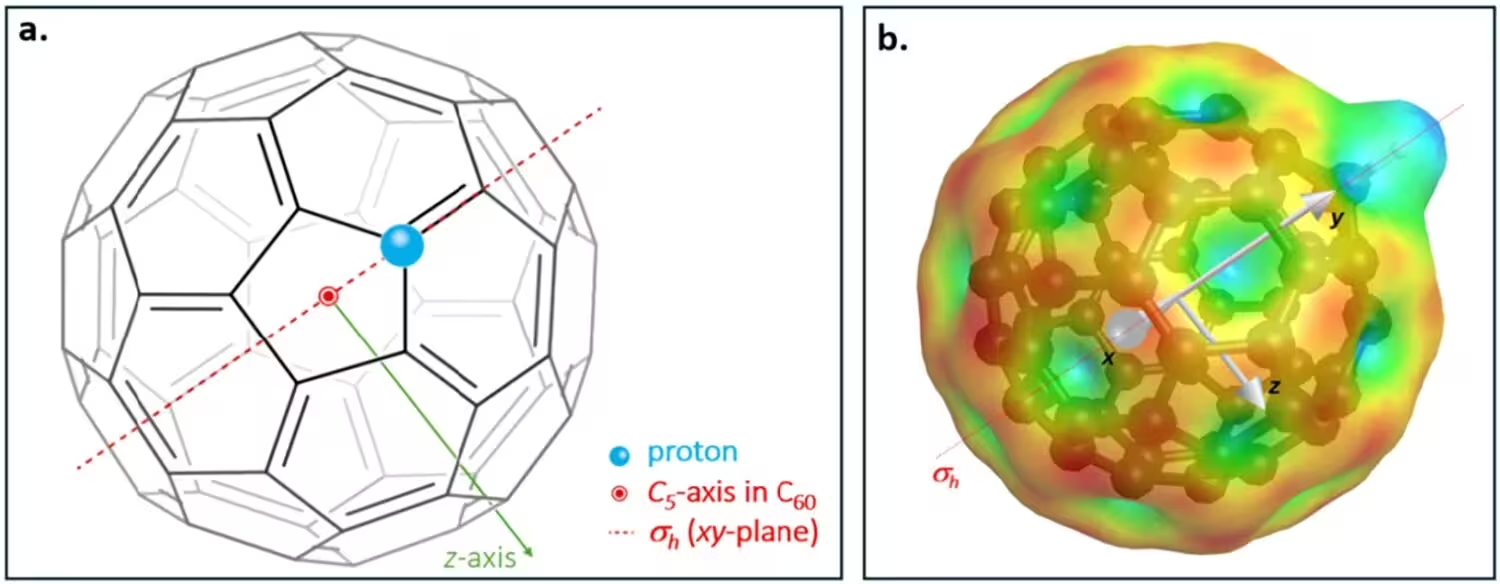
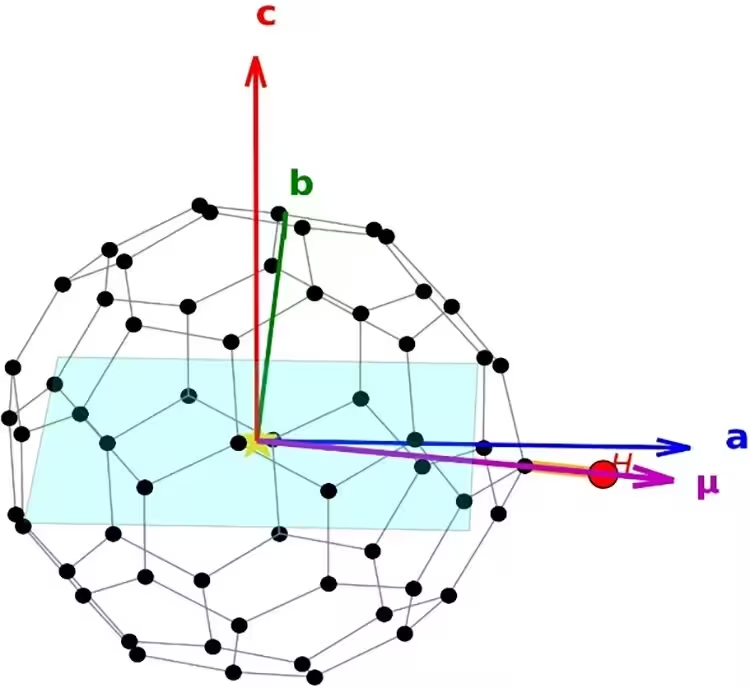
In a study published in ACS Earth & Space Chemistry, an international team of researchers detailed the predicted rotational spectrum of C60H+, or protonated buckminsterfullerene. Unlike its neutral counterpart, the addition of a single proton to the C60 cage breaks its perfect icosahedral symmetry. This structural shift creates a permanent dipole moment of approximately 3.8 Debye, effectively turning the molecule into a detectable signal source for radio astronomy.
The research team employed advanced density functional theory (DFT) to simulate the rotational behavior of the ion. By calculating both harmonic and anharmonic vibrational frequencies, they were able to account for the complex, non-rigid nature of the molecule at near-absolute-zero temperatures. These simulations, conducted using the PGOPHER spectral software, provide a precise roadmap for identifying the specific radio frequencies that C60H+ would emit in the cold, dense cores of molecular clouds.
Overcoming Cosmic Obstacles
Detecting molecules in space usually relies on two main techniques: infrared spectroscopy, which requires bright background stars or intense ultraviolet radiation to excite the molecules, and radio spectroscopy, which detects the natural rotation of polar molecules. In the dense, cold cores of molecular clouds like TMC-1, however, there is little to no ultraviolet light to trigger infrared emission, and dust extinction blocks the view of background stars. This leaves radio astronomy as the only viable tool for discovery.
The team’s findings suggest that C60H+ is an unusual case of a near-spherical top molecule. This unique geometry results in a peculiar rotational spectrum, characterized by a dense series of lines that form a distinct comb-like pattern. While the sheer number of possible rotational transitions makes the search difficult, the researchers argue that the specific, predictable spacing of these lines—combined with modern spectral matching techniques—could allow telescopes like the Green Bank Telescope to isolate the signal from the background noise of interstellar space.
Implications for Galactic Chemistry
The potential detection of C60H+ would have profound implications for our understanding of cosmic carbon. If confirmed, it would provide indirect evidence for the abundance of neutral C60, which is currently difficult to quantify in these regions. Furthermore, the study addresses the role of fullerenes in anomalous microwave emission (AME), a mysterious signal observed in the interstellar medium that has puzzled astrophysicists for years. By providing a theoretical basis for the rotational emission of protonated fullerenes, this work offers a concrete hypothesis for the origin of these signals.
While the researchers caution that the current line positions are not yet accurate enough for a direct, definitive search, the study provides the necessary framework for future laboratory experiments. By refining these models with high-resolution gas-phase measurements, astronomers will be better equipped to scan the cosmos for these carbon giants, potentially uncovering a hidden population of molecules that play a central role in the chemical evolution of galaxies.
The research was published in ACS earth & space chemistry on August 20, 2026.
This article has been fact checked for accuracy, with information verified against reputable sources. Learn more about us and our editorial process.
Last reviewed on .
Article history
- Latest version
Reference(s)
- Nemes, Laszlo., et al. “The Computed Microwave Spectrum of the Protonated Fullerene C60H+.” ACS Earth and Space Chemistry, vol. 10, no. 8, August 5, 2026, pp. 1938-1946. American Chemical Society (ACS), doi: 10.1021/acsearthspacechem.6c00110. <https://doi.org/10.1021/acsearthspacechem.6c00110>.
Cite this page:
- Posted by Aisha Ahmed