Astronomers Just Discovered a Mysterious Radio Source That Has Been Glowing for 20 Years
Astronomers are baffled by a mysterious radio signal from the Milky Way that defies known cosmic behavior and continues to puzzle the scientific community.

Astronomers have identified a mysterious, long-lived radio source within the Milky Way that defies standard categorization. Dubbed VT J1906+0849, this object has been consistently emitting intense radio signals for over two decades, yet it remains completely invisible to X-ray telescopes. The discovery, which challenges current models of galactic transients, suggests the presence of a hidden, highly active compact object.
The research, published on the arXiv preprint server on August 21, 2026, was led by Jessie M. Miller of the California Institute of Technology. By cross-referencing data from the Very Large Array Sky Survey (VLASS) with historical archives, the team reconstructed the object’s activity spanning more than 21 years.
Two Decades of Persistent Radio Activity
The anomaly was first captured by the MAGPIS survey in 2005, where it registered at approximately 35 millijansky (mJy). Over the following years, its radio output experienced significant fluctuations, peaking above 200 mJy around 2014 before dipping and rebounding in late 2025. Unlike typical radio transients, which are often defined by sudden, brief outbursts that quickly fade into the background, VT J1906+0849 has exhibited a sustained, multi-decadal presence.
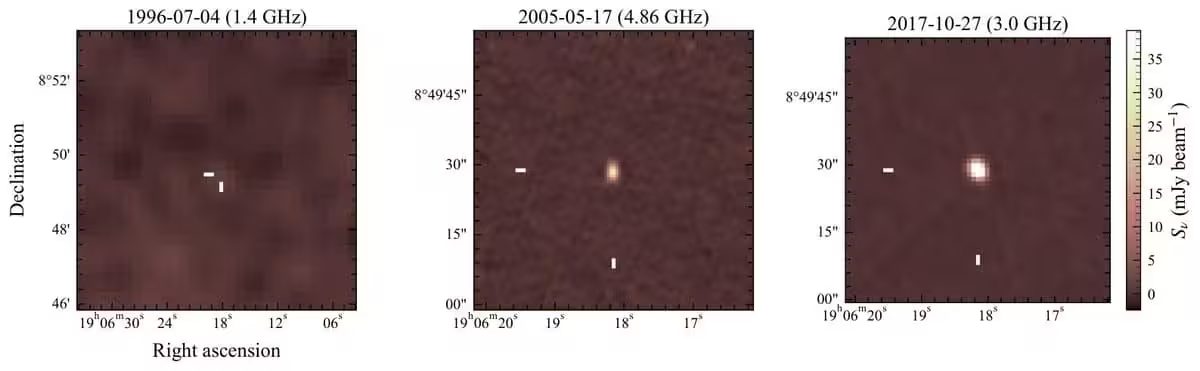
High-resolution follow-up observations using the Very Long Baseline Array (VLBA) confirmed that the source remains remarkably compact, despite the years of activity. This spatial confinement, combined with a brightness temperature reaching as high as 10 billion kelvin, suggests a nonthermal origin, likely driven by synchrotron radiation where relativistic electrons spiral through powerful magnetic fields.
An Obscured Cosmic Engine
The total absence of an X-ray counterpart, despite rigorous checks with the Swift X-ray Observatory, is the most puzzling aspect of the object. While many galactic phenomena such as flare stars or cataclysmic variables were considered, they fail to account for the sustained, high-luminosity radio signals. The study authors instead lean toward a scenario involving a compact object, such as a black hole or neutron star, actively accreting matter and launching relativistic jets.

Researchers propose that a dense disk wind surrounding the system may be responsible for the lack of detectable X-rays. This material could act as a veil, absorbing high-energy radiation while allowing radio waves to pass through. Near-infrared analysis supports this theory, as the team identified broad emission lines and a blueshifted component, indicating gas moving toward the observer—a configuration reminiscent of the well-known microquasar SS 433.
While the exact identity of the central engine remains a subject of ongoing investigation, VT J1906+0849 represents a rare class of long-lasting, obscured radio emitters, challenging astronomers to refine their understanding of how these energetic systems behave within our own galaxy.
This article has been fact checked for accuracy, with information verified against reputable sources. Learn more about us and our editorial process.
Last reviewed on .
Article history
- Latest version
Reference(s)
- “MAGPIS: The Multi-Array Galactic Plane Imaging Survey.” <https://sundog.stsci.edu/gps/>.
- “Very Long Baseline Array - National Radio Astronomy Observatory.”, October 8, 2016 National Radio Astronomy Observatory <https://public.nrao.edu/telescopes/vlba/>.
- projects, Contributors. “Binary star system, first known microquasar.”, February 1, 2005 Wikimedia Foundation, Inc. <https://en.wikipedia.org/wiki/SS_433>.
Cite this page:
- Posted by Aisha Ahmed