Scientists Have Measured The First Five Minutes Of The Big Bang With Unprecedented Precision
Scientists have achieved the most precise measurement of primordial helium to date, providing a clearer window into the universe’s earliest moments.
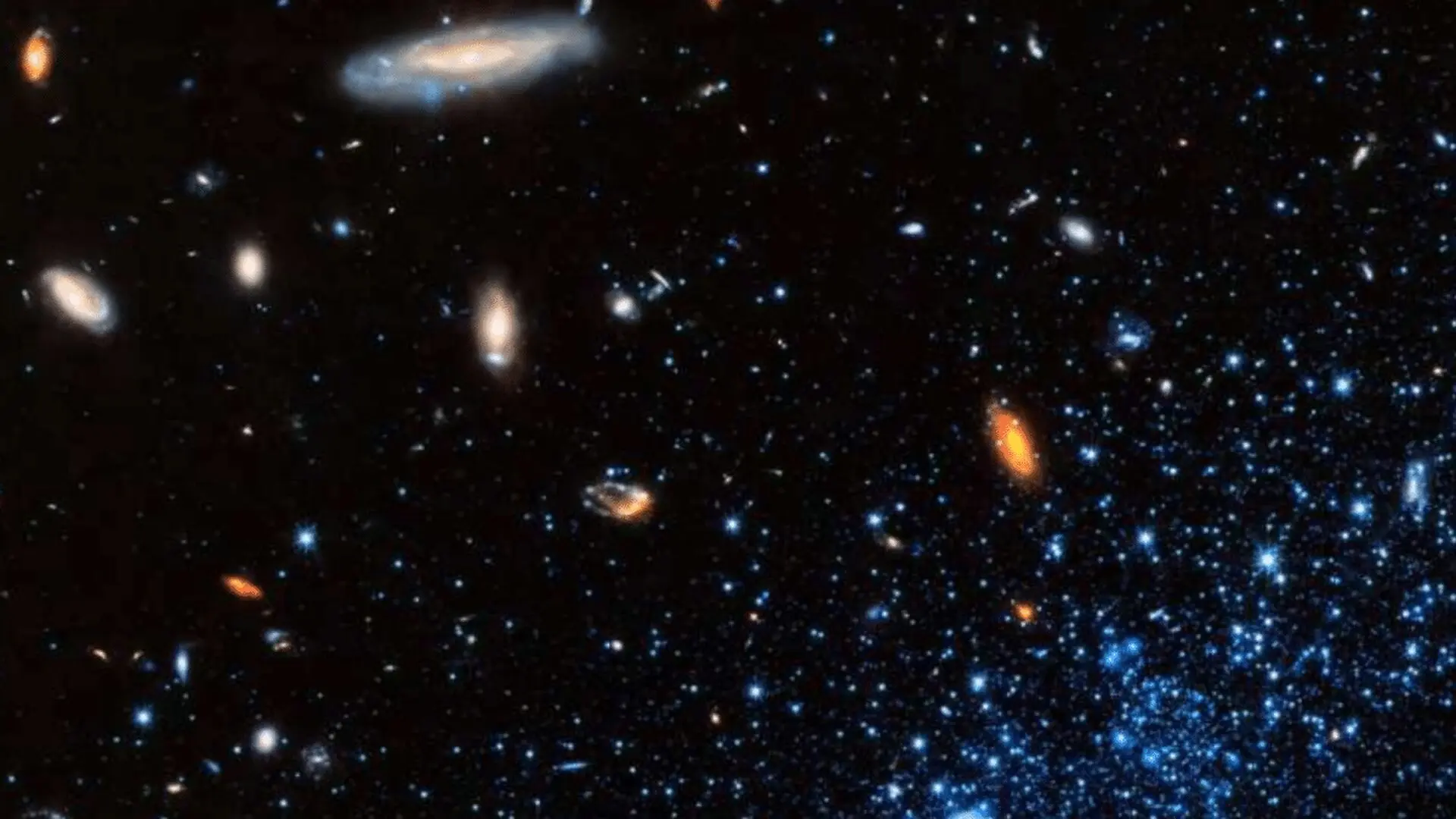
An international team of researchers has achieved a milestone in observational cosmology, pinning down the abundance of primordial helium created in the immediate aftermath of the Big Bang with unprecedented precision. By reducing the uncertainty of this fundamental value to just 0.5%, the study offers a powerful new metric for testing the conditions of the infant universe and the validity of the Standard Model of physics.
A glimpse into the chemically pristine past
The findings, detailed in a series of papers published in The Astrophysical Journal, depart from traditional methods that rely on broad surveys and statistical extrapolation. Instead, the team focused on 15 exceptionally rare, chemically primitive galaxies. These remote systems are near-perfect time capsules, containing minimal heavy elements and reflecting conditions remarkably similar to those present shortly after the cosmos began.
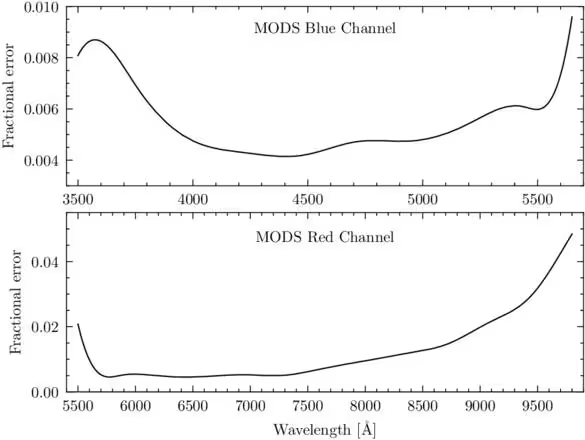
To extract this data, the researchers utilized the Large Binocular Telescope, dedicating 130 hours of observation time to these distant targets. They employed advanced Multi-Object Double Spectrographs (MODS) engineered at Ohio State University, which enabled the simultaneous analysis of more than 10 helium emission lines and 15 hydrogen lines. This technical precision allowed the team to account for subtle measurement variables that usually complicate high-accuracy astrophysical data, resulting in a three-fold improvement in precision over previous benchmarks.
Testing the limits of the Standard Model
The concentration of light elements acts as one of the primary pillars of the Big Bang theory, standing alongside the cosmic microwave background and the observed expansion of space. However, while those pillars have been extensively mapped, pinning down the exact primordial helium fraction has historically been a significant challenge.
This new, high-fidelity measurement provides a rigorous stress test for the Standard Model of Physics, allowing researchers to observe how subatomic particles behaved under the extreme conditions of the early universe. Specifically, the data allowed the team to infer the number of neutrino families present in the early stages of cosmic development, linking astronomical observation directly to particle physics theory.
“This is a physics experiment on a grand scale and one of the biggest findings in my entire 40-year career,” said Evan Skillman, University of Minnesota College of Science and Engineering Distinguished Professor in the School of Physics and Astronomy. “It’s a fundamental number that tells us specifically about the conditions of our universe in its first five minutes. It has diagnostic power that speaks directly to the Standard Model of Physics.”
Setting a new standard for precision cosmology
The success of this endeavor highlights the effectiveness of modern instrumentation and collaborative, multi-institutional science. The MODS spectrographs, which took over a decade to develop from concept to first light, performed exactly as intended, demonstrating the value of long-term investment in specialized astronomical hardware.
“The MODS spectrographs took 12 years to build from conception to first light on sky,” said Richard Pogge, College of Arts and Sciences Distinguished Professor of Astronomy at Ohio State University. “This is the kind of project we designed them to do, and to see them deliver is enormously satisfying. It’s not every day you can help build instruments that measure something fundamental about our universe.”
By meeting their ambitious goal of 0.5% uncertainty, the researchers have established a robust benchmark that will guide future cosmological investigations. As experts continue to probe the mysteries of the early universe, this refined helium value may serve as a crucial touchstone for identifying discrepancies between theoretical predictions and reality, potentially opening the door to new insights into the evolution of our cosmos.
The project involved a diverse collaboration of institutions, including the University of Minnesota Twin Cities, Ohio State University, Gonzaga University, Northwestern University, The University of Texas at Austin, Indiana University, the University of California Santa Cruz, the University of Illinois, the Universidad Nacional Autónoma de México, and TRIUMF.
This article has been fact checked for accuracy, with information verified against reputable sources. Learn more about us and our editorial process.
Last reviewed on .
Article history
- Latest version
Reference(s)
- Skillman, Evan D.., et al. “The LBT Y p Project. I. An Improved Determination of the Primordial Helium Abundance—Project Description, Sample Selection, Observations, and Methodology.” The Astrophysical Journal, vol. 1008, no. 2, September 9, 2026, pp. 237 American Astronomical Society, doi: 10.3847/1538-4357/ae879f. <https://iopscience.iop.org/article/10.3847/1538-4357/ae879f>.
Cite this page:
- Posted by Aisha Ahmed